Electric Scooter vs Moped: Which One Actually Fits Your Daily Ride?
A plain-English breakdown of how they differ — speed, license rules, safety, cost — so you can pick the one that matters for your commute, not the one with the flashier ad.
🔑 Key Takeaways at a Glance
- You stand on a scooter, you sit on a moped. That single design choice changes almost everything else.
- Mopeds are motor vehicles. They need registration, plates, and usually a license. Most electric scooters do not.
- Top speed is similar on paper — around 20–30 mph — but a moped feels far more stable at speed.
- Electric scooters are cheaper to own. No fuel, no insurance in most states, almost no maintenance.
- Mopeds win for longer trips and weather. Bigger wheels, a seat, weather fairings, and longer range.
- Pick by trip length: under 5 miles → scooter. 5–25 miles → moped. Over 25 miles → look at a small motorcycle or e-bike.
If you have ever stood on a curb watching the same downtown traffic crawl by every morning, you have probably wondered the same thing: would an electric scooter or a moped actually save me time, money, and a few headaches? Both look like easy answers. Both promise cheaper trips than a car. And both are sold by people who really, really want you to believe theirs is the right pick.
Here is the honest version. An electric scooter and a moped are not the same machine, not the same legal category, and not the same kind of commute. One is a personal mobility device — small, light, kick-style, mostly for short hops. The other is a registered motor vehicle with a seat, a license plate, and a much bigger appetite for distance. People mix them up because the word “scooter” gets used for both, especially online.
Segway Ninebot E45 — Best Commuter Scooter
If the scooter wins your comparison: the Segway E45 is the top commuter pick on Amazon.
EVERCROSS EV10K Pro — Best Moped on Amazon
If the moped wins: the EVERCROSS EV10K Pro is the top-rated electric moped on Amazon.
ILM DOT-Certified Half Helmet
Scooter or moped — you need a DOT helmet. Lightweight, ventilated, 10K+ reviews.
In this guide we will walk through the real differences — speed, licensing, safety, cost, range, and which life situation fits which ride. By the end you should know exactly which one belongs in your garage, and which one you can stop second-guessing.
An electric scooter is a stand-up personal device for short urban trips, usually under 20 mph and license-free. A moped is a seated, registered motor vehicle with a small engine or stronger electric motor, built for road use up to 30 mph and longer commutes. Pick the scooter for last-mile convenience, the moped for actual road riding.
📑 Table of Contents
What Is an Electric Scooter? What Is a Moped?
The fastest way to settle the electric scooter vs moped debate is to look at how each one is built and what the law calls it. Once that clicks, the rest of the differences make sense almost on their own.
The electric scooter — a personal mobility device
An electric scooter is the stand-up kind you have probably seen lined up on city sidewalks. You stand on a narrow deck, hold the handlebar, twist or thumb the throttle, and a battery-powered hub motor moves you along. Wheels are small, usually 8 to 11 inches. Most fold up so you can carry them onto a train or stash them under a desk. Top speed for street-legal consumer models sits between 15 and 20 mph, with a typical range of 15 to 30 miles per charge.
Federal and state regulators usually treat it as a “low-speed electric device” or “personal mobility device” — not a motor vehicle. That single classification is why you can usually buy one and ride it home the same day with no paperwork.
The moped — a small, registered motor vehicle
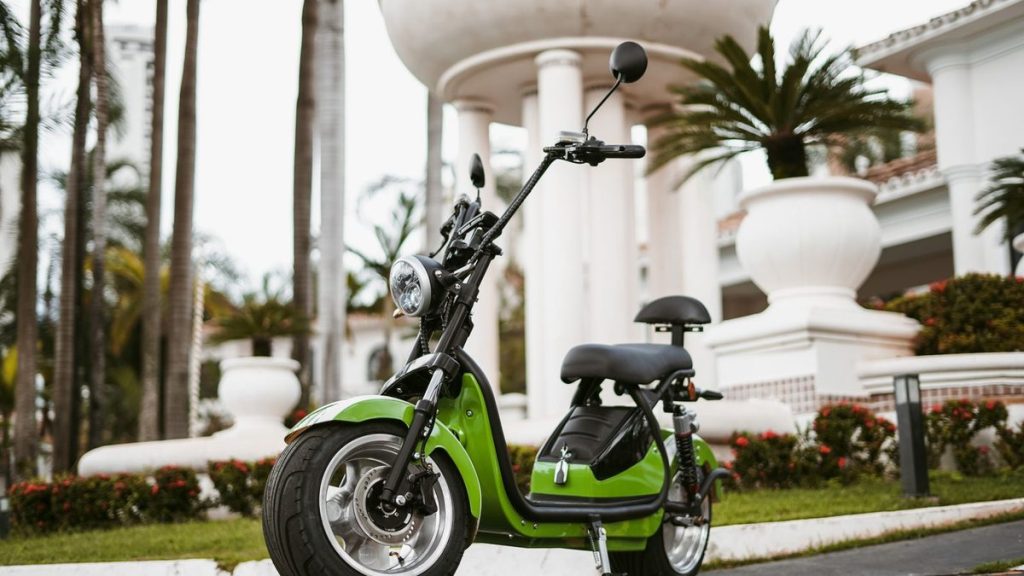
A moped is a seated, two-wheeled vehicle with either a small gas engine (traditionally up to 50cc) or, more commonly today, an electric motor in roughly the 1,500 to 3,000 watt range. It has larger wheels (10 to 16 inches), a real seat, footboards or pegs, mirrors, headlights, brake lights, and a horn. Top speed in most U.S. states is capped at 28 to 30 mph by the legal definition itself — go faster and the law calls it a motorcycle.
The U.S. National Highway Traffic Safety Administration (NHTSA) and most state DMVs classify mopeds as motor vehicles. That means a registration, a plate, and almost always at least a basic driver license.
Side-by-Side: The Honest Comparison
Specs are useful, but only if you know what they actually mean for daily life. Here is how the two stack up on the things people actually feel when they ride.
| Feature | Electric Scooter | Moped |
|---|---|---|
| Riding position | Standing on a deck | Seated, feet on a footboard |
| Top speed (legal) | 15–20 mph (consumer) | 28–30 mph |
| Wheel size | 8–11 inches | 10–16 inches |
| Range per charge / tank | 15–30 miles | 50–100+ miles (gas), 30–60 (electric) |
| Weight | 25–50 lbs | 150–250 lbs |
| License needed | Usually no (varies) | Yes, in most states |
| Registration / plate | Almost never | Always |
| Insurance required | No (most states) | Often yes |
| Foldable / portable | Yes | No |
| Typical price | $300–$2,000 | $1,200–$4,500 |
| Best trip length | Under 5 miles | 5–25 miles |
The biggest gap is not in the spec sheet — it is in how they feel on the road. A scooter at 18 mph over a pothole is a very different experience from a moped at 28 mph over the same pothole. Bigger wheels, more weight, and a real seat smooth out a ride that is genuinely jarring on small wheels.
License, Registration, and Where You Can Ride
This is the part most buyers underestimate, and it is the part that determines whether your new ride is a freedom machine or an expensive paperweight in your garage.
Electric scooter rules
Electric scooter laws vary by state and even by city, but the general pattern looks like this: if your scooter tops out under 20 mph and the motor is under 750–1,000 watts, most states treat it like an electric bike or low-speed device. That usually means:
- No registration, no plate
- No license required (some states ask for a basic driver license, a few don’t)
- Allowed in bike lanes
- Banned on most sidewalks
- Banned on highways and interstates
Cities like New York, Chicago, San Francisco, and Los Angeles have their own additional rules — speed caps in certain districts, helmet rules for under-18 riders, and equipment requirements like lights and a bell. Always check your city’s local rules, because state law is only half the story.
Moped rules
Mopeds live firmly inside the motor vehicle world. In nearly every state you will need:
- A valid driver license (some states require a separate moped permit or motorcycle endorsement)
- State registration and a plate
- A title (in most states)
- Liability insurance (in many states)
- DOT-approved helmet (in helmet-law states)
For an authoritative starting point, your state’s DMV website is the only source that actually counts. The NHTSA’s vehicle classification page is also a good federal-level reference if you want to understand why the categories exist.
Safety: What the Real Numbers Show
Both rides can hurt you. They hurt you in different ways, and at different rates, and knowing the difference is more useful than the usual “wear a helmet” advice (though, yes, please wear a helmet).
Why electric scooters injure more riders per mile
Studies from the U.S. Consumer Product Safety Commission (CPSC) have tracked a steady rise in electric scooter ER visits, with the most common injuries being broken wrists, head injuries, and facial fractures. The reasons are pretty mechanical:
- Small wheels drop into potholes and cracks that a larger wheel would simply roll over.
- Standing posture means a sudden stop sends you over the bars head-first, not just off a seat.
- Quick acceleration from a standstill can pull the deck out from under you if you are not braced.
- Most riders skip helmets because the scooter feels casual — a lot of injuries come from short, unprotected trips.
Why mopeds carry their own risks
Mopeds have better stability, but they share the road with cars at car speeds. That means:
- Visibility. Drivers do not see mopeds the way they see cars. Most moped crashes involve a car turning across the moped’s path.
- Higher speed = harder impact. A 28 mph crash on any two-wheeler hurts.
- Inexperienced riders. Mopeds attract people who would not buy a motorcycle, but moped crashes happen on real roads with real cars.
Look for batteries that meet the UL 2272 safety standard on either ride — that is the third-party certification that tells you the battery system has been independently tested for fire and electrical hazards. It is the same standard that brought hoverboard fires under control after 2016. Skip the unbranded eBay specials.
Cost of Ownership Over a Year
The sticker price is only the start. The real number is what each ride costs you twelve months from now.
| Annual Cost | Electric Scooter | Moped (gas) | Electric Moped |
|---|---|---|---|
| Initial purchase | $300–$2,000 | $1,200–$3,000 | $1,800–$4,500 |
| Registration & title | $0 | $30–$120/yr | $30–$120/yr |
| Insurance | $0 (most states) | $120–$400/yr | $120–$400/yr |
| Fuel / charging | ~$15/yr | $200–$400/yr | ~$30/yr |
| Maintenance | $30–$80/yr | $150–$350/yr | $60–$150/yr |
| Year 1 total* | ~$345–$2,095 | ~$1,700–$4,270 | ~$2,040–$5,200 |
*Estimated ranges for typical urban riders. Insurance and registration vary widely by state.
The takeaway: an electric scooter is dramatically cheaper to own. A moped costs more upfront and more every year, but it pays you back in the form of longer trips, weather tolerance, and the ability to legally ride on real roads.
Which One Is Right for You?
Forget the spec sheets for a second. The right ride is the one that fits your actual day. Here is the simple decision tree we use when readers email asking which way to go.
Pick an electric scooter if…
- Your trips are mostly under 5 miles
- You take a train or bus and need a “last mile” ride to fold and carry
- You live in an apartment without easy outdoor parking
- You don’t want to deal with DMV paperwork
- You’re okay riding in bike lanes, not in traffic
Pick a moped if…
- Your commute is between 5 and 25 miles each way
- You ride in any weather, not just sunny days
- You want a real seat and the ability to carry groceries or a passenger (where legal)
- You’re comfortable being part of car traffic
- You already have a driver license and don’t mind insurance
Myths vs Facts
Myth: “All scooters are mopeds, just smaller.”
Fact: They are different legal categories. A moped is a motor vehicle; a stand-up electric scooter usually is not. The classification changes everything from licensing to where you can park.
Myth: “Electric scooters can’t go fast enough to be useful.”
Fact: Most consumer scooters cap at 15–20 mph by law, but performance models legally exist that match moped speeds. The cap is a regulatory choice, not a hardware limit.
Myth: “Mopeds are basically motorcycles.”
Fact: They are a separate category capped at 30 mph in most states. Once a vehicle exceeds that speed or engine size, the law calls it a motorcycle, with stricter licensing.
Myth: “Electric mopeds don’t need any license.”
Fact: Electric mopeds are still mopeds. They need registration, plate, and usually a license. Switching from gas to electric does not change the legal category.
Related Topics Worth Knowing
If you are weighing scooter vs moped, a few related ideas usually come up next. Quick definitions plus a place to read more:
- Electric scooter laws by state — The single most useful page to bookmark before you buy. Speed caps and license rules differ by state.
- Pneumatic vs solid tires for electric scooters — The tire type matters more than most riders realize for ride feel and flat protection.
- UL 2272 certification explained — Why you should never buy any battery-powered ride without it.
- How electric scooter range really works — Why the advertised range is almost never what you actually get.
- Choosing an electric scooter for commuting — A practical buyer’s guide if you’ve decided the scooter is the right side of this comparison.
Frequently Asked Questions
Is an electric scooter the same as a moped?
No. An electric scooter is a stand-on vehicle with a small deck and handlebar, usually capped around 15 to 20 mph. A moped has a seat, larger wheels, and a small engine or motor, and it is registered as a motor vehicle in most U.S. states.
Do you need a license to ride a moped?
In most U.S. states yes. A moped usually requires at least a basic driver license, and several states also require a motorcycle endorsement or a separate moped permit. Rules vary, so always check your state DMV.
Which is safer, an electric scooter or a moped?
A moped is generally more stable because of its larger wheels, seat, and lower center of gravity. Electric scooters have higher injury rates, mainly from small wheels hitting cracks, potholes, or curbs at speed.
Can you ride an electric scooter on the road like a moped?
It depends on local law. Many cities allow electric scooters in bike lanes and on roads under 25 mph, but ban them on sidewalks and highways. Mopeds are road-legal in most states once registered, but cannot use bike lanes or interstates.
Are electric mopeds the same as electric scooters?
No. An electric moped looks like a small scooter-style motorcycle with a seat and floorboard. An electric scooter is the stand-up kick-style ride with a deck. Electric mopeds are still classified as motor vehicles in most states.
Which is cheaper to own, an electric scooter or a moped?
An electric scooter is cheaper overall. There is no registration, no insurance in most states, no fuel, and very low maintenance. A moped has registration fees, insurance, fuel or charging costs, and regular service like any small motor vehicle.
Summary: The Quick Recap
The electric scooter vs moped question really comes down to three honest realities: how far you ride, what your local law allows, and how much paperwork you are willing to handle. A scooter is a personal device — light, cheap, license-free, perfect for short hops. A moped is a small motor vehicle — heavier, faster, registered, built for actual road commutes.
If most of your trips are under 5 miles and you live near bike lanes, a quality electric scooter will be the easier, cheaper, and more flexible choice. If your daily ride is longer, mixed with road traffic, or has to happen in any weather, a moped pays you back for the extra cost in stability, range, and comfort. Match the ride to your real commute, not the version of yourself you wish you commuted as.
📚 Further Reading
Last Updated: May 2026
Author: Marcus Reyes, Senior Micromobility Editor — HoverboardsGuide.com
This article is educational and meant to help you understand how electric scooters and mopeds differ. It is not buying advice. Laws, prices, and product specifications change — always confirm current rules with your local DMV before making a purchase or hitting the road.