
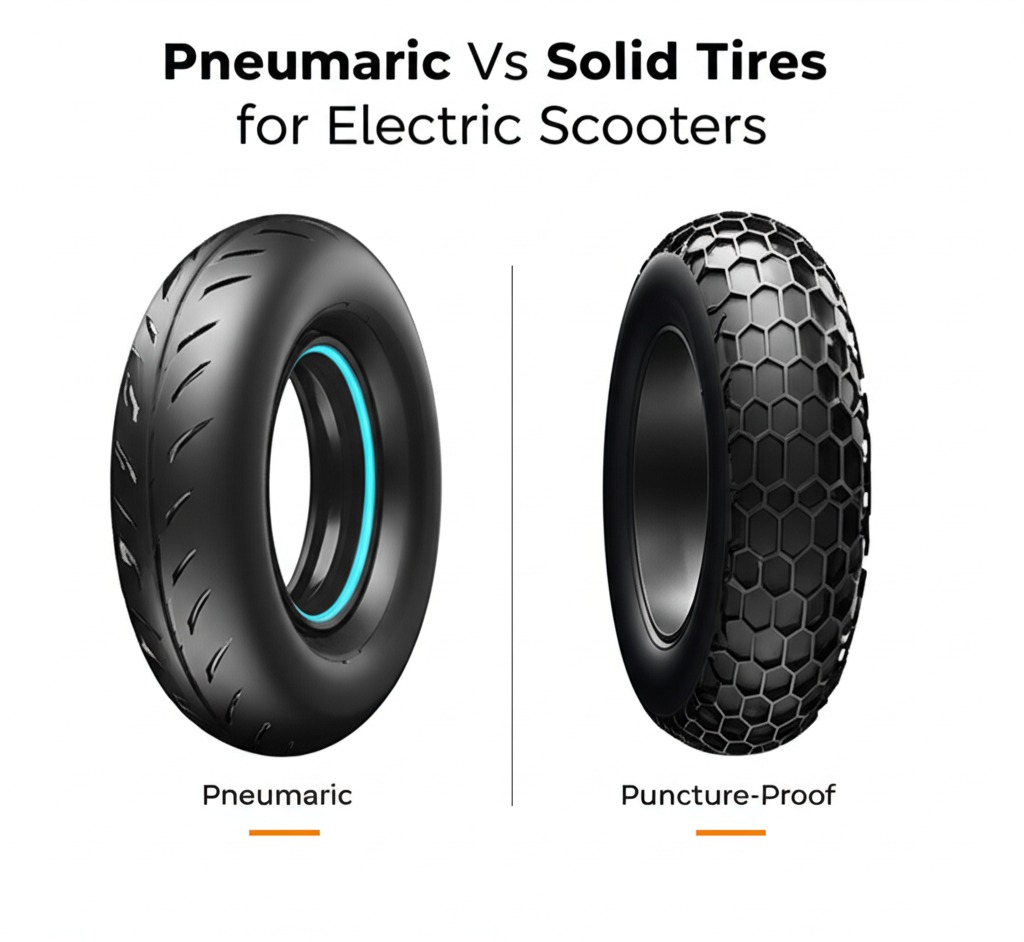
Choosing between pneumatic vs solid tires for electric scooters is one of the most important decisions you’ll make as a rider — yet most buyers overlook it completely. You spend hours comparing motor power, battery range, and price, then pick a scooter without thinking about what’s actually touching the ground.
That’s a costly mistake. 🚨 Your tire type directly affects ride comfort, safety, speed, maintenance time, and your long-term costs. In this guide, we break everything down in plain English so you know exactly which tire is right for your riding style — and why.
💡 Quick Answer
Pneumatic (air-filled) tires give a smoother, cushioned ride and better grip — but they can go flat. Solid (airless) tires are maintenance-free and puncture-proof — but ride rougher. Neither is universally better. It all depends on how and where you ride.
📋 Table of Contents
- What Are Pneumatic Tires?
- What Are Solid (Airless) Tires?
- Key Differences at a Glance
- Full Comparison Table
- Ride Comfort & Smoothness
- Safety & Traction
- Maintenance & Durability
- Best Terrain for Each Tire
- Who Should Choose Which?
- Honeycomb & Self-Healing Tires
- Common Mistakes & Fixes
- Pro Tips From Real Riders
- Real-Life Rider Experiences
- FAQ
- Final Decision Checklist
1
What Are Pneumatic Tires? 🔵
Pneumatic tires are air-filled tires — exactly like those on your car or bicycle. The word “pneumatic” comes from the Greek word for air. These tires have an outer rubber shell plus either an inner tube holding the air, or a tubeless design where the tire seals directly against the rim.
On electric scooters, pneumatic tires range from 8 to 11 inches in diameter. Popular scooters like the Segway Ninebot Max G2, Apollo Air, and Xiaomi Mi Pro 2 all use pneumatic tires. Standard on most mid-range and high-end models.
How They Work
The air inside acts as a natural shock absorber. When you hit a bump, crack, or pothole, the compressed air cushions the impact before it reaches your feet and knees. Typical pressure: 35–65 PSI — always check your manual.
Two Main Subtypes
- Tubed Pneumatic: Inner rubber tube holds the air. Common on budget models — easy to patch but prone to pinch flats.
- Tubeless Pneumatic: No inner tube — the tire seals directly to the rim. Harder to puncture, repairable with sealant. Found on premium scooters.
Tubeless tires are far less likely to go flat mid-ride and can be fixed with sealant in minutes. Its 10-inch pneumatic tires need checking at 35–40 PSI monthly.
🛒 Explore pneumatic scooter tires: 🛒 See Options on Amazon
2
What Are Solid (Airless) Tires? ⚫
Solid tires — also called airless tires, foam-filled tires, or rubber-filled tires — contain no air. They are made of solid rubber or dense foam all the way through. Found on many budget and beginner scooters, including most models under $300.
Three Types of Solid Tires
- Solid Rubber: Pure rubber, zero air. Maximum durability, maximum rigidity — every road vibration transfers directly to the rider.
- Foam-Filled: Pneumatic-style outer rubber filled with dense polyurethane foam. Slightly better vibration absorption. Popular as a conversion kit for delivery riders.
- Honeycomb / Airless Flex: Internal lattice structure that allows slight flex on bumps. Covered in detail in Section 10.
Many budget scooters advertise “anti-flat” tires as a feature. Never mistake “can’t go flat” for “comfortable.” On rough pavement, solid tires transmit every crack directly to your joints — especially noticeable for riders over 170 lbs on longer commutes.
3
Key Differences at a Glance
4
Full Comparison Table 📊
5
Ride Comfort & Smoothness 🛴
This is where the gap between tire types is most obvious — and where pneumatic tires dominate completely. Think about it: when you ride a bicycle on gravel, you feel every stone. Now inflate the tires properly — suddenly it’s smoother. The same physics apply to electric scooters.
Why Comfort Matters More Than You Think
- Average urban scooter commute is 10–25 minutes each way.
- City streets are full of cracks, raised joints, drain covers, and rough asphalt.
- Continuous vibration causes hand numbness, wrist fatigue, knee strain, and lower back pain over time.
- On solid tires, every road imperfection shoots straight through the deck into your joints.
The Numbers
Community testing shows pneumatic-tire scooters produce 30–50% less perceived vibration on the same urban routes compared to solid-tire scooters. On perfectly smooth roads, the gap shrinks. But the moment road quality drops, pneumatic tires pull far ahead.
Does Suspension Help?
Yes — partially. Suspension + solid tires can feel similar to no-suspension + pneumatic tires. But the best setup (suspension plus pneumatic tires) is found on high-performance scooters — a completely different riding experience.
If you ride more than 15 minutes per trip or on anything but perfectly smooth pavement — choose pneumatic tires. Your body will notice the difference within the first week.
6
Safety & Traction 🚦
Traction is a safety issue, not just a comfort issue. Your tires are the only thing preventing a slide or fall when you brake hard or corner.
Pneumatic Tires & Traction
Larger, more flexible contact patch with the road. Air pressure causes the sidewall to flex during cornering, increasing grip. In wet conditions, tread patterns channel water away from the contact zone. Independent tests show pneumatic tires stop several feet shorter on a damp road — enough to mean the difference between a safe stop and a crash.
Solid Tires & Traction
On clean, dry, smooth pavement, solid tires provide adequate traction. For casual riders on maintained paths, they’re fine. But on wet roads, loose gravel, or rough asphalt, solid tires can feel unpredictable during hard braking or tight cornering.
The Blowout Factor
A sudden blowout on a pneumatic tire at 20+ mph is rare but possible if the tire is over-inflated or hits a sharp object at speed. Mitigate this by keeping tires at correct PSI, choosing tubeless over tubed, adding sealant preventively, and inspecting weekly for cuts.
7
Maintenance & Long-Term Cost 🔧
Pneumatic Tire Maintenance
- Pressure checks: Every 2–4 weeks. 2 minutes with a bicycle pump and gauge.
- Flat repairs: Patch kits $5–$10, take 20–30 minutes. Tubeless sealant top-ups take 5 minutes.
- Replacement: Every 1,000–3,000 miles. Cost: $15–$50 per tire.
Solid Tire Maintenance
- Regular maintenance: Almost none. No pressure checks, no flat repairs, no sealant.
- Visual inspection: Every few months for cracking or worn tread.
- Replacement: Every 2,000–4,000 miles. Cost: $10–$40 per tire.
The gap narrows significantly with a tubeless + sealant setup. Spend $15 on sealant upfront and you eliminate most flat repair costs — making 2-year total costs nearly identical while keeping all the comfort benefits.
8
Best Terrain for Each Tire Type 🗺️
🔵 When Pneumatic Tires Are Better
- 🏙️ Urban commuting: Cracked pavement, expansion joints, potholes, drain grates — pneumatic handles all of it better.
- 🌧️ Wet or rainy conditions: Better grip and water-channeling tread reduces slip risk dramatically.
- 🌿 Light off-road: Gravel paths, dirt trails, grass.
- 🚀 High-speed riding (18+ mph): Better grip and stability.
- ⚖️ Heavier riders (180 lbs+): Air cushioning absorbs more load, reducing joint fatigue significantly.
⚫ When Solid Tires Are Better
- 🏫 Smooth campus or indoor paths: Consistent, well-maintained surfaces where comfort differences shrink.
- 🚚 Delivery riders: Can’t risk downtime from a flat.
- 🛒 Casual, short-distance riders: Under 3 miles per day on smooth paths — comfort difference is minimal.
- 💸 Budget buyers: Many budget scooters use solid tires and are perfectly practical for light use.
Don’t buy a solid-tire scooter just because the listing says “anti-flat.” Test your commute route first. If there’s even one stretch of rough road, you’ll regret it within two weeks — guaranteed.
9
Who Should Choose Which Tire? 👤
10
Honeycomb & Self-Healing Tires 🍯
🌟 The Best of Both Worlds?
Honeycomb tires (lattice or airless flex tires) have a geometric internal structure that compresses slightly on bumps, mimicking pneumatic shock absorption while staying 100% puncture-proof. They’re becoming common on mid-range scooters in 2025.
Meanwhile, the Segway Ninebot Max G2 uses self-healing tires — tubeless pneumatic tires pre-filled with liquid sealant that automatically seals small punctures while you’re still riding. The smartest compromise for urban commuters who want comfort and reliability. Now standard on premium $600–$1,200 commuter scooters.
Honeycomb Tire Pros & Cons
- ✅ Completely puncture-proof
- ✅ Noticeably better comfort than traditional solid tires
- ✅ Zero maintenance
- ⚠️ Still not as comfortable as true pneumatic tires
- ⚠️ More expensive than basic solid tires
- ⚠️ Not available for all scooter models yet
🛒 Explore honeycomb tire options: 🛒 Check Prices on Amazon
11
Common Mistakes & How to Fix Them ❌
Not Checking Tire Pressure Regularly
The problem: Under-inflated pneumatic tires ride like solid tires — rough, slow, hard to control. Over-inflated tires increase blowout risk.
✓ The Fix
Get a digital pressure gauge ($8–$15) and check every 2–3 weeks. Inflate to the PSI on your tire sidewall or in your scooter manual.
Choosing Solid Tires “For Easy Maintenance” Then Riding Rough Streets
The problem: Riders buy solid-tire scooters thinking they’re saving money, then spend 45 minutes daily on rough city roads battling hand numbness and joint pain.
✓ The Fix
Honestly assess your riding surface before buying. If your city has even average road quality, go pneumatic. The comfort difference is not subtle.
Ignoring a Slow Leak Until It Becomes a Full Flat
The problem: A slow leak can drop pressure from 50 PSI to 20 PSI over a week unnoticed — until you’re stranded mid-commute.
✓ The Fix
Add preventive tire sealant (like Slime) to tubeless tires from day one. It seals small holes as they form, before they become stranding events.
Replacing Only One Tire When Both Are Wearing Out
The problem: Mismatched tread levels create unpredictable handling, especially during emergency braking.
✓ The Fix
Replace tires in pairs when possible — just like on a car. At minimum, ensure both tires have similar tread depth before hard riding.
Using the Wrong Tire Size as a Replacement
The problem: Tire size is specific — both diameter AND width matter. Riders often assume any scooter tire will fit their model.
✓ The Fix
Find the size printed on your current tire (e.g., 8.5 × 2) and match it exactly when buying replacements. Never guess.
12
Pro Tips From Experienced Riders 🏆
Tubeless + Sealant = The Sweet Spot. Want pneumatic comfort without flat headaches? Go tubeless and fill with sealant from day one — 95% of the comfort, maybe 10% of the flat risk. Consistently the top advice across r/ElectricScooters and dedicated scooter forums for city commuters.
Know Your Tread Pattern. Look for tires with a center ridge (reduces rolling resistance on roads) and side knobs (increases cornering grip). Avoid aggressive knobbies unless you’re riding off-road — they add noise and rolling resistance on pavement.
Always Carry a Repair Kit. A CO2 inflator + small patch kit fits in a jacket pocket, weighs almost nothing, and saves you from walking home. Non-negotiable for pneumatic tire riders on longer commutes.
Read Full Real-World Reviews. Don’t buy based on tire type alone. Look for reviews that specifically test how tires handle cracked city pavement — this is the kind of real-world detail that matters.
Tire Size > Tire Type. Larger diameter tires absorb bumps better regardless of type. A 10-inch solid tire often rides smoother than an 8-inch pneumatic tire. Always check both tire type AND size when comparing scooter models.
13
Real-Life Rider Experiences 📱
Here’s what actual riders are saying in 2025, drawn from scooter forums, Reddit, and YouTube communities:
“
“The best tire for you is the one that matches your actual riding conditions — not what the spec sheet says or what looks cool online.” — Common wisdom across every major scooter community
14
Frequently Asked Questions ❓
15
Final Decision Checklist ✅
Answer these honestly — and the right tire type will be obvious.
📋 Your Tire Type Decision Checklist
| ☐ My streets are smooth & well-maintained → Solid | ☐ My streets have cracks or potholes → Pneumatic |
| ☐ I ride more than 15 min per trip → Pneumatic | ☐ I weigh more than 170 lbs → Pneumatic |
| ☐ I ride in rain or variable weather → Pneumatic | ☐ I can’t afford any delivery downtime → Solid |
| ☐ I hate any form of maintenance → Solid | ☐ I ride at 18+ mph regularly → Pneumatic |
| ☐ Tight budget, casual short rides → Solid OK | ☐ I want the best possible ride quality → Pneumatic |
🏁 Make the Right Tire Choice Before You Buy
The pneumatic vs solid tires debate has no universal winner — which is great news. It means there’s a perfect tire for your exact situation. Your tires touch the ground on every single ride. They deserve more than an afterthought.
Last updated: April 2026 · This article contains affiliate links. When you purchase through our Amazon links, we may earn a small commission at no extra cost to you. All recommendations are based on real-world research and rider feedback.

I’m the founder of HoverboardsGuide.com, a comprehensive website dedicated to electric scooters and hoverboards. With a deep-rooted passion for electric gadgets, I’ve accumulated extensive experience in this field. I aim to assist users in selecting the best gadgets and providing reliable guidance.
I’ve tested and reviewed numerous models, gaining in-depth knowledge about their features, performance, and overall quality. Feel free to reach out to me with any queries, as I’m dedicated to addressing your concerns promptly. Join me on this exciting journey of exploring the world of electric rides and making informed decisions