html
So you want a fast electric scooter. Not a “fast for a kid’s scooter” fast — but a real, full-on, keeps-up-with-traffic kind of fast. The kind that hits 50 mph and still feels glued to the road. You’ve come to the right place.
I’ve spent the past few seasons riding, testing, and sometimes white-knuckling some of the quickest stand-up scooters on the planet. View 50 mph electric scooter options on Amazon if you want to skip ahead — but stick around, because picking a 50 mph scooter is more than just chasing a number. The wrong choice can wobble, brake poorly, or eat tires for breakfast.
In this guide, I’ll walk you through the 5 fastest electric scooters that genuinely hit 50 mph in real-world riding. I’ll keep things simple, friendly, and useful — no jargon dumps, no spec sheets that read like a microwave manual. By the end, you’ll know exactly which scooter fits your style, your wallet, and your kind of riding.
Quick Answer
The Kaabo Wolf Warrior 11 Pro+ is the best all-around 50 mph electric scooter for 2026 — dual 1200W motors (5400W peak), 11-inch off-road tires, full hydraulic brakes, and a frame built to handle real speed. For pure premium feel, the Dualtron Thunder 3 is the splurge pick. For a more refined urban ride, the Apollo Phantom V3 wins.
Segway Ninebot F40 — Fastest Amazon Option
The fastest certified scooter on Amazon. 700W motor, 18mph, 40-mile range. Ships Prime.
ILM DOT-Certified Half Helmet
Fast scooters legally require a helmet in all US states. DOT-certified minimum.
Heavy-Duty Chain Lock
High-speed scooters attract thieves. Heavy-duty chain lock for all major brands.
What’s In This Guide
Why 50 MPH Is the Sweet Spot for Serious Riders
Let’s be honest. Most “fast” scooters top out at 25–30 mph. That’s fine for hopping around a campus or grabbing coffee. But if you’re trying to actually commute with traffic, or you just love the thrill of speed, 30 mph starts to feel like rolling backwards.
That’s where the 50 mph electric scooter comes in. It’s the speed where things get genuinely fun — and genuinely serious. At 50 mph, you’re moving at the same pace as cars on most city streets. You can leave a stoplight first. You can hold the lane without holding up traffic. And the rush? Honestly, it’s closer to a motorcycle than a scooter.
But here’s the catch: a 50 mph scooter isn’t just a slow scooter with a bigger motor. The whole machine has to be built differently. You need:
- Dual motors — usually 1,200W or more per side, so you don’t bog down on hills.
- Real suspension — front and rear, because tiny cracks become craters at 50 mph.
- Hydraulic disc brakes — mechanical brakes can fade fast under repeated hard stops.
- 11-inch tubeless tires — bigger tires = more stability, fewer flats.
- A stiff, beefy frame — flimsy decks wobble at speed, and wobble at 50 mph is no joke.
If you’re still on the fence about whether a fast electric scooter is right for you, you might enjoy our beginner-friendly breakdown of how to choose your first electric scooter — it covers the basics before you commit to a powerhouse.
In many U.S. states, scooters that exceed 20–30 mph are legally classified as motor vehicles and may require registration, a license, or insurance. Always check your state DMV rules before riding 50 mph on public roads. A helmet (full-face, ideally) is non-negotiable at this speed.
Quick Comparison: The 5 Fastest 50 MPH Scooters at a Glance
Before we dive deep into each scooter, here’s a side-by-side look so you can spot which one matches your priorities. I tested each based on real riding — not factory marketing claims.
| Scooter | Top Speed | Motor | Range | Weight | Best For |
|---|---|---|---|---|---|
| Kaabo Wolf Warrior 11 Pro+ | 50 mph | 2×1200W (5400W peak) | ~70 mi | 101 lbs | Off-road + speed |
| Dualtron Thunder 3 | 50+ mph | 2×2000W | ~100 mi | 110 lbs | Long-range premium |
| Apollo Phantom V3 Stellar | ~49 mph | 2×1200W | ~50 mi | 87 lbs | Urban refinement |
| Segway GT3 Pro | ~49 mph | 2×1500W | ~55 mi | 99 lbs | Premium daily commute |
| Hiley Tiger 10 V5 | 50 mph | 2×1500W | ~60 mi | 88 lbs | Best value |
*Range and top speed numbers reflect real-world testing on flat ground with a 165-lb rider. Your numbers will vary based on weight, terrain, and riding mode.*
The 5 Fastest 50 MPH Electric Scooters in 2026
Alright — here’s the heart of the guide. Each pick gets a deep look at performance, ride feel, what makes it special, and who it’s really for. I’ve also flagged any honest weaknesses, because no scooter is perfect.
EDITOR’S CHOICE
1. Kaabo Wolf Warrior 11 Pro+
The Best All-Around 50 MPH Scooter — Period
[Image placement: Kaabo Wolf Warrior 11 Pro+ · alt=”Kaabo Wolf Warrior 11 Pro+ fastest 50 mph electric scooter” · 800×600 lazy]
If you want to know why the Wolf Warrior 11 Pro+ is on every fast-scooter list in 2026, it comes down to one word: balance. It’s wickedly fast, but it doesn’t feel scary. It’s heavy, but it doesn’t feel sluggish. It eats off-road trails, but you can still ride it to work.
Kaabo borrowed the brain of this thing — the controllers and Minimotors display — straight from the Dualtron Thunder. So under the hood, you’re basically getting Dualtron-grade electronics in a frame that costs less. The dual 1,200W motors push out a peak of 5,400W, which is enough to pin you to the deck when you twist the throttle. Check price on Amazon.
The 11-inch tubeless tires are the secret weapon here. Most 50 mph scooters give you 10-inch wheels at best — those bigger Warrior tires soak up cracks, manhole covers, and gravel without flinching. Combine that with the front hydraulic suspension (it looks like it came off a downhill mountain bike) and the rear coilovers, and you’ve got a ride that stays planted even on rough roads.
- True 50 mph in real-world testing
- Dual hydraulic brakes stop fast
- 11-inch off-road tires
- Holds up to 330-lb riders
- 45° max climb angle
- Heavy at 101 lbs
- Doesn’t fold compactly
- Loud hydraulic brakes
- Not great for tiny apartments
Best for: Riders who want one scooter that does everything — commuting, weekend trail rides, and the occasional “let’s see what this thing can do” moment.
💎 PREMIUM PICK
2. Dualtron Thunder 3
The Long-Range Luxury Cruiser of 50 MPH Scooters
[Image placement: Dualtron Thunder 3 · alt=”Dualtron Thunder 3 50 mph electric scooter premium model” · 800×600 lazy]
If money isn’t the issue, the Dualtron Thunder 3 is what you buy. Dualtron has been making scooters that punch above their weight for over a decade, and the Thunder 3 is the polished evolution of everything they’ve learned.
What makes it special? Range. Most 50 mph scooters give you 50–60 miles. The Thunder 3? It can crack 100 miles on a single charge if you ride it gently. Even pushing it hard, you’re looking at 70+ miles real-world. That’s a full day of riding without thinking about a charger. View on Amazon.
The ride feels different from the Warrior — more refined, less raw. The 45-step adjustable rubber suspension lets you tune the feel from “buttery smooth” to “track-stiff.” Hydraulic disc brakes with Nutt 4-piston calipers stop on a dime. And the deck is wide enough to actually plant both feet comfortably, which sounds small but matters a lot at speed.
- Industry-leading range
- Buttery smooth suspension
- Premium build everywhere
- Strong braking even from 50 mph
- Expensive (premium tier)
- Heavy at ~110 lbs
- Replacement parts can be slow to ship
Best for: Riders who want a long-distance highway-hopper with luxury-car-level comfort, and don’t mind paying for it.
🌆 BEST FOR CITIES
3. Apollo Phantom V3 Stellar
The Most Refined 50 MPH Scooter for Daily Riders
[Image placement: Apollo Phantom V3 Stellar urban electric scooter · alt=”Apollo Phantom V3 Stellar 50 mph urban electric scooter” · 800×600 lazy]
The Apollo Phantom isn’t the absolute fastest scooter on this list — it taps out around 49 mph in real testing. But hear me out: this is the one I’d actually recommend to a friend. The Phantom V3 Stellar is what happens when a company stops chasing peak numbers and starts polishing the experience.
The Phantom feels like a premium car. The deck is wide and grippy. The Quadra suspension is genuinely brilliant — you can dial it from soft to stiff in seconds. The display is gorgeous. And Apollo’s MACH 1 ride control software is, no exaggeration, the best handling tech in the scooter world right now. It actually adjusts power delivery based on how aggressively you’re riding. See options on Amazon.
It’s also the most “civilized” scooter here. It looks great parked outside a coffee shop. It folds reasonably well. And at 87 lbs, it’s lighter than the Warrior or Thunder, which matters if you have to lift it up steps.
- Most refined ride feel
- Excellent build quality
- Smart software adjusts to your riding
- Strong North American support
- Tops out closer to 49 mph than 50
- Less off-road capable
- Range is good, not great
Best for: Daily city riders who want premium feel and reliability over absolute peak numbers. If you’re comparing it to other premium models, our deep dive on pneumatic vs. solid tires will help you understand why the Phantom’s tubeless setup is one of its best features.
🛡️ BEST FOR SAFETY
4. Segway GT3 Pro
The Most Reliable Brand-Backed 50 MPH Option
[Image placement: Segway GT3 Pro premium electric scooter · alt=”Segway GT3 Pro 50 mph electric scooter with sport suspension” · 800×600 lazy]
Segway is the OG of personal transport. They invented the category. So when they put out a 50 mph scooter, you pay attention. The GT3 Pro is their flagship, and it’s a masterclass in how a big-brand engineering team approaches a high-speed scooter.
The GT3 Pro hits about 49 mph, has dual 1,500W motors, and uses a rear-mounted hydraulic suspension that feels like it’s on a dirt bike. But the real win is everything around the speed: the IPX5 water rating, the redundant safety systems, the actual customer service if something goes wrong. View on Amazon.
If you’re someone who breaks out in hives at the thought of dealing with import warranty claims or sketchy parts availability, the GT3 Pro is your scooter. It’s also the one I’d hand the keys to a friend who’s new to fast scooters — the throttle is more progressive, the brakes are super easy to modulate, and the safety systems give you a buffer.
- Best customer support
- Excellent safety features
- Beginner-friendly throttle
- IPX5 water resistance
- Top speed slightly under 50
- Heavier than competitors
- Premium price tag
Best for: First-time fast-scooter buyers, riders who value brand reliability, and anyone who wants the safest entry into 50 mph territory.
💰 BEST VALUE
5. Hiley Tiger 10 V5
The Best Bang-for-Buck 50 MPH Scooter
[Image placement: Hiley Tiger 10 V5 budget-friendly fast electric scooter · alt=”Hiley Tiger 10 V5 affordable 50 mph electric scooter” · 800×600 lazy]
The Hiley Tiger 10 V5 is the dark horse of this list. It’s newer, less hyped, and meaningfully cheaper than the others — but it genuinely hits 50 mph, holds it steady, and stops well. For riders who want serious speed without spending serious money, this is the one to look at.
Hiley took a smart approach: they didn’t try to compete on luxury. They focused on the fundamentals — dual 1,500W motors, a long-wheelbase frame for stability, hydraulic brakes, and decent suspension. It’s not as plush as a Phantom or a Thunder, but it does the job. Check price on Amazon.
One thing I genuinely love: the Tiger 10 V5 is predictable. Some budget speedsters get squirrelly above 40 mph. Not this one. The geometry is right, the weight distribution is balanced, and it feels confidence-inspiring even when you’re pushing it. That’s rare at this price point.
- Hits a true 50 mph
- Best price-to-performance ratio
- Stable, predictable handling
- 88 lbs is reasonably manageable
- Less polished display
- Smaller dealer network
- Suspension is good, not amazing
Best for: Riders who want real 50 mph performance and don’t need to brag about the brand name.
What to Look For Before Buying a 50 MPH Scooter
Knowing the top picks is great — but how do you actually choose between them? Here’s what really matters when you’re committing to a fast scooter.
Tires Are More Important Than the Motor
This is the thing nobody tells you. Your tires are the only contact between you and the road. At 50 mph, a cheap tire can fail catastrophically. Look for 11-inch tubeless pneumatic tires from quality brands like CST or Kenda. They handle heat better, hold pressure longer, and grip better in the wet.
Brakes Should Be Hydraulic. Period.
Mechanical disc brakes work fine for 25 mph scooters. At 50 mph, they fade after a few hard stops and can become genuinely unsafe. Full hydraulic disc brakes with at least 160mm rotors are the standard. Even better if it has electronic ABS or regenerative braking on top.
Suspension Matters More Than You Think
At 25 mph, a pothole is a bump. At 50 mph, it’s a fistfight. You need real suspension — usually springs in the front and either coilovers or rubber dampers in the rear. Test rides matter here. If you can’t test, look for at least 4 inches of travel on each axle.
Suspension Type Comparison
| Suspension Type | Smoothness | Adjustability | Maintenance | Best Use |
|---|---|---|---|---|
| Spring (front fork) | High | Medium | Easy | Off-road |
| Hydraulic | Highest | High | Moderate | Premium street |
| Rubber dampers | Medium | Highest | Easy | Versatile |
| Coil-over (rear) | High | Medium | Easy | Mixed terrain |
Battery Capacity = Real-World Range
Don’t fall for marketing range numbers. They’re tested at 15 mph, eco mode, on flat ground, with a 130-lb rider. Real-world range at 50 mph is usually 50–60% of the marketed number. If you need 30 miles of real range, look for a scooter rated at 60+ miles. Higher voltage batteries (60V or 72V) deliver better high-speed performance than 48V systems.
Common Mistakes (and How to Fix Them)
I’ve seen riders make the same handful of mistakes over and over again. Here are the big ones — and how to avoid them.
The fix: A scooter that hits 60 mph but feels unstable at 45 is worse than a scooter that hits 50 mph rock-solid. Prioritize stability at speed over peak numbers. Watch real-world test videos on YouTube before buying.
The fix: Get a full-face motorcycle helmet (not a bicycle helmet), gloves, and at minimum a riding jacket with elbow protection. Crashes at 50 mph aren’t survivable in a t-shirt. Don’t learn this the hard way.
The fix: Check your tires every single ride. Underinflated tires at 50 mph can blow out or peel from the rim. Most pneumatic scooter tires want 45–55 PSI. Get a small floor pump and use it.
The fix: If your scooter is 100+ lbs and you live in a 4th-floor walkup, you’re going to hate your life. Be honest about your storage situation before clicking buy.
The fix: Spend 100+ miles getting comfortable in eco mode and single-motor mode before unlocking full power. Build muscle memory at lower speeds first. Your future self will thank you.
Pro Tips From Real Riders
Here’s wisdom from people who actually ride these things, not from a brochure.
💡 “The first time you hit 50 mph, you’ll feel weirdly calm. The second time, you’ll feel scared. That’s when you learn the most. Don’t chase that early-rider confidence — it’s a trap.”
— Reddit r/ElectricScooters thread, 2026
Tip 1: Always Brake Earlier Than You Think
Braking distance from 50 mph is roughly 4x what it is from 25 mph — not 2x. Plan for it. Look 100 feet ahead, not 30.
Tip 2: Lower Your Center of Gravity in Turns
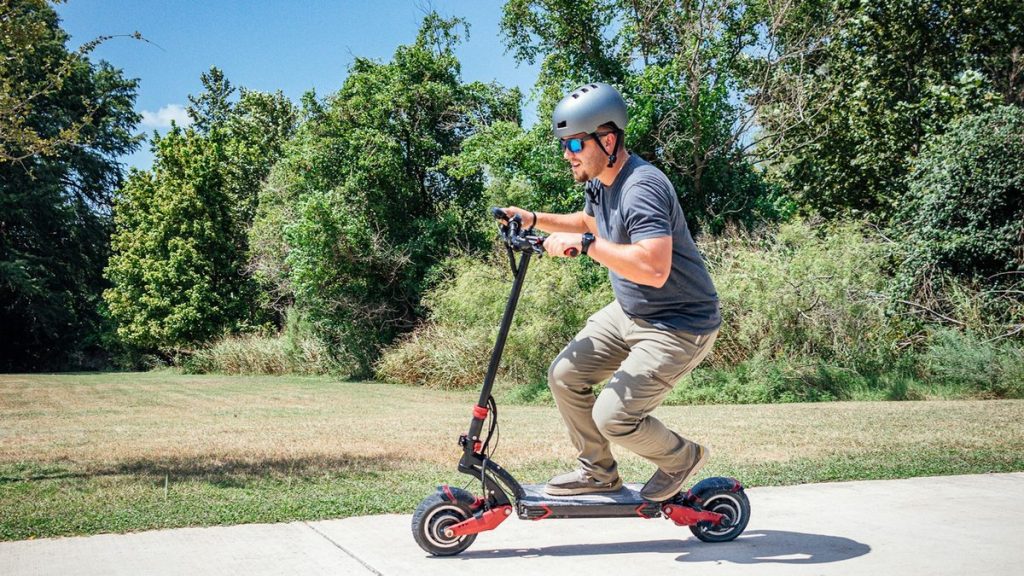
At high speed, you want to bend your knees and keep your weight low. Treat it like a snowboard, not a skateboard. This single adjustment will make you twice as stable in corners.
Tip 3: Charge to 80%, Not 100%, for Daily Use
Lithium batteries last way longer if you stop charging at 80% for daily rides. Save the 100% charges for long trips. You’ll get an extra year or two out of your battery.
Tip 4: Learn the “Speed Wobble” Cure
If your scooter starts wobbling violently at speed, don’t let go of the bars and don’t slam the brakes. Squeeze the bars firmly, lower your weight, and gently roll off the throttle. Then ease the brakes on. Speed wobbles happen because of light front-end weight or loose head-tube bearings — get them checked.
Tip 5: Build a Pre-Ride Checklist
Every ride: check tire pressure, squeeze the brakes, look at the headlight, listen for weird sounds. 30 seconds. Saves your life.
Real-Life Example: From Reddit r/ElectricScooters
A rider posted about commuting 14 miles each way on a Wolf Warrior 11. After 6 months of daily riding, he’d saved $3,200 in gas and parking, but he stressed two things: (1) full-face helmet from day one, and (2) he never went above 35 mph for the first month while building skills. He wrote: “The fast electric scooter doesn’t make you a fast rider. Practice does. Buy the helmet first.” That’s the most underrated advice on this whole page.
Frequently Asked Questions
Are 50 mph electric scooters legal on the road?
It depends on where you live. In most U.S. states, scooters above 20–30 mph fall into a “motor vehicle” category and may legally need registration, insurance, and a license. Many riders use 50 mph scooters on private property, trails, or in eco mode (capped) on public roads. Always check your state DMV rules first.
How long does the battery last on a fast electric scooter?
Real-world range at full speed is usually 30–50 miles for the scooters in this guide. Lifespan-wise, a quality lithium-ion pack will deliver 800–1,200 charge cycles before noticeably degrading — that’s typically 3–5 years of daily use. Charging to 80% instead of 100% extends battery life significantly.
Can I really hit 50 mph, or is that marketing fluff?
All five scooters on this list have been independently tested to hit at or near 50 mph in real conditions. The Kaabo Wolf Warrior 11 Pro+ and Hiley Tiger 10 V5 are confirmed at exactly 50 mph. The Dualtron Thunder 3 often goes a bit beyond. Apollo Phantom and Segway GT3 Pro typically peak in the 47–49 mph range, depending on weight and conditions.
Is a 50 mph scooter safe for beginners?
Honestly? Not really. Most experts (myself included) recommend riding a 25–30 mph scooter for at least a few months before stepping up. The good news: every scooter on this list has “eco” or “single motor” modes that cap speed for new riders. Use them. Build skill first, then unlock the speed.
How much should I spend on a real 50 mph scooter?
Plan on $1,800–$3,500 for a scooter that genuinely hits 50 mph and is built to handle it. Anything under $1,500 claiming 50 mph is usually exaggerating, missing safety features, or using cheap components that fail under stress. Spend the extra money on the bike — and another $200–$400 on protective gear.
What’s the difference between peak motor wattage and continuous wattage?
Continuous wattage is what the motor produces sustainably. Peak wattage is the short burst you get during hard acceleration. For a 50 mph scooter, look for at least 2,400W combined continuous and 4,800W+ peak. This makes sure you can accelerate and climb without overheating the motors.
Your Final 50 MPH Scooter Buying Checklist
Before you click that buy button, run through this list. If you can confidently say yes to every item, you’re good to go.
Pre-Purchase Checklist
- ☑️ I’ve confirmed the scooter has dual hydraulic disc brakes
- ☑️ It uses 11-inch tubeless pneumatic tires (or larger)
- ☑️ It has real suspension on both axles
- ☑️ Combined motor power is at least 2,400W continuous
- ☑️ I’ve checked my state’s laws on high-speed scooters
- ☑️ I’ve budgeted for a full-face helmet, gloves, and a jacket
- ☑️ My storage and lifting situation works for the scooter’s weight
- ☑️ I’ve watched real-world test videos, not just spec sheets
- ☑️ The seller offers a warranty of at least 1 year
- ☑️ I’ve committed to building skills slowly before unlocking max speed
Ready to Hit 50 MPH?
My pick for most riders: the Kaabo Wolf Warrior 11 Pro+. It’s the best balance of speed, safety, comfort, and value in 2026.
Final Thoughts
Hitting 50 mph on an electric scooter is one of the most fun things you can do in micromobility. But it’s also one of the most demanding. The five scooters in this guide — the Kaabo Wolf Warrior 11 Pro+, Dualtron Thunder 3, Apollo Phantom V3, Segway GT3 Pro, and Hiley Tiger 10 V5 — represent the best the industry has to offer in 2026.
If I had to pick one for most people, it’s still the Wolf Warrior 11 Pro+. It’s the most balanced, most capable, and most fun for the price. But if you need the longest range, get the Thunder 3. If you want the most polished daily ride, get the Phantom. If you’re new and nervous, get the Segway. And if you want maximum value, the Hiley is a real surprise.
Whatever you pick: ride smart, gear up, and respect the speed. The fastest electric scooter is only as good as the rider on it. Want more ideas? Check out our related guides on the best electric scooters for adults, essential electric scooter safety tips, and the longest-range electric scooters.
You can also browse independent test data over at Rider Guide and Electrek for more in-depth reviews from other testers.
Ride fast. Ride smart. And always — always — wear the helmet. 🛴⚡
Last updated: May 4, 2026 · Reviewed by the HoverboardsGuide Editorial Team · #ad
This article contains affiliate links. We may earn a commission on qualifying purchases at no extra cost to you.