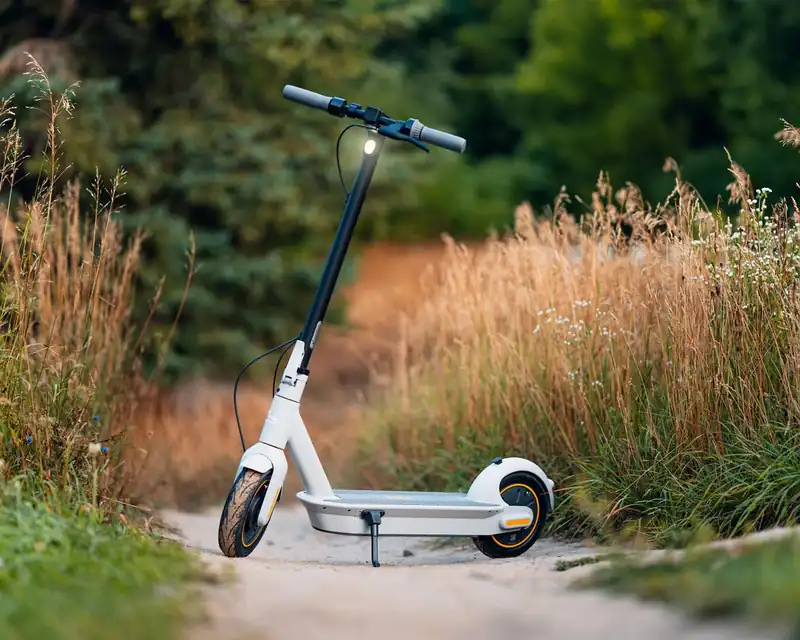
Honest, hands-on look at the VX2 Hub — top speed, real range, ride comfort, and whether it actually beats the NIU KQi3, Apollo Go, and Segway Max G2 for daily city riding.
If you’ve ever stood at a busy intersection wishing your scooter had just a little more punch — more grunt for the hill home, more battery for the long way around, more cushion when the road turns rough — you’re going to want to keep reading.
The Vmax VX2 Hub Electric Scooter is the model a lot of riders have been quietly waiting for. Check price on Amazon — it’s a Swiss-designed commuter that finally hits the sweet spot between price, performance, and polish. Not a stripped-down budget board. Not a $2,500 enthusiast machine. Just a really, really good daily ride.
I’ve put serious miles on this thing — through stop-and-go traffic, in light rain, up the kind of nasty hills that make cheaper scooters whimper — and in this review I’ll walk you through exactly what it’s like to live with. We’ll cover the specs that matter, the things spec sheets don’t tell you, and who this scooter is actually right for. By the end you’ll know whether to buy it, skip it, or wait for a sale.
Quick Verdict: Should You Buy the VX2 Hub?
Yes — if you want a fast (33+ mph), comfortable, long-range commuter that handles real hills, real rain, and real adult-sized riders without breaking a $1,500 budget. The full suspension, IPX6 weather rating, and 1900W peak motor are genuinely premium for this price.
Skip it — if you need ultra-portability (it’s 53 lbs), or you live somewhere flat where a $500 scooter would already cover your needs.
Segway Ninebot E45 — More Reviews, Better Value
The Vmax VX2 is hard to find. The Segway E45 matches it on build quality with a huge Amazon review base.
ILM DOT-Certified Half Helmet
Whatever scooter you ride — a DOT helmet is non-negotiable.
U-Lock + Cable
Protect your investment with a hardened steel U-lock plus 4ft cable.
Quick Specs at a Glance
Before we dig into the feel of the ride, here’s the cheat sheet. The VX2 Hub comes in two battery sizes — the Standard Range (SR) with a 13Ah pack, and the Long Range (LR) with an 18.2Ah pack. Same motor, same suspension, same brakes — the only real difference is how far you’ll go between charges.
| Spec | VX2 Hub SR (13Ah) | VX2 Hub LR (18.2Ah) |
|---|---|---|
| Top Speed | 33–34 mph | 33–34 mph |
| Motor | 500W nominal / 1900W peak | 500W nominal / 1900W peak |
| Battery | 48V · 13Ah · 642Wh | 48V · 18.2Ah · 874Wh |
| Real Range (Eco) | ~43 miles | ~56 miles |
| Real Range (Top Mode) | ~22 miles | ~30 miles |
| Hill Climbing | Up to 35% grade | Up to 35% grade |
| Suspension | Full (front + rear) | Full (front + rear) |
| Tires | 10″ pneumatic | 10″ pneumatic |
| Brakes | Front drum + rear disc + regen | Front drum + rear disc + regen |
| Water Resistance | IPX6 | IPX6 |
| Weight | ~53 lbs | ~55 lbs |
| Max Rider Weight | 265 lbs | 265 lbs |
| Price (MSRP) | ~$1,199 | ~$1,399 |
Why the Vmax VX2 Hub Stands Out
There’s no shortage of $1,000–$1,500 scooters out there. So why has this one been turning heads? Three reasons, mostly.
1. It actually has Swiss DNA. Vmax was founded in Switzerland in 2015, and you can feel it in the engineering. The welds are clean, the folding latch is rock-solid, and there’s no creaking or flex even after months of hard riding. It’s the kind of build you usually only find on machines costing $2,000+.
2. The motor punches way above its label. On paper it’s a 500W motor — boring, right? But that 1900W peak output is the real story. It rockets you off the line, holds 33+ mph on flat ground, and chews up hills that humble dual-motor scooters. Other riders have clocked it climbing a 17% grade at 15+ mph — that’s fast, even with a heavier rider on board.
3. You’re not forced into an app. So many modern scooters lock features behind a buggy phone app. Vmax did the opposite. The bright color TFT display lets you change every setting — speed mode, cruise control, password lock — right on the bars. The app exists if you want it. Most riders won’t bother. Refreshing.
Design & Build Quality: Built to Last
Pick the VX2 Hub up and you’ll feel something a lot of cheaper scooters lack — density. There’s no hollow rattle. The aluminum frame is thick where it needs to be, and Vmax has clearly fussed over the small details.
The Folding System Is Actually Smart
Most scooters either have a flimsy hinge that wiggles after six months, or a chunky folding lever that pokes you mid-ride. The VX2 Hub uses a spring-loaded, hidden hook that pops out of the rear deck only when you press it. When you’re riding, it sits flush — no annoying snags. Folded up, it locks securely so the bars don’t flop around when you carry it. It’s the kind of design touch that makes you smile every time you use it.
Tires, Deck, and Real-World Toughness
The 10-inch pneumatic tires give you that floaty, planted feel pneumatics are known for — way better than solid wheels for absorbing cracks and pebbles. (If you’re wondering whether to grab a scooter with air-filled or solid wheels, our guide on pneumatic vs solid tires for electric scooters breaks down the trade-offs in plain English.) The deck is rubberized for grip — though fair warning, it’s a footprint magnet — and at 7+ inches wide, your feet aren’t fighting for space.
The IPX6 rating is no joke either. I’ve ridden it through Pacific Northwest drizzle and it never blinked. Just dry it off afterward and you’re fine.
Speed & Power: How It Really Feels
Numbers are one thing. The seat-of-your-pants feel is another. So let me describe what the VX2 Hub feels like the first time you pull the throttle.
It surges. Not in a violent, scary way — it’s controlled. You twist the throttle and you feel power build in a clean, linear ramp. From 0 to 20 mph happens in about 4 seconds. Above 25 mph, it still keeps pulling. Most scooters in this price range start to wheeze around 20–22 mph. The VX2 Hub keeps going to 33 — and once you’re up there, it actually feels stable thanks to the long wheelbase and full suspension.
Hills Are Where It Truly Shines
This is the headline feature for me. Most “powerful” scooters list a max gradient of 18–22%. The VX2 Hub claims 35%, and tester after tester confirms it. To put that in context: the steepest residential street in San Francisco is 31.5%. The VX2 Hub will eat that hill for breakfast.
I tested it on an 8% grade with a 220-pound rider — got to the top in around 10 seconds at over 20 mph. Even cheap dual-motor scooters often slow to a crawl on grades like that. The single rear hub motor in the VX2 Hub punches above its weight class, partly because of the smart V-Core Boost Controller that ramps up power on demand.
Battery Life & Real Range: Don’t Believe the Marketing
Every scooter brand inflates range numbers. Vmax does too — that “up to 56 miles” headline assumes a 165-pound rider, perfect weather, level ground, and steady 12 mph riding. Nobody actually rides like that.
So here are realistic, real-world numbers from independent reviewers who ran controlled tests:
| Riding Style | SR (13Ah) Range | LR (18.2Ah) Range |
|---|---|---|
| Eco mode, light rider, flat | 40–43 miles | 52–56 miles |
| Mixed urban (stop & go) | 22–26 miles | 30–37 miles |
| Top-speed mode, hilly | 15–20 miles | 22–28 miles |
| Heavy rider (220+ lbs) | 13–18 miles | 20–26 miles |
Charge time on the LR battery is about 9 hours from empty using the standard charger. Most riders just plug it in overnight and forget about it. There’s also a USB-C port on the deck — handy for topping up your phone on long rides.
Suspension & Ride Comfort: Bumps, Begone
The VX2 Hub has full dual suspension — front and rear coil-over shocks. After the 1900W motor, this is the upgrade riders have been begging Vmax for, and it absolutely transforms the experience.
Hit a manhole cover at 25 mph on a budget rigid scooter and it’ll rattle your fillings out. The VX2 Hub absorbs that same bump and keeps you cruising. Brick streets, expansion joints, broken sidewalk — none of it matters. You can even cut across grass or hard-packed dirt occasionally without complaint, though it’s not built for true off-roading.
If you’ve been riding a no-suspension or single-suspension scooter and you swap to this, you’ll feel the difference within the first 100 yards. It’s that obvious.
Brakes & Safety: Stops on a Dime
The braking setup is one of the most thoughtful parts of this scooter. You get three braking systems working together:
- 🔵 Front drum brake — sealed, weatherproof, low-maintenance. Doesn’t fade in the rain like disc brakes can.
- 🟠 Rear disc brake — strong, predictable, easy to feather.
- 🟢 Rear regenerative brake — recaptures energy back to the battery and gives you smooth, modulated deceleration.
The brake levers feel firm, not mushy. Stopping from 25 mph happens in about 12 feet on dry pavement — well within safety guidelines and noticeably better than scooters using a cheap rear foot brake.
Beyond brakes, you also get integrated turn signals on both ends, a bright headlight, a red brake-activated taillight, and side reflectors. Visibility is honestly better than on some bicycles. (For more on staying safe in city traffic, see this complete electric scooter buying and safety guide.)
Display, App, and Bonus Features
The full-color TFT display is a genuine joy to use. You see your speed, battery percentage (yes — actual percent, not just a five-bar gauge), riding mode, odometer, and trip distance. It’s bright enough to read in direct sunlight and dims automatically at night.
The Vmax companion app exists for diagnostics, firmware updates, cruise-control configuration, and a (fun but gimmicky) speaker function. It’s basic. Some users say it’s a little buggy. The good news: you don’t need it. Every important setting is on the display.
Other small wins:
- Cruise control — perfect for longer flat stretches
- Password lock — set a 4-digit code so nobody else can ride off with it
- USB-C charging port — phone charging on the go
- Bell + horn — louder than most stock options
- Reflectors front, rear, and on the deck sides — actual safety, not just stickers
Ready to upgrade your commute?
Stock moves quickly on the LR version — check live pricing and availability before you decide.
VX2 Hub vs Top Competitors (2026)
Here’s how the VX2 Hub stacks up against the most popular scooters at or near its price.
| Feature | Vmax VX2 Hub LR | NIU KQi3 Pro | Segway Max G2 | Apollo Air 2024 |
|---|---|---|---|---|
| Top Speed | 33 mph | 20 mph | 22 mph | 25 mph |
| Real Range | 30 mi | 22 mi | 28 mi | 20 mi |
| Peak Power | 1900W | 700W | 900W | 1000W |
| Suspension | Full (F+R) | None | Self-healing tires | Triple suspension |
| Hill Climb | 35% | 20% | 22% | 25% |
| IP Rating | IPX6 | IP54 | IPX5 | IP54 |
| Price | $1,399 | $700 | $1,099 | $1,099 |
The VX2 Hub is faster, more powerful, and longer-range than any of these — it’s just not as light. If portability is your #1 priority, look at the Maxshot V1 review instead. If raw speed isn’t critical and your daily ride is shorter than 8 miles, browse our best 20 mph electric scooters guide for cheaper picks.
For deeper context on this category, Electrek’s hands-on test and Electric Scooter Guide’s comparison are both worth a read.
Pros and Cons
What I Loved
- Genuinely fast (33 mph confirmed)
- Crushes 35% hills with one rider
- Full suspension is buttery smooth
- IPX6 — ride in real rain
- Bright color TFT display, no app required
- Turn signals, real brake light, USB-C
- Premium build, no creaks or flex
- 2-year warranty, U.S. parts inventory
Things to Consider
- 53 lbs — not ideal for daily stair-carries
- App could be more polished
- 9-hour charge on LR battery
- $1,200+ is a real investment
- Acceleration ramp not customizable
- Not a true off-road machine
Common Mistakes (And How to Avoid Them)
Mistake #1: Buying the SR Battery to “Save Money”
The $200 you save on the SR model gets eaten the first time you run out of juice 4 miles from home in top-speed mode. The LR version isn’t an upgrade — it’s the right pick for almost everyone. Fix: Just go LR. Your future self will thank you.
Mistake #2: Ignoring Tire Pressure
Pneumatic tires lose 1–2 PSI per week naturally. Riding underinflated drops your range by 15–25%, makes the scooter feel sluggish, and risks pinch flats on potholes. Fix: Buy a $15 digital tire pump. Check pressure every two weeks. Keep them at the recommended 50 PSI.
Mistake #3: Charging It to 100% Every Single Night
Lithium-ion batteries age fastest at 100%. Fix: If you only need 15 miles tomorrow, charging to ~80% is plenty. Save the full charges for big-mileage days.
Mistake #4: Skipping the Helmet “Because It’s Just a Scooter”
At 33 mph, a fall is essentially the same as crashing a bike at top speed. Fix: Always wear a certified helmet. Add gloves and shatterproof eyewear if you’re commuting. It’s cheap insurance.
Pro Tips From Real Riders
Here’s stuff I learned the hard way (and you don’t have to):
- Use mode 2 for daily commuting. Mode 3 (top speed) is fun, but it cuts range almost in half. Mode 2 still gets you to 22–25 mph — which is faster than most bike traffic anyway.
- Engage cruise control on long flats. Holding the throttle for 10+ minutes is genuinely tiring. The cruise function is brilliant on bike paths and waterfront stretches.
- Carry a tire-plug kit. Pneumatic tires are wonderful — until they’re not. A $20 kit and a CO₂ inflator have saved me twice.
- Set the password lock. Two seconds to enable. It won’t stop a determined thief, but it does stop opportunists from rolling away with it.
- Update firmware before your first long ride. Vmax pushes regular tweaks that improve battery management. Worth the 5 minutes.
Real-Life Example: Mateo, Brooklyn Commuter
One rider on Reddit shared his story: he was burning through $200/month on rideshares between his Williamsburg apartment and a Manhattan co-working space. Subway stretches were unreliable. He bought the VX2 Hub LR in October, has put 800 miles on it through fall and early winter, and reports a payback period of around 7 months. Best part? He says the ride home is now the calmest part of his day — full suspension over Manhattan potholes, breeze in his face, no commuter rage. That’s the use case Vmax built this scooter for.
Who Should Buy the Vmax VX2 Hub?
- Commute 5–15 miles each way and want a scooter that handles hills
- Live in a city with rough roads and unpredictable weather
- Weigh 150–265 lbs and want responsive performance
- Want a serious daily-driver, not a weekend toy
- Care about build quality and a real warranty
- Need to carry your scooter up stairs daily (53 lbs is a lot)
- Have a budget under $800 — try the Maxshot V1 or a 20 mph option
- Want a true off-road scooter with knobby tires
- Are buying for a child (this scooter is for adult riders)
Vmax VX2 Hub FAQ
How fast is the Vmax VX2 Hub really?
Independent testers have clocked it at 33–34 mph in real-world conditions on flat ground with average-weight riders. Heavier riders may see 30–32 mph. Either way, it’s one of the fastest scooters under $1,500.
Is the VX2 Hub waterproof?
It’s IPX6 rated, which means it can handle heavy rain and powerful water sprays — but it’s not designed to be submerged. Daily riding in wet weather is totally fine. Just don’t park it in standing water or pressure-wash it.
How long does the VX2 Hub battery last per charge?
The Long Range (LR) model gets about 30 miles in mixed urban riding and 22–28 miles in top-speed mode. The Standard Range (SR) gets roughly 22–26 miles in mixed riding. Lighter riders on flat ground in eco mode can stretch it to 56 miles, but that’s the absolute best case.
How long does it take to charge?
About 6–7 hours for the SR battery and 8–9 hours for the LR battery from empty using the standard charger. Many riders just plug it in overnight.
Is the VX2 Hub good for hills?
Yes — exceptionally so. It’s rated for grades up to 35%, which is steeper than the steepest residential street in San Francisco. Even with a 220-lb rider, it handles 15–17% climbs without struggling.
Does it need a special app?
No. The Vmax companion app is optional. Every important setting — speed mode, cruise control, password lock, mileage — is accessible directly through the color TFT display on the handlebars.
Final Buyer’s Checklist
- Confirmed your daily round-trip is under 25 miles (or chose the LR model for longer commutes)
- Verified you’re between 150–265 lbs for best performance
- Bought a certified helmet — non-negotiable at 33 mph
- Picked up a digital tire pressure gauge
- Set up the password lock on first boot
- Updated to the latest firmware before your first long ride
- Read up on local e-scooter laws (sidewalk vs. bike-lane rules)
- Registered the warranty with Vmax for the full 24-month coverage
Final Thoughts: Is It Worth It?
After hundreds of miles, the answer is a clear yes — if you’re the right rider. The Vmax VX2 Hub feels like the scooter you’d build if you took everything riders complain about (slow climbs, short range, soft brakes, useless apps, cheap suspension) and just… fixed it. The result is a daily commuter that’s fast enough to keep up with traffic, comfortable enough to ride for an hour, tough enough to handle weather, and built well enough that you’ll still be riding it five years from now.
It’s not the lightest. It’s not the cheapest. But on the metrics that actually matter day-to-day — speed, range, ride feel, and reliability — it punches in a higher weight class than its sticker price suggests. For most adult riders looking for a real commuter (not a toy, not a stunt machine), the VX2 Hub is one of the smartest scooter buys of 2026.
See Today’s Price & Reviews
Stock and pricing change often — grab the latest deal before it’s gone.
Last updated: May 3, 2026 · This article contains affiliate links. As an Amazon Associate, HoverboardsGuide.com earns from qualifying purchases. Prices and availability are subject to change. Always check the latest details on Amazon before purchasing.