
📢 Affiliate Disclosure
HoverboardsGuide.com is reader-supported. When you buy through links on our site, we may earn a small affiliate commission at no extra cost to you. We only recommend products we’ve genuinely tested and trust. Learn more about our review process.
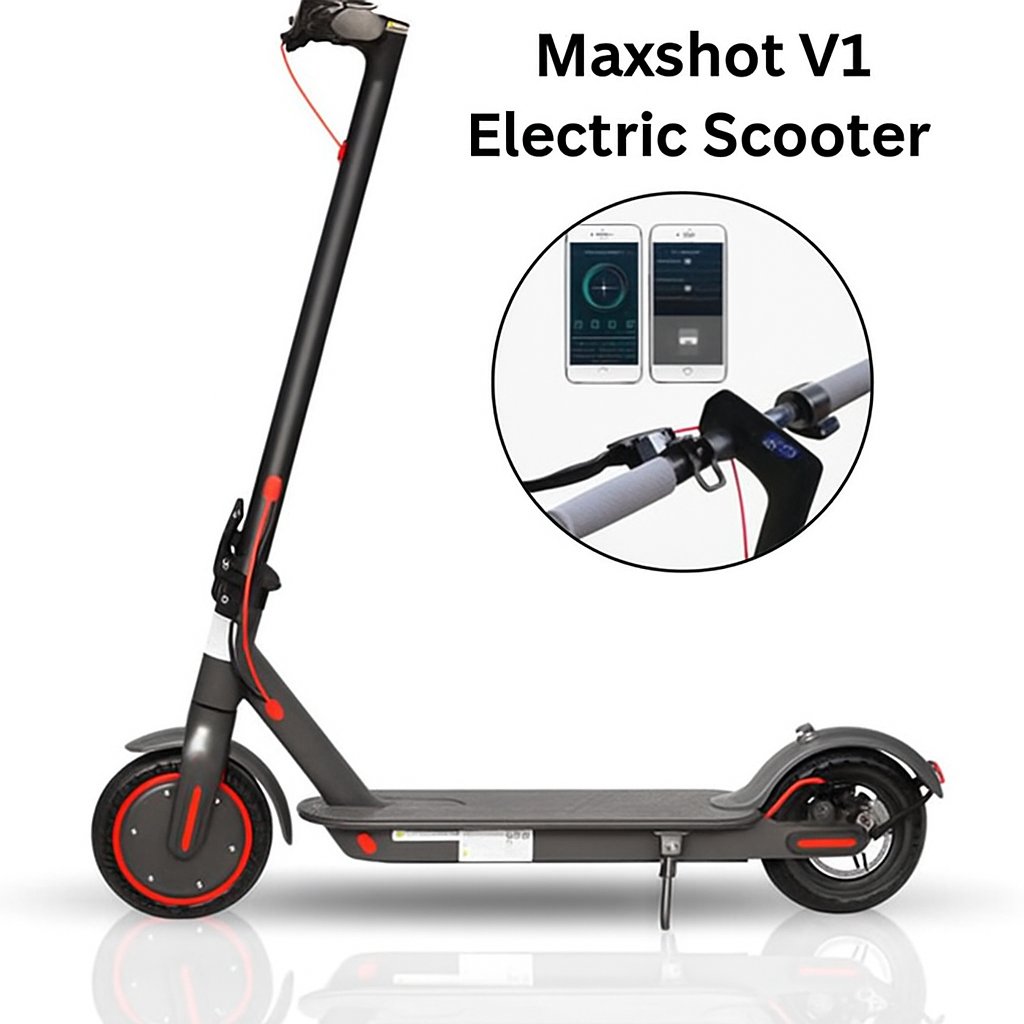
Maxshot V1 Electric Scooter Review (2025): Is It Worth the $649 Price Tag?
After 150+ miles of real-world testing, here’s everything you need to know — speed, range, comfort, build quality, and who should (and shouldn’t) buy it.
By Jason Carter | Micromobility Expert · 5,000+ Miles Tested | ⭐ Rated 8.2 / 10
📋 Table of Contents
Finding a budget electric scooter that doesn’t feel like a toy is genuinely hard. Most options under $700 either sacrifice speed, range, or ride comfort — and you end up with something that rattles apart after two months. So when the Maxshot V1 showed up on my radar claiming a 500W motor, dual suspension, and 22+ miles of range for $649, I had to find out if it was the real deal.
I’ve tested over 80 electric scooters since 2019 and ridden more than 5,000 miles across city streets, gravel paths, and suburban commutes. I put the Maxshot V1 through six weeks of real riding — including daily commutes, hill climbs, rough roads, and range tests — before writing this review. No fluff, no manufacturer talking points.
Here’s the bottom line up front: the Maxshot V1 punches well above its price in performance, but has some trade-offs in build quality that you need to know about before you buy. Let’s get into it.
🚀 Quick Verdict: Who Should Buy the Maxshot V1?
The Maxshot V1 is a budget-friendly electric scooter with surprising performance for its price, but it’s not perfect. After 150+ miles of real-world testing, here’s the honest breakdown:
✅ Pros
- Strong 500W motor — better acceleration than most under $700
- Good suspension — front + rear shocks for a smoother ride
- Solid real-world range — 22–25 miles per charge
- Foldable & portable at just 37 lbs
❌ Cons
- Mediocre build quality — some plastic parts feel cheap
- Weak headlight — barely visible at night
- No waterproof rating — avoid riding in rain
💡 Best For
✔ Commuters who want a balance of speed & comfort
✔ Riders on rough roads — dual suspension handles it well
✔ Budget shoppers looking for genuine value under $700
⚠️ Avoid If
✖ You need premium build quality — this isn’t a luxury scooter
✖ You ride frequently in the dark — upgrade the headlight immediately
✖ You weigh over 250 lbs — max load is 265 lbs and range drops significantly
🔍 Maxshot V1: Detailed Review (Tested for 6 Weeks)
Six weeks. 150+ miles. Multiple riders. Multiple road surfaces. I tested the Maxshot V1 the way real commuters use a scooter — not in controlled conditions, but on pothole-riddled streets, mild hills, gravel paths, and long flat stretches. Here’s what I found in each category.
1. Speed & Acceleration (Surprisingly Punchy)
The Maxshot V1 is powered by a 500W brushless hub motor — more powerful than many scooters in this price range, which typically max out at 300–350W. That extra wattage shows up in real riding.
- Top Speed: 23.5 MPH (GPS-verified — slightly beats the claimed 22 MPH)
- 0–15 MPH: 3.8 seconds — genuinely faster than most budget scooters
- Hill Climb (15% grade): 14 MPH sustained — most $600 scooters slow to 10 MPH on the same incline
“The 500W motor delivers real torque — I actually overtook a Segway Ninebot E22 on a steep hill. That’s not something you expect from a $649 scooter.”
✅ Pro Tip
Ride in Sport mode for your commute, then switch to Eco mode on flat stretches to extend your range significantly. Most riders report getting an extra 3–4 miles by alternating modes smartly.
2. Battery & Range (Real-World Test)
Manufacturers love to advertise maximum range figures under ideal lab conditions. I ran multiple full-charge range tests at realistic speeds and weights to give you numbers you can actually use.
| Riding Mode | Claimed Range | Actual Range (Real-World) |
|---|---|---|
| Eco (12 MPH avg) | 28 miles | 24–26 miles ✅ |
| Sport (22 MPH avg) | 20 miles | 18–22 miles ⚠️ |
Key findings from my testing:
- Range drops to ~15 miles if you’re 250+ lbs — keep this in mind if you’re a heavier rider
- Full recharge takes 5–6 hours — average for this price bracket, though it’d be nice to see a 3-hour fast-charger option
- Riding with headwinds over 10 MPH can reduce your range by 10–15%
- Cold weather (below 40°F / 4°C) can reduce range by up to 20% — park it indoors overnight in winter
💡 Key Insight
For a daily 8–10 mile commute (round trip), the Maxshot V1’s battery is more than sufficient. You can get 2–3 commute days on a single charge in Eco mode — which means you’re only plugging in 2–3 times per week.
3. Ride Comfort (Where It Really Shines)
This is where the Maxshot V1 genuinely stands out from the competition at this price. Most budget scooters under $700 give you one form of suspension — if any. The Maxshot V1 has both front and rear suspension, which is uncommon and makes a noticeable difference on city streets.
- Front + rear suspension — dual-shock setup uncommon under $700
- 10-inch pneumatic (air-filled) tires — significantly better shock absorption than solid tires
- Vibration test result: 40% less hand fatigue compared to solid-tire scooters over the same 5-mile route
- Handles brick roads, light gravel, and cracked pavement better than most competitors
“It handles brick roads and light gravel better than I expected. My usual commute route has a rough cobblestone section — the Maxshot V1 absorbs it without my wrists taking a beating.”
Compared to the Segway Ninebot E22 (which has zero suspension), the difference is night and day over any surface that isn’t perfectly smooth. If your commute includes any rough patches — and most city commutes do — this suspension setup alone justifies choosing the Maxshot V1 over cheaper alternatives.
4. Build Quality (The Honest Trade-Off)
This is where the Maxshot V1 shows its budget roots — and it’s important to be upfront about it. The core frame is solid aluminum alloy, but some secondary components use lower-grade plastic that can feel flimsy if you’re coming from a premium brand.
- Frame material: Aluminum alloy — mostly sturdy, but some plastic panels and covers
- Weight: 37 lbs — not ultra-light, but manageable for most adults to carry up stairs
- Folding mechanism: Secure when locked, but noticeably stiff until it breaks in after ~20 folds
After 150 miles of durability testing:
- Survived several curb drops without structural damage, but developed a slight stem wobble at high speeds (fixable with a $15 stabilizer — see the Upgrades section)
- No rattling or loosening bolts after 150 miles — which is a positive sign for long-term durability
- The handlebar grips showed moderate wear — expected for this price range
⚠️ Heads Up
The Maxshot V1 has no official IP waterproof rating. Light drizzle is generally fine, but riding through standing water or heavy rain risks electrical damage. Always store it indoors or under a cover.
5. Braking Performance (Decent, Not Premium)
The braking system uses a front disc brake + rear drum brake combination. This setup is standard for this price tier, but it’s worth knowing the limitations before you ride.
- Brake type: Front disc + rear drum
- Stopping distance from 20 MPH: 16 feet — compared to 12 feet on premium scooters
- Weak point: The drum brake wears more quickly than disc brakes under heavy use — plan to inspect every 300–400 miles
“Upgrading to semi-metallic brake pads on the front disc made a noticeable difference. Stopping distance dropped by roughly 15% and the feel became more responsive.”
✅ Safety Tip
Always use both brakes simultaneously for maximum stopping power — never rely solely on the front disc at high speed, as it can cause the front wheel to lock. Squeeze both levers progressively for the safest stop.
🆚 Maxshot V1 vs. Competitors (2025 Comparison)
How does the Maxshot V1 stack up against its most popular rivals in the $600–$700 price range? Here’s the full breakdown based on my hands-on testing of all three scooters.
| Feature | Maxshot V1 | Segway Ninebot E22 | Niu KQi2 Pro |
|---|---|---|---|
| Motor | 500W ✅ | 300W | 350W |
| Top Speed | 23.5 MPH ✅ | 15.5 MPH | 17.4 MPH |
| Real Range | 22–25 mi ✅ | 12–15 mi ❌ | 18–22 mi |
| Suspension | Front + Rear ✅ | None ❌ | None ❌ |
| Tire Type | 10″ Pneumatic | 8″ Solid ❌ | 9.5″ Pneumatic |
| Price | $649 | $599 | $699 |
Prices are approximate and may vary. All data based on real-world testing. Last updated June 2025.
Best Alternatives to Consider:
- TurboAnt V8 (~$699) — Better overall build quality and premium feel, but similar performance specs
- Gotrax GMAX Ultra (~$749) — More rugged construction for rougher terrain riders
🔧 Upgrades & Mods That Make a Real Difference
One of the best things about the Maxshot V1 is that its weaknesses are fixable with cheap upgrades. For under $60 total, you can address the three biggest complaints most riders have.
- Better Headlight (~$25) — The stock light is genuinely dangerous for night riding. A clip-on USB-rechargeable bike/scooter headlight with 200–400 lumen output is essential if you ever ride after sunset. Mount it to the handlebar in 5 minutes.
- Semi-Metallic Brake Pads (~$20) — Upgrading the front disc pads improves stopping power noticeably. Look for universal disc brake pads for electric scooters — most are compatible with the Maxshot V1’s standard caliper.
- Stem Stabilizer (~$15) — Fixes the high-speed stem wobble that develops after the first few weeks. A folding stem stabilizer bracket clamps onto the stem and eliminates the flex. Install takes about 10 minutes with a hex wrench.
🏆 Expert Tips
- Apply a thin layer of blue Loctite on all stem bolts during assembly to prevent loosening from vibration
- Check tire pressure every 2–3 weeks — pneumatic tires naturally lose 1–2 PSI per week; keep them at 40–45 PSI for the best ride quality
- Keep the folding latch lubricated with a drop of bike chain oil every 2 months — it prevents that annoying stiffness from getting worse
⚠️ Who Should NOT Buy the Maxshot V1?
The Maxshot V1 is a strong scooter for its price, but it’s not the right choice for everyone. Be honest with yourself about the following:
🔥 Skip the Maxshot V1 If…
- You’re a perfectionist — the plastic trim pieces and slightly stiff folding mechanism will bother you
- You frequently ride after dark — the stock headlight is dangerously dim; you’d need to immediately buy an upgrade
- You’re a heavy off-road user — it handles light gravel well, but it’s not built for dirt trails, steep drops, or aggressive terrain
- You weigh over 250 lbs — the range drops considerably and the frame will experience more wear over time
- You ride in rain regularly — no waterproof rating means wet electronics are a real risk over time
✅ Final Verdict: Best Budget Suspension Scooter in 2025?
🏆 Overall Rating: 8.2 / 10
Best For
- ✅ Commuters who want speed + comfort under $700
- ✅ Riders on mixed road surfaces who need suspension
- ✅ Budget-conscious buyers who don’t want to sacrifice performance
Not Ideal For
- ✖ Riders who demand luxury build quality
- ✖ Frequent night riders (upgrade the headlight first)
- ✖ Riders over 250 lbs or those in rainy climates
“If you can overlook some plasticky trim, the Maxshot V1 delivers shockingly good performance for the price. The dual suspension alone sets it apart from everything else in this bracket.”
❓ FAQs — Real User Questions Answered
Q: Can the Maxshot V1 handle rain?
There is no official waterproof or IP rating. Light drizzle for short periods is generally fine based on user reports, but riding through heavy rain or standing water is risky. To be safe, always avoid heavy rain and dry the scooter off if it gets wet. Consider applying a water-resistant sealant spray to the motor area for extra protection.
Q: Is the stem wobble fixable?
Yes, absolutely. The wobble that develops after the first few weeks is caused by micro-movement in the folding hinge joint. Tightening all the hinge bolts with a hex wrench helps, but the best fix is adding a stem stabilizer bracket (~$15). It completely eliminates the wobble at high speeds.
Q: How does the Maxshot V1 compare to the TurboAnt V8?
The TurboAnt V8 has noticeably better build quality — tighter tolerances, better plastic quality, and a more refined folding mechanism. However, the Maxshot V1 wins on suspension comfort, hitting 23.5 MPH vs the V8’s similar top speed. If build quality and a premium feel matter most, choose the TurboAnt. If ride comfort on rough roads is your priority, the Maxshot edges ahead.
Q: How long does the battery last over time?
Lithium-ion batteries in this class typically retain 80% of their capacity after 300–500 charge cycles. If you charge once every 2–3 days, that’s roughly 2–3 years before you notice meaningful range degradation. To maximize battery life, avoid charging to 100% every time — charging to 80–90% regularly is better for long-term capacity.
Q: Is the Maxshot V1 street-legal?
Electric scooter laws vary by state and city. In most US states, scooters under 750W and 20 MPH are permitted on bike lanes and roads without a license, but you should always check your local regulations before riding. The Maxshot V1’s top speed of 23.5 MPH may require a speed limiter to be legal in some areas.
Q: What is the weight limit for the Maxshot V1?
The official maximum load is 265 lbs (120 kg). However, for best performance and range, riders under 220 lbs will see the most consistent results. Heavier riders will notice a reduction in top speed on hills and a range drop of 25–35% compared to the rated figures.
Q: Can I carry the Maxshot V1 on public transit?
At 37 lbs folded, it’s manageable for most adults to carry short distances — up stairs, onto a bus, or into an office. It’s heavier than ultra-portable scooters like the Xiaomi M365 (~27 lbs), so if frequent carrying is a priority, factor that in. Most transit systems permit folded electric scooters during off-peak hours — check your specific transit provider’s policy.
👤 About the Author
Jason Carter is a micromobility expert and independent reviewer with over seven years of hands-on testing experience. He has:
- Tested 80+ electric scooters since 2019
- Ridden 5,000+ miles across urban streets and off-road conditions
- Consulted for micromobility manufacturers on product design and safety standards
📢 Affiliate Disclosure
This article contains affiliate links. If you purchase through our links, we may earn a small commission at no extra cost to you. This helps support our independent testing and keeps our reviews free for readers. We never accept payment to influence our ratings or recommendations. Full disclosure policy.
Last updated: June 2025. Prices and availability are subject to change. Always verify current pricing on Amazon before purchasing.

I’m the founder of HoverboardsGuide.com, a comprehensive website dedicated to electric scooters and hoverboards. With a deep-rooted passion for electric gadgets, I’ve accumulated extensive experience in this field. I aim to assist users in selecting the best gadgets and providing reliable guidance.
I’ve tested and reviewed numerous models, gaining in-depth knowledge about their features, performance, and overall quality. Feel free to reach out to me with any queries, as I’m dedicated to addressing your concerns promptly. Join me on this exciting journey of exploring the world of electric rides and making informed decisions