A teenager is the easiest rider to buy a hoverboard for and the easiest to get wrong. They are heavy enough that a kids’ board feels sluggish and small, but a 420 lb off-road monster is overkill for a trip to a friend’s house. The seven boards below are the ones from our own reviews and roundups that fit the teenage years best, sorted by where they ride, how big the rider is and what you want to spend.

How we chose these boards
We did not ride these boards side by side for this article. The picks come from the reviews and roundups already on this site, which quote the manufacturers’ advertised figures for speed, range and rider limit. We then asked three questions a parent of a 13-to-17-year-old would ask: does the rider limit leave room to grow, do the tyres match the ground they will actually ride on, and does the price make sense for something that may be outgrown in two years. Every board here carries a UL 2272 listing on its product page, which is the minimum we would accept. Our full buying guide explains every spec in detail.
Gyroor Warrior G2: best overall for teenagers
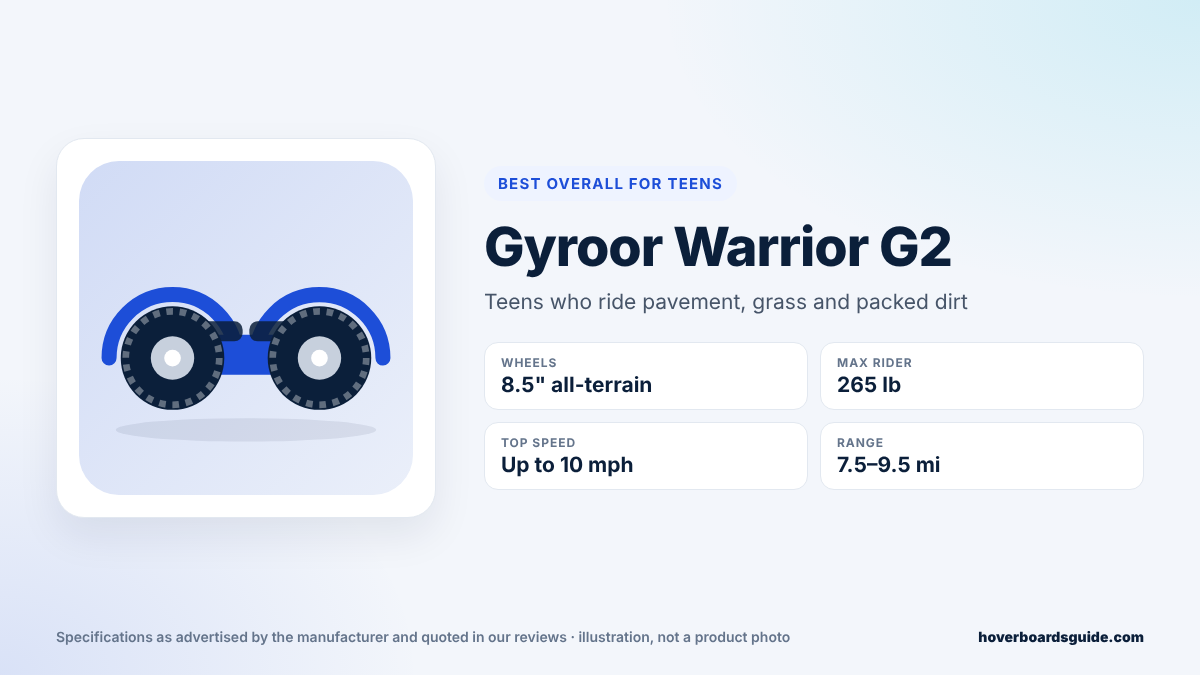
The Warrior is the board that comes up most often across our roundups, and for a teenager it hits the middle of every range that matters. The 8.5-inch solid all-terrain tyres handle pavement, short grass and packed dirt without the weight or tyre maintenance of a 10-inch board. The advertised 265 lb rider limit covers almost every teen with room to spare, and the advertised 10 mph top speed feels quick without being frightening. Most listings include a Bluetooth speaker and an app, which is where you will find the speed limit for a new rider.
Two things to check on the listing before you buy: Gyroor has sold several Warrior versions with different speed and rider-limit figures, so confirm the numbers on the exact page you order from, and expect it to be heavier to carry than a 6.5-inch board.
Advantages
- 8.5-inch tyres cope with grass, gravel and cracked pavement
- 265 lb advertised rider limit leaves room to grow
- Bluetooth speaker and app with speed settings on most listings
Limitations
- Heavier to carry up stairs than a 6.5-inch board
- Different Warrior versions quote different figures; read the exact listing
Check price on Amazon Read our full roundup
Hover-1 Titan: best all-terrain value
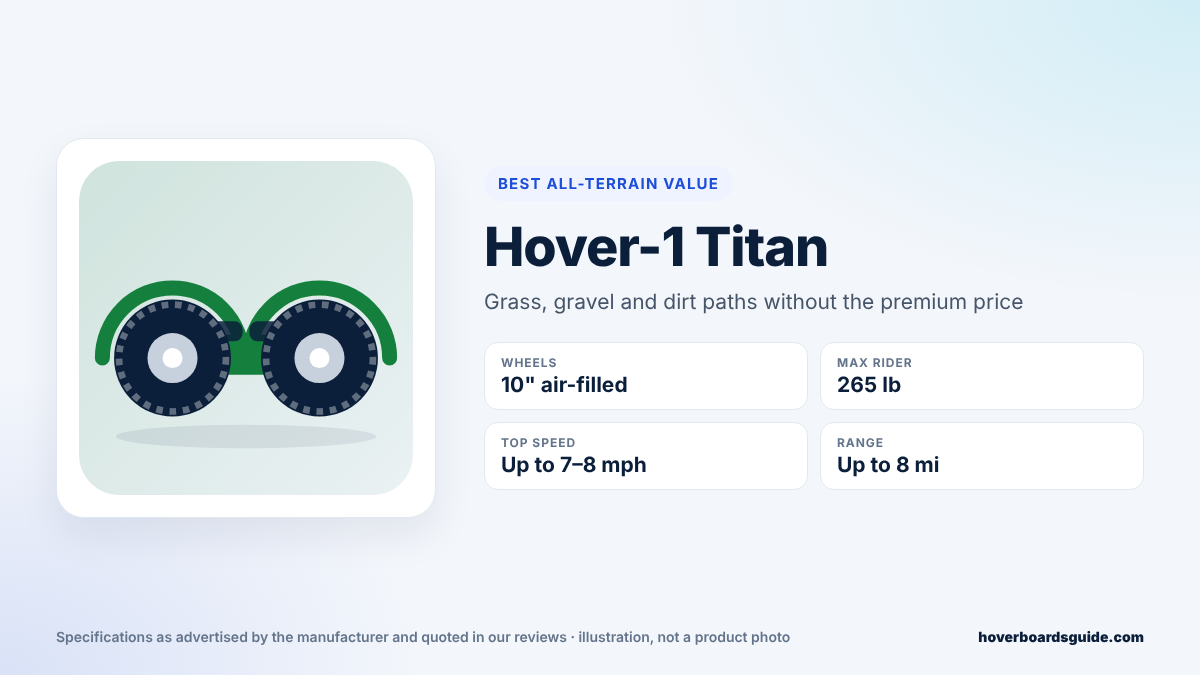
If the rider lives on a gravel drive, a farm track or a street with more grass verge than sidewalk, air-filled 10-inch tyres change the experience completely. The Titan is our review’s budget way into that class: big pneumatic wheels and a 265 lb rating at a price closer to 6.5-inch boards. Three ride modes let a nervous first-timer start slow and a confident teen unlock the full advertised 7 to 8 mph.
The trade-offs are a lower top speed than the Warrior, a short 90-day warranty quoted in our review, and tyres that need a pump every few weeks like a bicycle’s.
Advantages
- 10-inch air-filled tyres soak up bumps, grass and gravel
- 265 lb advertised limit at a modest price
- Three ride modes for beginners and experienced riders
Limitations
- Slower than the Warrior or T6
- Short 90-day warranty quoted in our review
- Pneumatic tyres need occasional air
Check price on Amazon Read our Titan review
Swagtron T6 Outlaw: best for tall or heavier teens
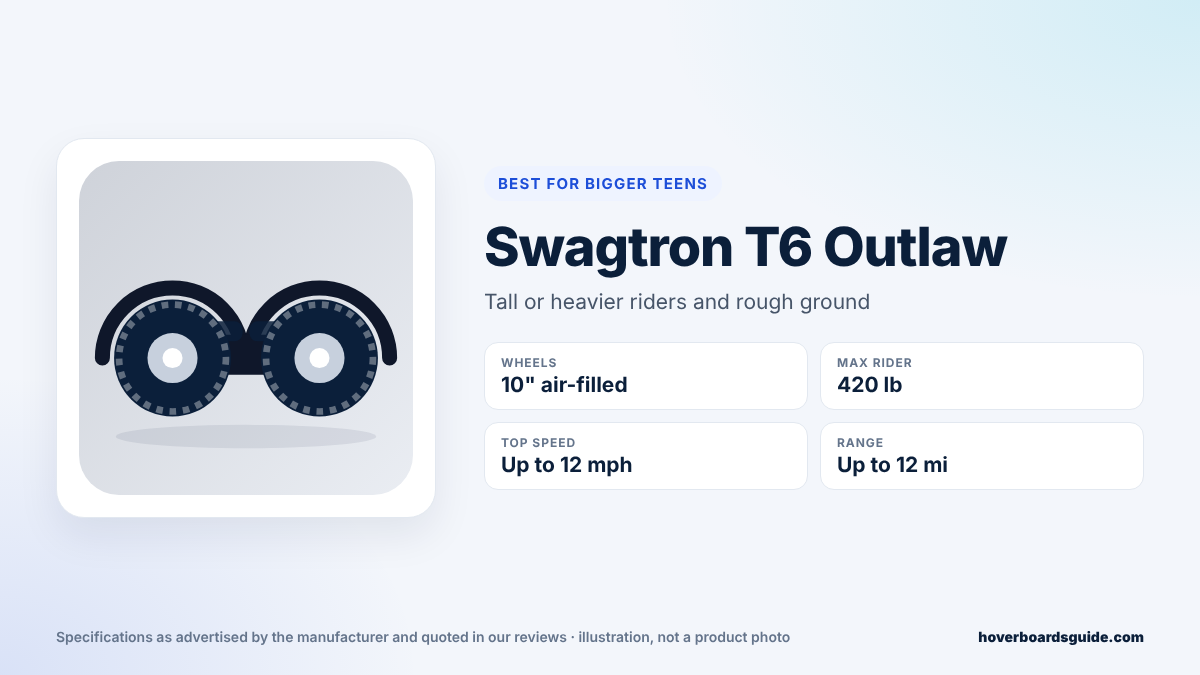
A 16-year-old who is already six feet tall needs a board rated for an adult, and the T6 Outlaw has the highest rider limit of anything we cover at an advertised 420 lb. It is also the fastest board on this list, with 10-inch air-filled tyres built for trails and rough driveways. Our adult roundup sends heavier and taller riders here first.
It is heavy, bulky to carry and costs more than entry-level boards, so it only makes sense when the rider’s size or the terrain demands it.
Advantages
- Highest advertised weight rating of any board we cover
- Air-filled 10-inch tyres for trails and rough ground
- Faster than typical 6.5-inch boards
Limitations
- Heavy and bulky to carry
- Costs more than entry-level boards
- Pneumatic tyres need occasional air
Check price on Amazon Read our adult roundup
Hover-1 Helix: best budget pick
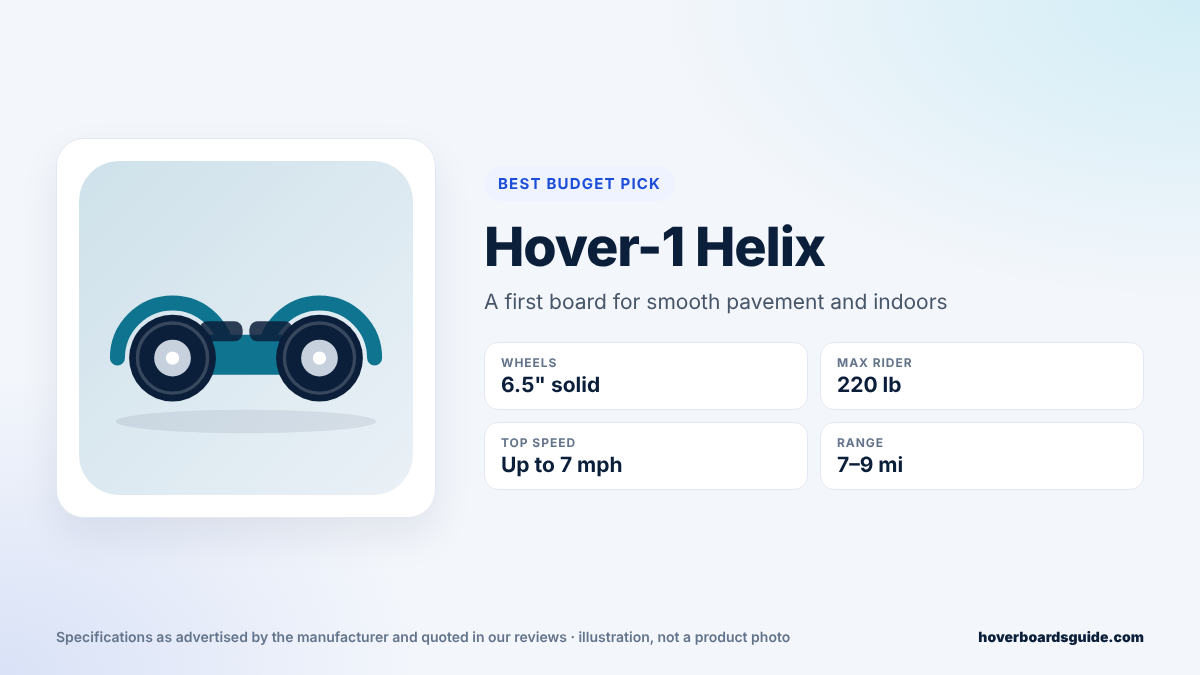
For a teenager who will mostly ride a smooth driveway, a cul-de-sac or a school gym, a 6.5-inch board is fine and the Helix is the one our under-$200 roundup picks first. It is UL 2272 listed, comes from a brand with US support, and the 220 lb advertised limit is higher than most boards of its size. LED wheels and a built-in speaker are the features teens actually ask for.
Small solid wheels are the limit here: grass, gravel and deep sidewalk cracks will stop it, and the advertised 7 to 9 mile range is short.
Advantages
- Low price from a brand with US support
- 220 lb advertised limit is generous for a 6.5-inch board
- LED wheels and built-in speaker
Limitations
- Small solid wheels struggle on grass and cracks
- Short range on a single charge
Check price on Amazon Read our Helix review
Gyroor G13: best for younger teens
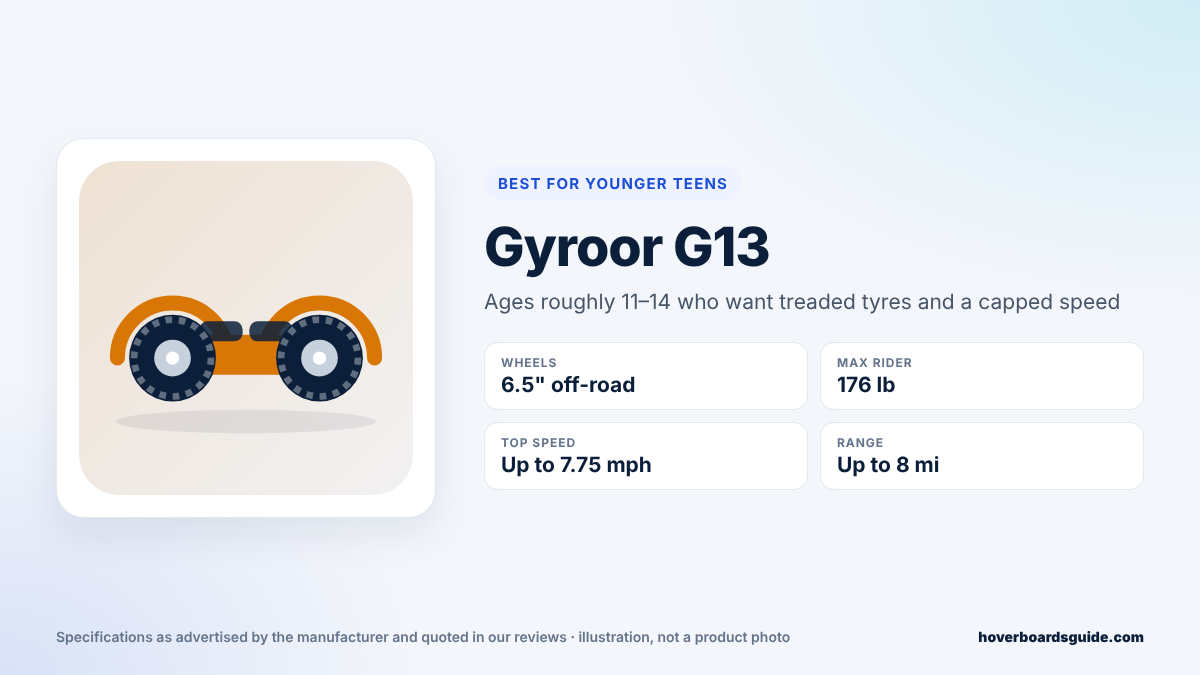
For an 11-to-14-year-old, the G13 bridges the gap between a kids’ board and a full-size one. Its 6.5-inch tyres have real tread, so short grass and driveways are fine, the top speed is capped at an advertised 7.75 mph, and a self-balancing start-up mode makes the first ride less scary. Our kids’ guide rates it the best overall value for ages 6 to 12, and it stays useful into the early teens.
The 176 lb advertised limit is the catch: a teen who is growing fast may outgrow it within a couple of years, and range figures vary between listings.
Advantages
- Speed capped at a level that suits beginners
- Treaded tyres cope with short grass and driveways
- Self-balancing start-up mode
Limitations
- 176 lb limit will be outgrown by bigger teens
- Range figures vary between listings
Check price on Amazon Read our kids’ guide
Gotrax Edge: best for nervous beginners
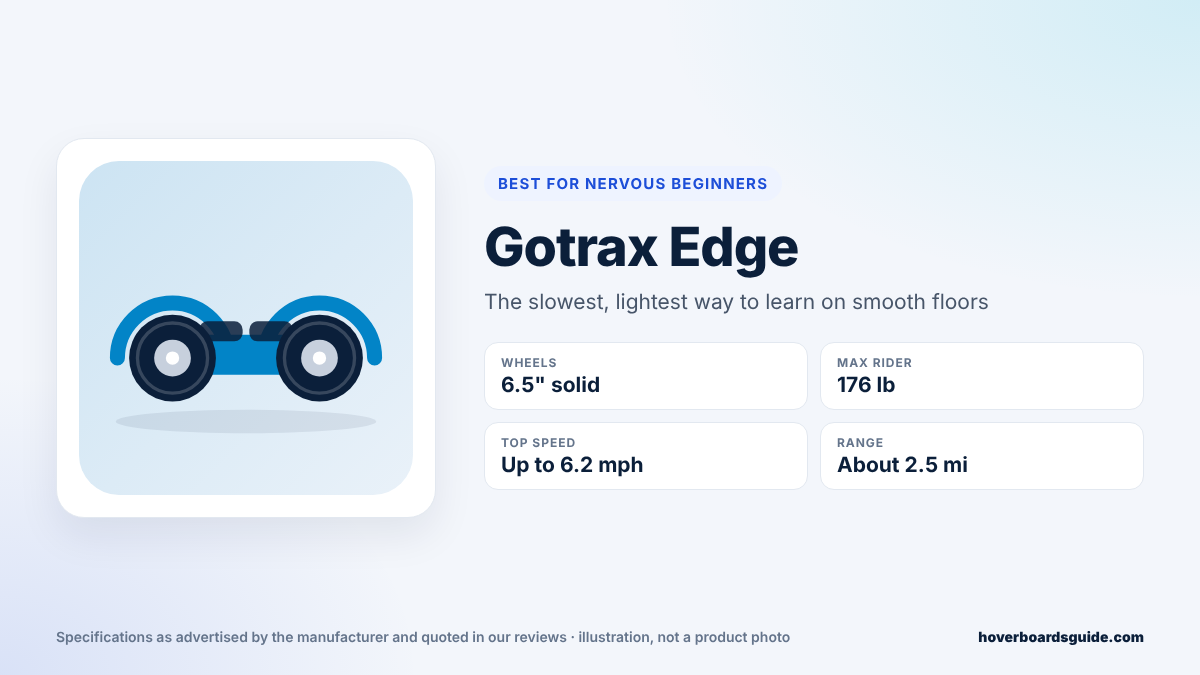
Some teenagers want to learn without an audience and without a board that runs away from them. The Edge is the slowest, lightest board here, with an advertised 6.2 mph top speed, and it is inexpensive enough to be a “see if they like it” purchase. It is the first-board pick in our main roundup.
Be honest about its limits before you buy: the advertised range is about 2.5 miles, there is no Bluetooth, it is pavement-only, and the 176 lb rider limit rules out bigger teens.
Advantages
- Low top speed suits nervous beginners
- Light and easy to store
- Inexpensive entry point
Limitations
- Very short range
- Pavement only; no grass or gravel
- 176 lb limit
Check price on Amazon Read our full roundup
Segway Ninebot S: easiest to learn
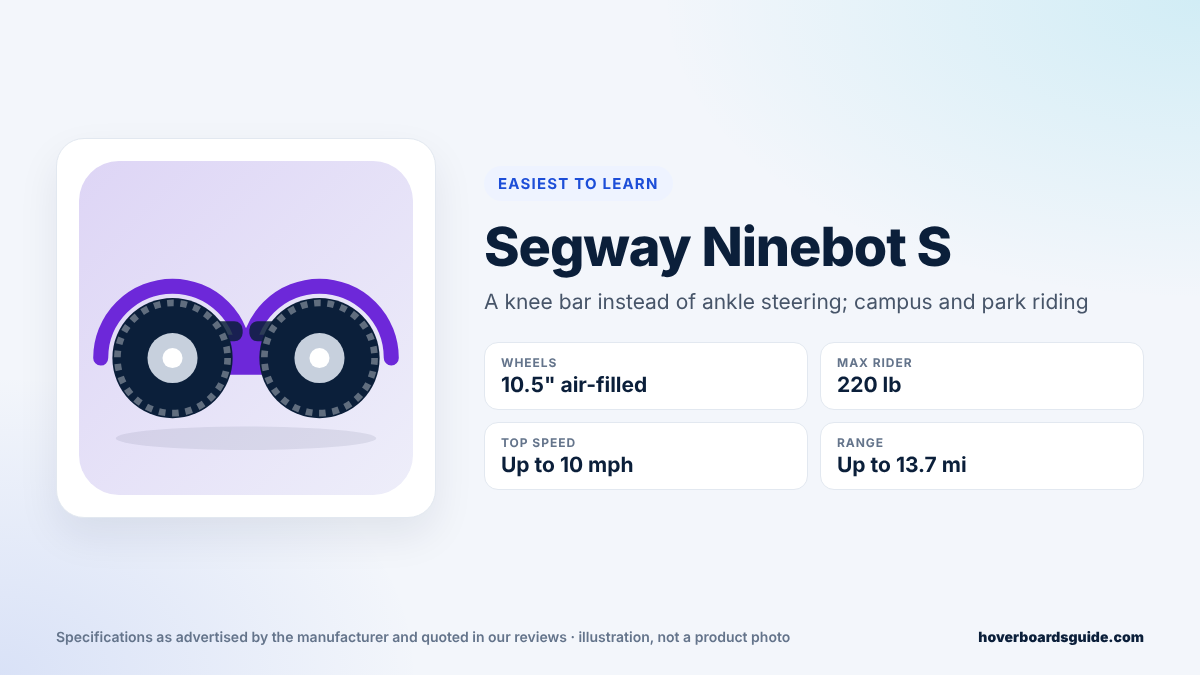
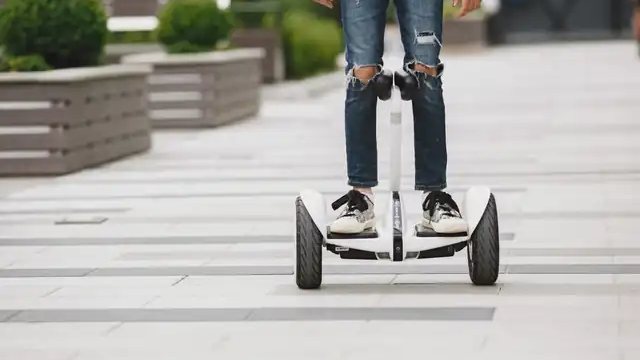
Strictly speaking the Ninebot S is a self-balancing scooter rather than a hoverboard: you steer with a knee bar instead of your ankles, which most people pick up in minutes rather than an afternoon. It has 10.5-inch air-filled tyres, the longest advertised range on this list at 13.7 miles, and an app with speed limits and an anti-theft lock that parents will appreciate. For a teen commuting across a campus or a park, it is the premium choice.
It costs considerably more than a classic hoverboard and the 220 lb advertised limit is lower than the Warrior’s.
Advantages
- Knee bar steering is quick to learn
- Longest advertised range of our picks
- App with speed limits and anti-theft lock
Limitations
- Costs considerably more than classic hoverboards
- 220 lb rider limit
Check price on Amazon Read our full roundup
The seven picks side by side
Speed and range are manufacturer figures as quoted in our reviews. Expect less in real riding, especially for heavier riders, on hills and in cold weather. “Highest” marks the top advertised figure among these seven.
What to check before you buy
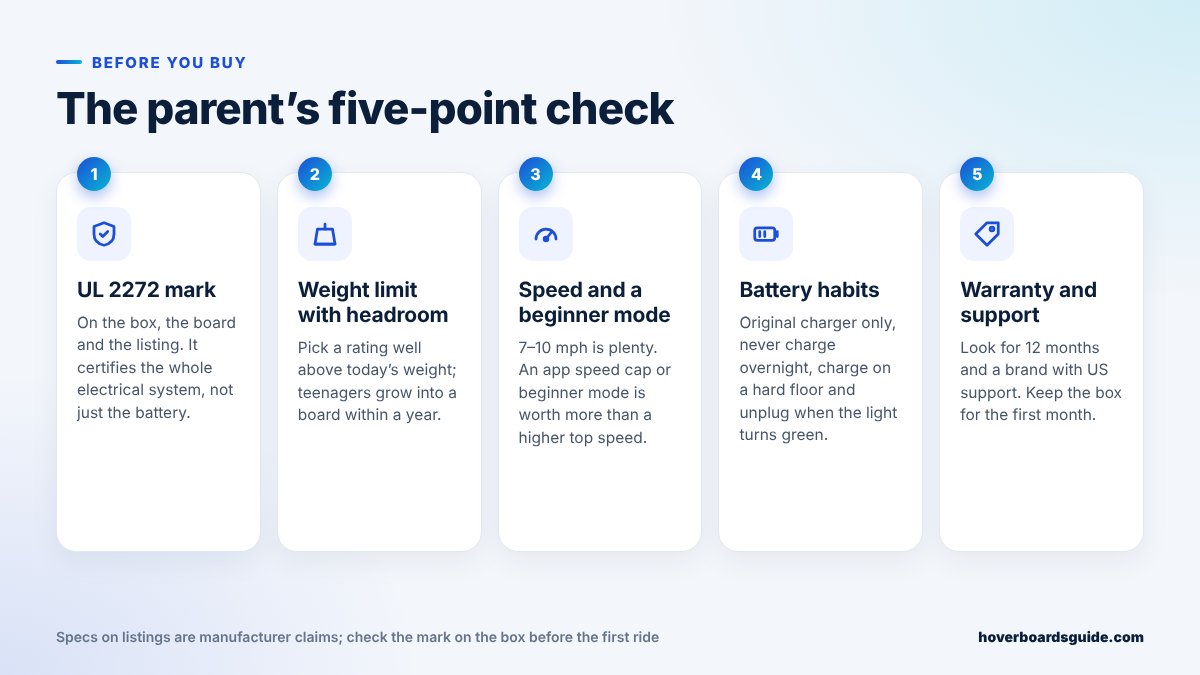
UL 2272 on the box, not just the listing
UL 2272 is the safety standard that covers a hoverboard’s whole electrical system: battery, charger, wiring and the circuitry that stops the pack overcharging. Every board above states the listing on its product page, but counterfeit stickers exist, so look for the holographic UL mark on the packaging and the board itself when it arrives. Our piece on hoverboard fires explains why this is the one spec that is not negotiable.
Weight limit with headroom
Teenagers grow into a board quickly. Pick an advertised rider limit well above today’s weight, because a board ridden at its limit accelerates slowly, climbs badly and drains its battery faster. A 176 lb board suits a 100 lb rider now and may not in two years; a 220 to 265 lb board covers the whole of secondary school for most teens. Our weight-limit guide goes deeper.
Speed and a beginner mode
Seven to ten miles per hour is plenty. What matters more is whether the board has a beginner mode or an app speed cap, so a new rider can start at a jog and you can decide when to raise it. The Warrior, Titan, G13 and Ninebot S all advertise one.
Battery habits
Use only the charger in the box, charge on a hard floor rather than a bed or carpet, never leave a board charging overnight, and unplug it when the light turns green. Here is what to expect from a hoverboard battery and how to make it last.
Warranty and support
A 12-month warranty and a brand with a US support line are worth paying a little more for. Keep the box for the first month in case a return is needed.
Safety gear for a teenage rider
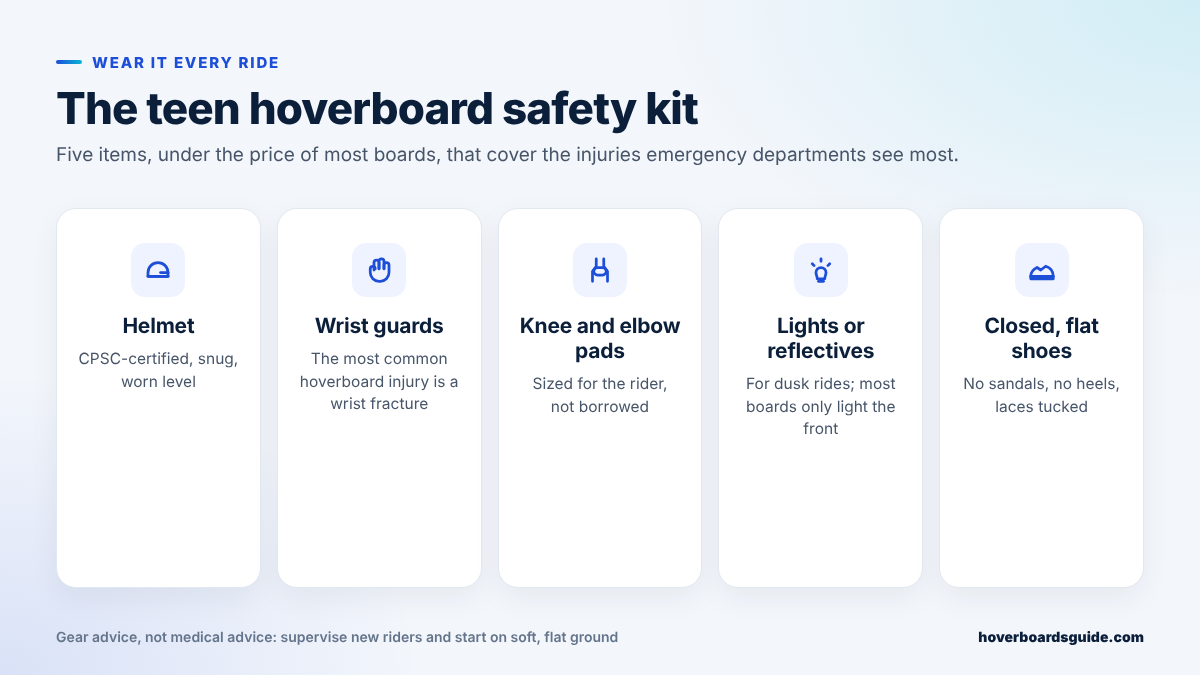
Wrist fractures are the most common hoverboard injury seen in emergency departments, followed by head injuries, so wrist guards and a helmet are the two items we would not skip. A CPSC-certified skate or multi-sport helmet sized for the rider costs less than a tank of fuel; our helmet guide lists the ones we would choose. Knee and elbow pads matter most in the first few weeks, lights or reflective strips if they ride at dusk, and flat closed shoes every time. Our safe-riding guide covers the first ride step by step.
Shop youth helmets on Amazon Shop pad sets on Amazon
Frequently asked questions
What age is a hoverboard suitable for?
Most manufacturers state 8 years and up, and by 13 most riders can handle a full-size board. The deciding factors are weight against the board’s rated limit and whether the rider will wear protective gear. Our age guide breaks it down year by year.
Is a 6.5-inch or 8.5-inch hoverboard better for a teenager?
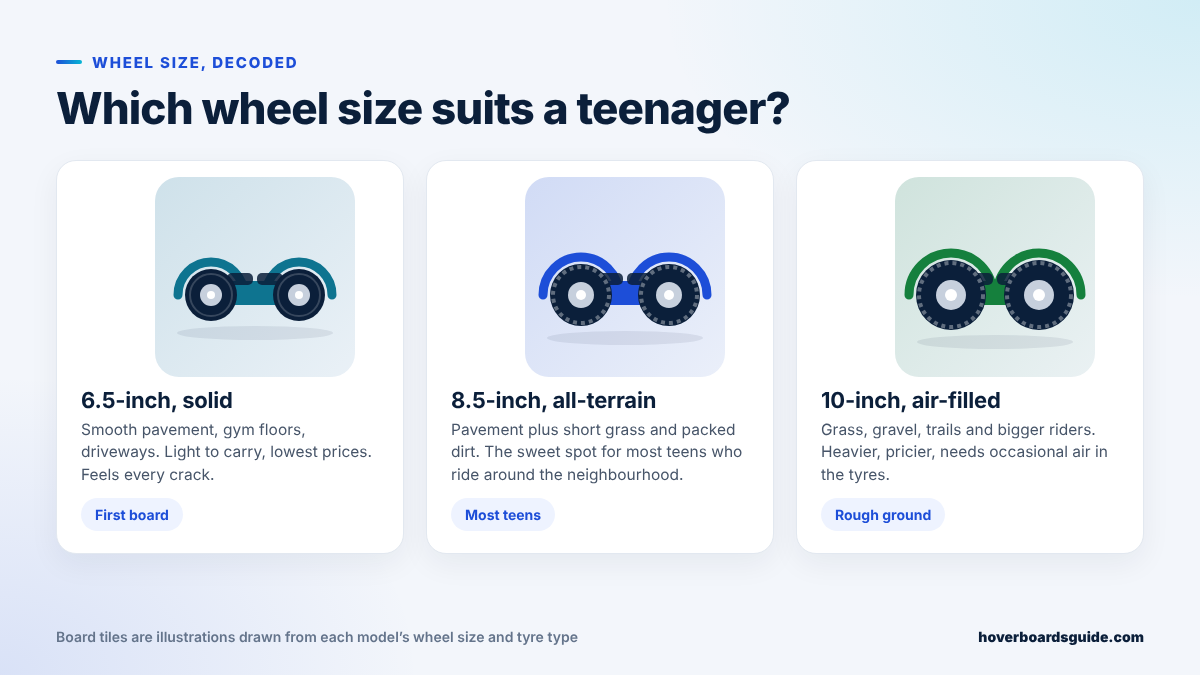
8.5-inch for most teens: the bigger tyres cope with grass, cracks and gravel, and the boards usually carry higher rider limits. 6.5-inch boards are lighter and cheaper and fine for smooth pavement only. Here is our full comparison.
How fast should a teenager’s hoverboard go?
Advertised top speeds of 7 to 10 mph are typical and plenty for a teenager. A board with a beginner mode or app speed limit matters more than a higher top speed.
Can a 150 lb teenager ride a board rated for 176 lb?
Yes, but with little headroom. Boards ridden near their limit feel slow and drain faster, and a teenager may pass 176 lb within a year or two. A 220 to 265 lb rating is the safer buy.
Do teenagers need a helmet on a hoverboard?
Yes. Head and wrist injuries are the most common hoverboard injuries, and several states require helmets for riders under 18 on electric rideables. A CPSC-certified helmet and wrist guards cover the two biggest risks.
Are the prices in this article current?
We do not print prices because they change daily. Every “Check price” link opens the current Amazon listing; it is an affiliate link, and we earn a small commission on qualifying purchases at no extra cost to you.
Specifications in this article are the manufacturers’ advertised figures as quoted in our reviews; we have not measured them ourselves. We recommend only boards whose listings state UL 2272 certification, and we have no commercial relationship with any brand named above beyond the Amazon Associates programme.