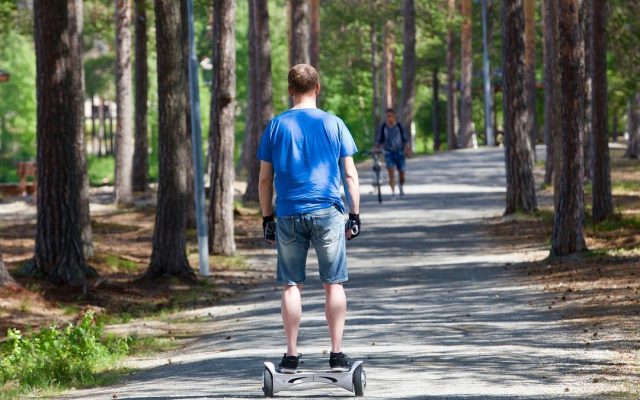
Short answer: most hoverboards can’t handle grass or gravel, but the right kind absolutely can. Here’s how to tell the difference, and how to ride off-road without wrecking your board.
Key Takeaways
- Standard 6.5″ hoverboards are made for smooth, hard surfaces — not grass or gravel.
- All-terrain hoverboards with 8.5″–10″ pneumatic tires and 400W+ motors per wheel handle grass and small gravel well.
- IP54 rating or higher is what lets a board survive damp grass and dusty trails.
- Wet grass and large loose gravel are still risky, even for off-road models.
- Slow speeds (under 6 mph), bent knees, and softer turns dramatically lower your crash risk off-road.
- Riding off-road on a standard board usually voids the warranty and can damage the motor or shell within minutes.
If you’ve ever stood on your hoverboard, looked at the lawn, and thought “could I just… roll across that?” — you’re not alone. It’s one of the most common questions new riders ask, and the honest answer surprises a lot of people. Yes, hoverboards can ride on grass and gravel, but only certain types, and only under certain conditions. Roll a basic 6.5-inch board into your backyard and you’ll either bog down in seconds or feel the motors grinding like they’re about to give up.
In this guide, we’ll walk through exactly when off-road riding works, when it doesn’t, and what really separates a “lawn-friendly” hoverboard from one that will burn out the first time you try. You’ll learn how tire size, motor power, IP ratings, and rider technique all play a part. We’ll cover real-world examples from riders who’ve tried it (sometimes successfully, sometimes very much not), bust a few common myths, and finish with a clear checklist so you can decide before you take that first off-road step. By the end, you’ll know whether your hoverboard belongs on grass or gravel — or strictly on the sidewalk.
Gotrax E4 — 8.5″ All-Terrain for Grass & Gravel
Designed for exactly this question. 8.5″ pneumatic tires handle grass, gravel and uneven ground.
80SIX Triple-Certified Multisport Helmet
Off-road riding is higher risk. Always wear a triple-certified helmet.
187 Killer Pads Wrist Guards
Off-road falls are harder. These pro-grade wrist guards take the impact for you.
Can hoverboards ride on grass or gravel? Standard hoverboards cannot — they’ll struggle, overheat, or break. All-terrain hoverboards with 8.5″+ pneumatic tires, dual 400W+ motors, and an IP54 rating handle short grass and pea gravel reliably. Wet grass, deep mud, and large rocks remain off-limits even for off-road models.
Table of Contents
- The Short Answer (Yes, But With a Big Asterisk)
- Why Standard Hoverboards Struggle Off-Road
- All-Terrain Hoverboards: What Makes Them Different
- Grass vs Gravel: Which Is Tougher On Your Board?
- How To Ride Safely On Grass or Gravel
- Standard vs All-Terrain: A Side-By-Side Comparison
- Common Mistakes (And How To Fix Them)
- Pro Tips From Off-Road Riders
- Real Rider Stories From the Field
- Myths vs Facts
- Related Concepts You Should Know
- Frequently Asked Questions
- Final Off-Road Checklist
1. The Short Answer (Yes, But With a Big Asterisk)
Hoverboards can ride on grass and gravel — but only the right kind, and only on the right kind of grass and gravel. That’s the whole story in one sentence. The longer story is that there are basically two worlds inside the hoverboard category, and they’re built for completely different surfaces.
The first world is the classic 6.5-inch hoverboard you’ve seen in malls, schools, and YouTube fail compilations. It has small solid rubber wheels, a 250–300W motor on each side, and a plastic body. It’s made to glide on flat surfaces like sidewalks, school hallways, smooth driveways, and shopping mall floors. Push it onto your lawn and it doesn’t really know what to do.
The second world is the all-terrain hoverboard. Think bigger pneumatic (air-filled) tires, beefier motors, sealed casings, and proper suspension. These boards are sometimes called off-road hoverboards or all-terrain hoverboards, and they’re designed from day one to grip grass, dirt, and gravel. Same self-balancing technology, completely different chassis.
“The mistake isn’t ‘taking a hoverboard off-road.’ The mistake is taking the wrong hoverboard off-road. Match the board to the terrain and the experience is genuinely fun.”
So before we go any further: pull out your hoverboard’s spec sheet. Look at wheel size, motor wattage, and IP rating. Those three numbers will tell you 90% of what you need to know about whether it belongs on grass or only on the sidewalk.
2. Why Standard Hoverboards Struggle Off-Road
If you’ve ever pushed a shopping cart over a lawn, you already understand the basic problem. Small, hard wheels don’t roll well on soft, uneven ground. They sink, they catch, and the motor (or in the cart’s case, your arms) has to work way harder to push them forward. A 6.5-inch hoverboard runs into the exact same physics — except now there’s also a battery, a motherboard, and a self-balancing gyro that all really don’t like being jostled.
Here’s what actually goes wrong when you take a standard hoverboard onto grass or gravel:
- Wheels lose grip. Solid rubber tires on a 6.5″ board have very little surface area. On grass, they slip; on gravel, they bounce off pebbles instead of rolling over them.
- Motors overheat. A 250W hub motor designed for flat concrete can spike to 100% load just trying to push through 1-inch grass. Sustained high load = thermal cutoff (or worse, a burned coil).
- The shell takes hits. Most standard hoverboards have plastic bodies that sit only 1–2 inches off the ground. A single sharp rock can crack the underside.
- Moisture sneaks in. Even dry-looking grass holds dew. Water in the motor housing or battery compartment is the #1 killer of cheap hoverboards.
- Vibration loosens everything. Gravel sends constant micro-shocks through the frame. Over time, screws back out, ribbon cables wiggle loose, and the gyroscope starts to drift.
There’s also a less obvious issue: UL 2272 certification, the safety standard that every legit hoverboard sold in the US should meet, only tests electrical fire safety. It says nothing about water, dirt, or impact resistance. So a UL 2272 board can still die instantly when grass moisture touches the wrong wire.
3. All-Terrain Hoverboards: What Makes Them Different
An all-terrain hoverboard isn’t just a regular hoverboard with bigger tires slapped on. It’s a different machine, engineered around the assumption that the ground will fight back. View options on Amazon if you want to see what the current off-road models look like, but first, here’s what actually changes from a standard board:
The four upgrades that matter:
- Pneumatic tires (8.5″ or 10″). Air-filled tires absorb shock, deform around obstacles, and dramatically increase grip on grass and gravel. This is the single biggest upgrade.
- Dual 400W–700W motors. More torque means the board can push through resistance instead of bogging down. Most off-road climbs require this.
- Sealed, reinforced casing (IP54+). An IP54 rating means dust-protected and splash-resistant. That’s what lets you ride through dewy grass without killing the electronics.
- Higher ground clearance. Off-road boards typically sit 2.5–3.5 inches off the ground vs. 1–1.5 for standard. Big difference when there’s a tree root in your path.
Some popular all-terrain models (mentioned for context, not as a buying recommendation): Swagtron T6, Halo Rover X, EpikGo Sport, Gyroor Warrior 8.5″, and Tomoloo H1. These typically weigh 25–35 lbs (vs. ~22 lbs for standard) and cost roughly 2–3× more than a basic hoverboard. They’re heavier, bulkier, and not as fun on perfectly smooth concrete — but on grass and gravel, they’re a different animal entirely.
4. Grass vs Gravel: Which Is Tougher On Your Board?
Grass and gravel sound similar — both are “off-road” — but they stress your hoverboard in totally different ways. Knowing which one is causing problems helps you ride smarter and protect your board longer.
Grass is mostly a resistance problem. Each blade pushes back against the wheel. The taller and thicker the grass, the more your motors have to fight. Add moisture and you also get a slip problem (less grip + electrical risk). Long grass can even wrap around the axle on small-wheel boards.
Gravel is mostly an impact and stability problem. Each pebble is a tiny obstacle. Small pea gravel (under 1/4 inch) is fine for all-terrain boards. Larger crushed stone or river rock can dent wheels, knock the board off balance, and shoot up into the underside. Gravel also kicks up dust, which is why IP54 matters.
The pattern is clear: grass is generally more forgiving than gravel for all-terrain models, while gravel is generally much harsher on standard models. If you have a basic 6.5-inch board, neither is really safe — but if you absolutely had to test it, dry mowed grass on a flat lawn for 10 seconds is the least-bad option.
5. How To Ride Safely On Grass or Gravel
If you’ve got an all-terrain hoverboard, riding off-road is genuinely fun — but only if you change your technique. Sidewalk riding habits will get you in trouble on grass and gravel. Here’s the simple, step-by-step approach we teach new off-road riders:
Step-by-step: your first off-road ride
- Check the surface first. Walk it. Look for sprinkler heads, hidden roots, large stones, or animal holes. Anything taller than your ground clearance is a hazard.
- Drop your speed setting. Most all-terrain boards have a beginner mode capped around 6 mph. Use it. You’ll have so much more reaction time.
- Bend your knees more than usual. Off-road needs an athletic stance — knees soft, weight slightly forward, arms loose. Your legs are now the suspension.
- Make turns wider and slower. Sharp turns that work on concrete can throw you off on grass. Lean gently and let the wider tires carve the turn.
- Cross obstacles head-on. If you have to roll over a small root or curb, hit it square (90°), not at an angle.
- Let off the throttle on slopes. Going downhill on grass, your weight shifts forward — the board may speed up unexpectedly. Stand tall and lean back slightly.
- Stop and check after each ride. Look for grass wrapped around axles, dust in the casing seams, or wobbly tires. Fix issues before the next ride.
One more big one: battery management. Off-road riding burns through battery 30–50% faster than smooth surfaces. A board that gets you 8 miles on pavement might give you 4 on grass. Always start your off-road session with a full charge, and turn back when you hit 50%.
6. Standard vs All-Terrain: A Side-By-Side Comparison
Here’s a quick comparison of the specs that actually matter for off-road riding. If you’re trying to figure out whether your current board can handle grass and gravel, just match it against this table:
The big thing to notice: it’s not just one upgrade. All-terrain boards combine bigger tires with stronger motors with better sealing. Each piece is doing a job — and missing any one of them creates a weak spot off-road.
7. Common Mistakes (And How To Fix Them)
Most off-road hoverboard problems come from a small list of repeating mistakes. Here are the ones we see again and again — plus how to actually fix them:
❌ Mistake #1: Riding a 6.5″ board on grass “just for fun.”
Fix: Test on a hard, flat surface that mimics grass resistance — like a rubber gym mat — first. If your board strains there, it has no business on a real lawn.
❌ Mistake #2: Going full speed on gravel.
Fix: Drop into beginner/learner mode. Most off-road tip-overs happen above 7 mph when a tire suddenly hits a larger pebble at an angle. Slow speeds give the gyro time to compensate.
❌ Mistake #3: Riding right after rain.
Fix: Even with IP54, give the lawn 4–6 hours to dry. Wet grass holds way more water than it looks like, and that’s what gets into the seams.
❌ Mistake #4: Turning sharply on grass.
Fix: Make every turn at least 50% wider than you would on concrete. Grass doesn’t grip predictably — sharp leans cause the inside wheel to slip first.
❌ Mistake #5: Forgetting to clean the board after riding.
Fix: After every off-road session, wipe the wheels, axles, and casing with a slightly damp microfiber cloth. Pull any grass strands out of the wheel hubs. 2 minutes of cleaning saves months of life.
❌ Mistake #6: Ignoring tire pressure on pneumatic models.
Fix: Check pressure weekly. Underinflated tires bog down on grass and pinch-flat on gravel. Most all-terrain boards run best at 30–35 PSI — check your manual.
8. Pro Tips From Off-Road Riders
A few habits that experienced off-road hoverboard riders swear by — small things that make a big difference once you’ve put a few hours of grass and gravel time on your board:
- Mow the lawn the day before. Fresh-cut grass is the easiest to ride on. Once it grows past 2 inches, every ride gets noticeably harder on the motors.
- Pre-ride check: spin both wheels by hand. They should turn freely with no grinding. Any drag means dirt or grass is in the bearing — clean it before riding.
- Keep weight slightly toward the heels off-road. Helps the board climb resistance instead of nose-diving into soft spots.
- Use a helmet camera on first rides. Watching your own footage back is the fastest way to spot bad habits, especially weight distribution.
- Carry a battery indicator app on your phone. Many all-terrain boards have Bluetooth apps that show real-time motor temperature. Watch for spikes — they predict trouble.
- Treat your first 10 hours off-road as practice. The handling is genuinely different from sidewalk riding. Don’t ride with friends or carry a camera in your hands until it feels natural.
“The riders who break their off-road boards almost always do it in the first month — usually by trying something they saw on TikTok. The riders who keep theirs for years just go slow, clean often, and never ride wet.”
9. Real Rider Stories From the Field
Sometimes the best lessons come from other people’s experiences. Here are three honest off-road stories we’ve collected from the hoverboard community over the past year — names changed, situations real:
🌱 The “yard test gone wrong”
Jake bought a $180 entry-level 6.5″ hoverboard for his daughter and decided to “just see” if it could cross the lawn. Twenty feet in, the right motor cut out and the left motor started screeching. Diagnosis: thermal cutoff plus moisture in the hub from morning dew. The board powered on but never balanced correctly again. Lesson: even a “quick test” can be terminal for entry-level boards.
⛰️ The all-terrain success
Priya bought a Halo Rover X specifically for her gravel driveway and grass front yard. Two years and roughly 200 hours of off-road riding later, the board is still going strong. Her secret? Pressure-checks the tires every Sunday, never rides in the rain, and rinses the wheels (not the body) after dusty rides. Lesson: the right board plus basic care equals years of fun.
🛞 The “I thought IP54 meant waterproof” mistake
Diego rode his all-terrain hoverboard through a small puddle on a gravel trail. Board worked fine for a week, then the battery wouldn’t hold a charge. Replacement battery cost $90 and the warranty didn’t cover it. Lesson: IP54 means splash, not submersion. Avoid puddles, period.
10. Myths vs Facts
A lot of bad off-road hoverboard advice floats around online. Here are the myths that come up most often, with the actual reality:
- ❌ Myth: “All hoverboards labeled UL 2272 are safe for any surface.”
✅ Fact: UL 2272 only certifies electrical and fire safety. It says nothing about water, dust, or impact resistance. - ❌ Myth: “Bigger wheels alone make a hoverboard off-road capable.”
✅ Fact: Wheel size matters, but without stronger motors and proper sealing, bigger wheels just hide the problem until something breaks. - ❌ Myth: “Off-road hoverboards can ride through anything.”
✅ Fact: Even premium all-terrain boards struggle with deep mud, loose sand, snow, and large rocks. They’re improved, not invincible. - ❌ Myth: “You can upgrade a regular hoverboard with bigger wheels.”
✅ Fact: Wheel size is locked to motor specs and frame design. Aftermarket swaps cause balancing failures and void warranties + UL certification. - ❌ Myth: “If the manual doesn’t say ‘no grass,’ it’s fine.”
✅ Fact: Most manuals explicitly say “smooth, hard, dry surfaces only.” Read the fine print before riding off-road on any board.
11. Related Concepts You Should Know
A few side topics that come up constantly when people ask about off-road hoverboard use. Worth knowing:
- IP ratings — Two-digit code (like IP54) showing dust + water resistance. First digit = dust (0–6), second digit = water (0–8). Higher = better. Full IP rating guide →
- UL 2272 — US safety standard for electrical fire risk in self-balancing scooters. Required for legal sale in the US. UL Solutions overview →
- Pneumatic vs solid tires — Pneumatic = air-filled (better grip + cushion), solid = rubber (zero maintenance, harsher ride). Tire types compared →
- Hub motors — The motors built directly into the wheels. Higher wattage = more torque for resistance. All-terrain models →
- Self-balancing gyroscopes — The chips that detect tilt and adjust motor speed. Off-road impacts can knock them out of calibration. Most boards have a recalibration procedure in the manual.
12. Frequently Asked Questions
Can a regular hoverboard ride on grass?
A regular 6.5-inch hoverboard can roll over very short, flat, dry grass for a few feet, but it is not built for it. The small solid wheels and 250W motors strain quickly, and any moisture can damage the electronics. For real grass riding, you need an all-terrain hoverboard with 8.5- to 10-inch tires and at least 400W motors per wheel.
Will riding on gravel damage my hoverboard?
Yes, riding a standard hoverboard on gravel will likely damage it. Loose stones can crack plastic shells, scuff or split solid rubber wheels, jam motor axles, and create vibration that loosens internal screws and connectors. All-terrain models with pneumatic tires and reinforced casings handle gravel much better, especially smaller pea gravel.
What is the best hoverboard for grass and gravel?
The best hoverboards for grass and gravel are all-terrain models with 8.5-inch or larger pneumatic tires, dual motors of at least 400W each, an IP54 or higher water and dust rating, and UL 2272 electrical safety certification. Popular examples include the Swagtron T6, Halo Rover X, EpikGo, and Gyroor Warrior.
Are off-road hoverboards waterproof?
Most off-road hoverboards are water resistant, not waterproof. An IP54 rating means the board can handle splashes, dust, and damp grass, but not puddles, streams, or rain. Submerging any hoverboard, even an all-terrain one, will void the warranty and likely destroy the battery.
How fast should I go on grass or gravel?
Keep your speed under 6 mph (10 km/h) on grass or gravel, even on an all-terrain hoverboard. Lower speeds give you more time to react to hidden roots, soft patches, or loose stones, and they reduce the chance of the wheels losing traction or the motors overheating on long uphill grass.
Does riding off-road void my hoverboard warranty?
It depends on the model. Standard hoverboards usually list off-road or wet surface use as out of warranty. All-terrain hoverboards advertised for grass, gravel, and dirt typically cover those uses, but most still exclude water submersion, jumps, drops, and sustained riding through deep mud or sand.
Can I add bigger wheels to a regular hoverboard?
No, you cannot safely upgrade a 6.5-inch hoverboard to 8.5 or 10-inch wheels. Wheel size is tied to the motor, axle, frame, and gyro calibration. Mismatched wheels throw off the self-balancing system, strain the motors, and almost always void both the warranty and the UL 2272 safety certification.
13. Final Off-Road Checklist
Run through this list before any off-road ride:
- ✅ Confirm board has 8.5″+ pneumatic tires
- ✅ Motors are at least 400W per wheel
- ✅ IP rating is IP54 or higher
- ✅ Battery is at 100% before starting
- ✅ Tire pressure checked (30–35 PSI)
- ✅ Surface walked and inspected for hazards
- ✅ Speed mode set to beginner / under 6 mph
- ✅ Helmet, knee pads, wrist guards on
- ✅ Grass is dry and recently mowed (if grass)
- ✅ Plan to clean the board afterward
Summary: Match the Board to the Ground
If there’s one thing to take away, it’s this: hoverboards can ride on grass and gravel, but only the right type, the right way. A standard 6.5-inch hoverboard belongs on smooth, dry, hard surfaces — pushing it onto a lawn or driveway is asking it to fail. An all-terrain hoverboard with bigger pneumatic tires, beefier motors, and a real IP rating opens up a whole new range of fun: backyards, parks, trails, and gravel paths.
Even with the right board, conditions still matter. Dry grass good, wet grass risky. Pea gravel good, river rock dangerous. Slow speeds, soft knees, wide turns, and a quick clean afterward will keep your board running for years instead of weeks.
Off-road riding is one of the most rewarding things you can do on a hoverboard — but only when your gear and your technique line up with the ground beneath your feet. Now you know exactly how to make sure they do.
Further Reading
Last Updated: May 2026 · Author: Marcus Reid, Senior Hoverboard & PEV Editor
This article is educational. It explains how hoverboards interact with different surfaces and is not buying advice. Always read your specific board’s manual before any off-road riding, and follow local regulations on where electric rideables are permitted.