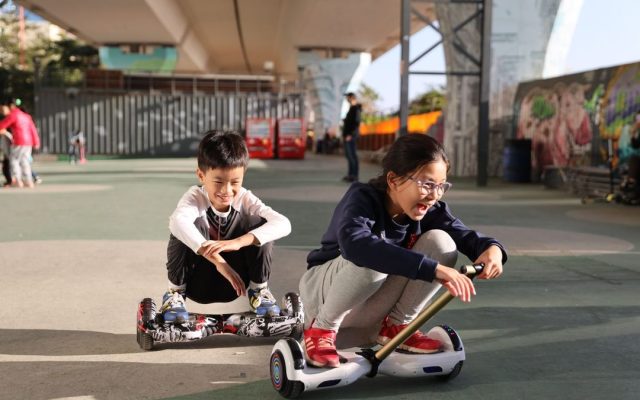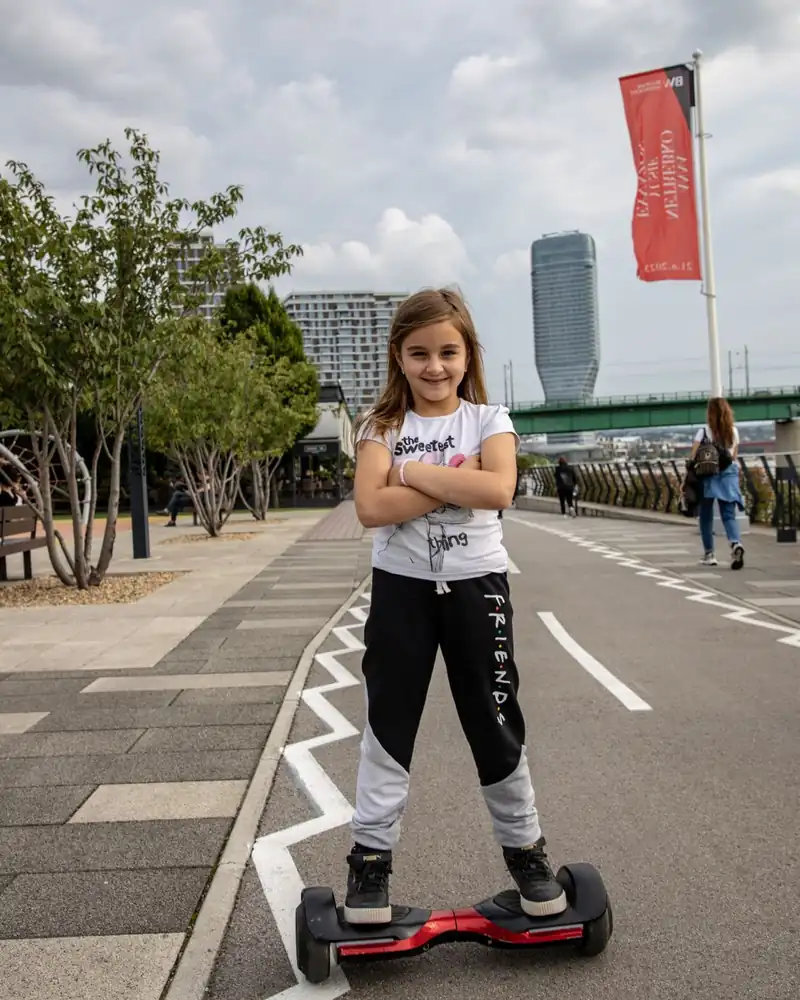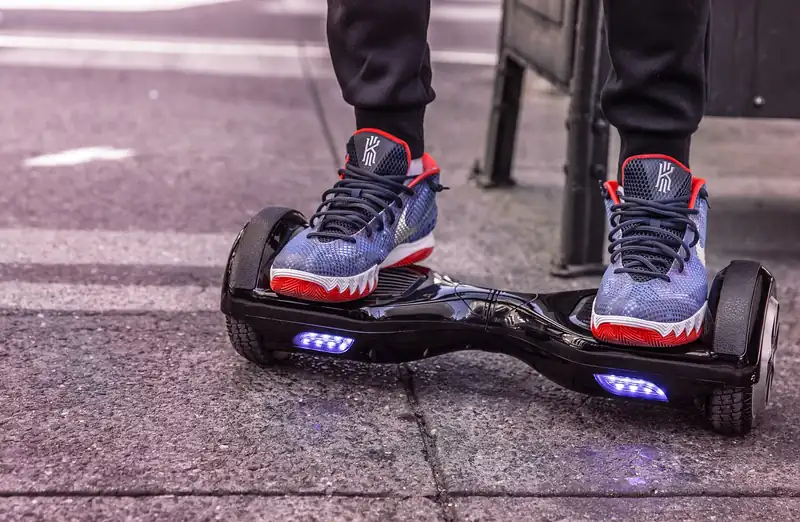
Most kids can safely start riding around age 8. But age is only half the story — weight, balance, and the right certified board matter just as much. Here’s the friendly, no-jargon breakdown.
Hoverboards are generally suitable for ages 8 and up, with kid-specific models available for ages 6+. Children should weigh at least 44 lbs, wear full safety gear, and only ride a UL 2272 certified board. Adults up to 330 lbs can ride heavier-duty models with 8.5″–10″ wheels.
Key Takeaways
- Minimum recommended age: 8 years old (some kid models from 6+).
- Weight matters more than age — most boards need 44+ lbs to engage the motors safely.
- UL 2272 certification is non-negotiable — it’s the U.S. fire and electrical safety standard.
- Adults can ride too — look for 220–330 lb capacity and 8.5″–10″ wheels.
- Helmet + pads = always. The CPSC strongly recommends them for everyone under 16.
- Match the wheel size to the rider: small wheels for kids, bigger wheels for teens and adults.
If you’ve ever stood in a toy aisle staring at a hoverboard box and thought, “Wait, is my kid even old enough for this?” — you’re not alone. It’s the question we get more than any other from parents, grandparents, and gift-givers. The truth is, the right age for a hoverboard isn’t a single number. It depends on your child’s weight, balance, attention span, and the type of board you buy.
This guide cuts through the marketing noise. We’ll walk you through what age range hoverboards are actually suitable for, why some 6-year-olds do fine while some 10-year-olds shouldn’t ride yet, and how to pick a board that matches your rider’s stage. By the end, you’ll know exactly what to look for, what to avoid, and how to keep things safe and fun. No technical manual feel — just the kind of advice you’d get from a friend who’s tested a lot of boards and watched a lot of first rides.
Table of Contents
- What’s the Safe Age for a Hoverboard?
- Age Range Breakdown (With Table)
- Why Age Really Matters for Safety
- How to Choose the Right Board by Age
- Weight, Speed, and Skill Factors
- Common Mistakes Parents Make (and Fixes)
- Pro Tips for Every Age Group
- Real-Life Examples From Riders & Parents
- Comparison: Best Features by Age Group
- Frequently Asked Questions
- Final Safety Checklist
What’s the Safe Age for a Hoverboard?
Most major hoverboard makers — including Hover-1, Segway, Razor, and Jetson — set the recommended minimum age at 8 years old. That’s the standard you’ll see on most boxes. A handful of smaller, slower kids’ models drop the minimum to 6, but those are special builds with smaller wheels (around 4.5″) and capped speeds.
The reason 8 is the magic number isn’t random. By around that age, most kids have the balance, body weight, and reaction time to handle a self-balancing board. Younger children often don’t weigh enough to even trigger the foot sensors, which means the board won’t balance properly under them. They also tend to lock their knees instead of staying loose, which leads to falls.
If you’re shopping for a younger child and want to know more about beginner-friendly options like the Hover-1 Hoverboard family of boards, you can check price on Amazon for current kid-rated models with low top speeds and small wheels.
Age Range Breakdown (With Quick-Look Table)
Hoverboards aren’t one-size-fits-all. Different age groups need different boards because their bodies, skills, and confidence levels change so much from year to year. Here’s the breakdown we use when we help families pick:
Under 6: Not Recommended
Skip the hoverboard at this age. Toddlers and preschoolers don’t have the coordination or weight needed. Try a tilt-and-turn scooter or balance bike instead — those build the same skills with way less risk.
Ages 6–8: Kids’ Models Only
This is the earliest realistic starting point, and only with a board designed for kids. Look for 4.5″ or 6.5″ wheels, a top speed under 6 mph, and a low minimum weight (around 44 lbs). These boards feel softer and stop quicker.
Ages 8–12: The Sweet Spot
This is where hoverboards truly shine. Kids in this range have the balance and weight to ride confidently, and most standard 6.5″ boards fit them perfectly. Speeds of 7–9 mph are plenty.
Ages 12–16: Teens Want More
Teenagers usually outgrow basic boards fast. They want speed, off-road tires, and Bluetooth speakers. 8″ wheels and dual 350W motors are a good match here.
Ages 16+ & Adults: Heavy-Duty Territory
Adults need higher weight capacity (220–330 lbs), bigger wheels (8.5″–10″), and stronger motors. Off-road models with rubber tires handle grass, gravel, and small bumps without throwing the rider.
Why Age Really Matters for Hoverboard Safety
Age isn’t just a label on a box. It tells you a lot about how a child’s body and brain handle a self-balancing machine. A hoverboard reads your weight shifts and reacts in milliseconds. That feedback loop only works when the rider can stay relaxed, lean smoothly, and react fast if something goes wrong.
Balance and Coordination Develop Over Time
Younger kids are still wiring up the part of their brain that handles balance — the cerebellum. By around age 8, most kids have enough fine motor control to stand still on a moving board without flailing. Before that, they often stiffen up, and that’s when falls happen.
Reaction Time Gets Faster With Age
If a wheel hits a pebble, you have a fraction of a second to recover. Adults and older teens can usually do that. A 5-year-old? Not really. That’s why minimum-age guidelines exist — they line up with research on motor development and reaction time in children.
Judgment and Impulse Control
Even if a young child can ride, do they know not to ride into the street? Older kids understand consequences better. CPSC injury reports show most hoverboard injuries happen when riders take risks they didn’t think through — and that risk-taking is more common in younger kids.
“We tested boards with kids from 5 to 15. The cleanest, calmest first rides were almost always from kids 9 or older. Younger riders needed twice as much support and twice as many breaks.” — HoverboardsGuide testing notes, 2025
How to Choose the Right Hoverboard by Age
Picking the right board isn’t about getting the flashiest model. It’s about matching the board’s specs to the rider’s body and skill. Here’s the simple checklist we use:
- Check certification first. If it’s not UL 2272 certified, walk away. This is the U.S. safety standard for the battery and electrical system, and it’s there because of real fires that happened with cheap boards in 2015–2016.
- Match the wheel size to age. 4.5″–6.5″ for younger kids, 8″ for tweens, 8.5″–10″ for teens and adults. Bigger wheels handle bumps; smaller wheels feel quicker.
- Confirm weight range. Boards have both a minimum and a maximum. Too light and the motors won’t engage; too heavy and the board will buck.
- Look at the speed cap. For under 10s, you want under 6 mph. For teens, 9–10 mph is plenty.
- Look for a beginner mode. Many boards have a “training mode” that limits speed and slows the responsiveness — perfect for a first rider.
- Skip the cheapest no-name boards. If a board is shockingly cheap, the certification is probably fake. Stick with brands that publish their UL test reports.
Weight, Speed, and Skill: The Real Factors That Matter
Honestly? Age is just a rough guide. The three things that actually decide if a hoverboard is right for someone are weight, speed control, and skill level. Let’s break each one down.
Weight: The Most Overlooked Factor
Every board has a weight window. If your rider is below the minimum, the gyroscope sensors don’t get enough pressure to activate — the board essentially won’t balance them. Above the maximum, you risk the motors overheating and the board lurching.
For example, most adult-rated boards need 100+ lbs to work properly. Putting an 8-year-old who weighs 60 lbs on one is like asking a treadmill to read a feather walking on it — it just doesn’t register.
Speed: Less Is Often More
Top speed sells boards, but it doesn’t help new riders. A 9-mph board feels terrifying for a 7-year-old. Many parents don’t realize their kids’ first crashes happen at the upper speed range when the rider over-leans. Pro move: always start in beginner mode for the first week.
Skill: Practice Beats Age Every Time
A 7-year-old who has skated for two years will outride an out-of-shape teenager any day. Balance sports build the same muscles. If your rider has experience with skateboards, scooters, or even ice skates, they’ll pick up a hoverboard fast. If they don’t, plan on extra practice time and a softer landing zone (grass works great).
Common Mistakes Parents Make (and How to Fix Them)
We see the same mistakes over and over. Here are the big ones, and what to do instead:
Fix: Match the wheel size to the rider. Big wheels feel unwieldy under little feet. Stick with 4.5″–6.5″ boards under age 10.
Hover-1 My First Hoverboard — Designed for Kids
Specifically built for young and first-time riders. Slower speed, lower height, safer learning curve.
Gotrax Hoverboard — UL2272 Certified
The most popular hoverboard on Amazon for teens and adults. Dual 200W motor, LED wheels, 6.2mph.
80SIX Triple-Certified Multisport Helmet
Whatever age you are, wear a helmet. This triple-certified pick works for everyone.
Fix: Most ER visits from hoverboards happen at low speeds in driveways, according to CPSC data. Helmet on, every ride, no exceptions.
Fix: Look up the brand on the UL Solutions site. Real certifications are listed publicly. If you can’t find it, it’s probably fake.
Fix: Carpet or short grass for the first 15 minutes. Hold their hand. The first dismount is where most beginners lose balance — a soft surface saves bruises.
Fix: Charge while you’re awake and home. Even certified batteries shouldn’t be left unattended. Unplug as soon as it’s full (usually 2–3 hours).
Pro Tips for Every Age Group
For Young Kids (6–8)
- Start indoors on carpet or in a hallway with handrails.
- Use beginner mode for the first two weeks.
- Have them step on with one foot at a time, leaning on something solid.
- Keep first sessions to 15 minutes — small kids tire fast and tired kids fall.
For Tweens (8–12)
- Practice emergency stops on day one. Most kids skip this and regret it.
- Set a “no riding into traffic” rule and stick to it.
- Make sure the board’s app (if it has one) is set to a parent’s phone.
For Teens (12–16)
- Talk about the speed cap. Many teens unlock max speed and get hurt.
- Pair the board with a real helmet, not a bike-helmet-as-an-afterthought.
- Check local laws — many cities don’t allow hoverboards on sidewalks.
For Adults
- Don’t try fancy moves on day one. Your reflexes aren’t what they were at 12.
- Off-road tires are worth the extra cost if you’ll ride on grass or trails.
- Wear wrist guards. Adult wrists break easier than kid wrists in falls.
Real-Life Examples From Riders & Parents
Reading specs is one thing. Hearing what actually happens is another. Here are a few real-world stories we’ve gathered from our reader community and Reddit’s hoverboard threads:
The 7-year-old who thrived: “We got our daughter a kid-rated 6.5″ board for her 7th birthday. She weighed 50 lbs and was already a confident scooter rider. Two days of carpet practice and she was riding the driveway like a pro. The key was the small wheels and beginner mode.”
The teen who outgrew his board: “Got my son a 6.5″ entry-level board at 11. By 13 he was 5’7″, 140 lbs, and the board felt like a toy. We upgraded to an 8.5″ off-road model and the difference was night and day. Lesson: think two years ahead.”
The cautionary tale: “Bought a no-brand board off a marketplace site. Three rides in, the battery puffed up overnight. We were lucky — caught it before any fire. Replaced it with a UL 2272 board from a real brand, and it’s been three years with zero issues.”
Comparison: Best Features by Age Group
Myths vs. Facts
Fact: Hoverboards are battery-powered, self-balancing personal mobility devices. The CPSC tracks them as such, and they require real safety gear and adult oversight.
Fact: Marketplaces have sold counterfeit boards for years. Always verify UL 2272 certification independently.
Fact: Kids do learn fast, but balance development still takes time. An 8-year-old’s body simply has more skills wired in than a 5-year-old’s.
Related Topics Worth Reading
- UL 2272 Certification Explained — what the standard actually tests for.
- Hoverboard Weight Limits Guide — how to read min/max weight specs.
- Best Hoverboards for Kids — our age-tested picks.
- Hoverboard Safety Gear Checklist — exactly what to wear.
- Hoverboard Laws by State — where you can and can’t ride.
Frequently Asked Questions
What is the minimum age for a hoverboard?
Most manufacturers say 8 years old. Some kid-specific models go down to 6, but only with smaller wheels and capped speeds. Children under 6 should not ride.
Are hoverboards safe for 6-year-olds?
Only with a kids-specific model rated for that age, plus a helmet, pads, and adult supervision. The board needs a low top speed (around 5 mph) and a low minimum-weight requirement.
Can adults ride hoverboards?
Absolutely. Adult-rated boards usually support 220–330 lbs and have 8.5″–10″ wheels. Off-road models work great for grass, gravel, and small bumps.
What weight limit should I look for by age?
Kids’ boards: 44–150 lbs. Tween/teen boards: 100–220 lbs. Adult boards: 150–330 lbs. Always check both minimum and maximum weights.
Do hoverboards need certification for kids?
Yes. UL 2272 certification is required by the U.S. Consumer Product Safety Commission. It tests fire and electrical safety. Don’t buy any board without it.
What safety gear should kids wear?
A properly fitted helmet, knee pads, elbow pads, wrist guards, and closed-toe shoes. The CPSC strongly recommends full pad sets for everyone under 16.
Final Safety Checklist
Before Your Rider Steps On:
- ✅ Rider is at least 6 (kid model) or 8 (standard model).
- ✅ Rider’s weight falls inside the board’s range.
- ✅ Board is UL 2272 certified — verified, not just labeled.
- ✅ Helmet fits snugly and is buckled.
- ✅ Knee, elbow, and wrist pads are on.
- ✅ Beginner mode is activated for the first 2 weeks.
- ✅ Riding surface is smooth and away from traffic.
- ✅ Adult is nearby for the first 5 sessions.
- ✅ Battery is charged in a safe, attended location.
The Bottom Line
So, what age range are hoverboards suitable for? The honest answer: most riders ages 8 and up, with kid-specific models available from age 6, and adult models that go all the way through retirement age. The number on the birthday card matters less than the rider’s weight, balance, and the board’s certification.
Pick a UL 2272 board that fits the rider’s body, gear up properly, start slow, and you’ll get years of fun out of it. Skip the certification check or buy a board sized wrong, and you’re rolling the dice in a way that’s just not worth it.
Whether you’re shopping for a curious 7-year-old or a commuting adult, the playbook is the same: match the board to the rider, not the marketing.
Further Reading
- CPSC.gov — official U.S. consumer product safety guidance.
- UL Solutions — verify UL 2272 certifications.
- Best Hoverboards for Kids — our age-by-age picks.
- Hoverboard Safety Gear — what to wear, head to toe.
- Hoverboard Laws by State — riding rules near you.
Last Updated: May 2026 • Author: Marcus Reilly, Senior Editor
This article is educational. It is not buying advice or a substitute for the safety guidance of the manufacturer of any specific product. Always read the user manual that comes with your hoverboard and follow all local regulations.