Ride to work sitting down, then fold it small enough for the trunk, train, or under your desk. Here are 2026's best seated commuter scooters.
A foldable electric scooter for commuting with a seat is a game-changer if your ride to work leaves your legs tired. You get to sit back and cruise, then fold the whole thing down small enough to carry onto a train or tuck under your desk. It is comfort and convenience rolled into one machine.
Standing scooters are fun, but after 20 or 30 minutes your feet and lower back start to complain. Adding a seat changes the whole experience. Longer commutes feel easy, and you arrive fresh instead of sore. The best part is that most seats pop off in seconds, so you can still ride standing when the mood strikes.
In this guide we will walk through what makes a seated commuter scooter worth buying, compare the top foldable models for 2026, and share real tips on range, comfort, and folding. Whether you want a light budget pick or a long-range cruiser, there is a seated scooter here that fits your route and your wallet.
Why a Seat Changes Your Whole Commute
Standing on a scooter for five minutes is fine. Standing for a 40-minute commute is a different story. Your feet get sore, your knees take every bump, and your lower back tightens up. A seat spreads your weight out and lets your legs relax. Suddenly a long ride feels short, and you get to work without that stiff, tired feeling.
A seated scooter is also kinder to your body over the long run. If you have bad knees, an old back injury, or you are simply not as young as you used to be, sitting takes the pressure off. Plenty of riders who gave up on stand-up scooters come back happily once they add a saddle. It turns a workout into a relaxing glide.
The beauty of a foldable seated scooter is that it does not lock you into one style. Most seats clamp on and pop off in seconds. On a lazy Monday you sit and cruise. On a sunny Friday you take the seat off and ride standing like a kid again. You get two scooters in one, and it still folds down to fit in a trunk or closet.
- Less fatigue on rides longer than 15 to 20 minutes
- Easier on knees, hips, and lower back
- Great for older riders or anyone recovering from injury
- Carry a bag or groceries without balancing on your feet
- Switch between sitting and standing whenever you want
| Model | Top Speed | Range | Weight | Max Load | Seat | Price |
|---|---|---|---|---|---|---|
| Hiboy S2 | 19 mph | 17 mi | 29.5 lb | 220 lb | Removable | ~$320-380 |
| isinwheel S9Max | 21 mph | 22 mi | 35 lb | 264 lb | Removable | ~$429-499 |
| Hiboy S2 Pro | 19 mph | 25 mi | 40 lb | 220 lb | Removable | ~$429-499 |
| Gotrax A5 | 15.5 mph | 15 mi | 51 lb | 220 lb | Built-in | ~$300 |
| HOVSCO Porto Max | 19 mph | 35 mi | 43 lb | 260 lb | Removable | ~$599-699 |
| EMOVE RoadRunner V3 | 34 mph | 50 mi | 77 lb | 330 lb | Built-in | ~$1,695 |
What to Look For in a Foldable Seated Commuter
Not every scooter is built to carry a seated rider well. When you sit, all your weight lands on the frame and the back wheel instead of being spread across the deck. That means you want a sturdy frame, a strong-enough motor, and tires that soak up bumps. Here is what actually matters when you shop.
Range that matches your route
Add up your round trip, then buy a scooter with at least 30 percent more range than that. Batteries lose range in cold weather, uphill, and as they age. A claimed 20-mile scooter often gives 13 to 15 real miles with an adult aboard. For most commutes, look for 20 to 25 miles of rated range so you are not charging every single day.
Motor power and hills
A 350W motor is fine for flat city streets and lighter riders. If your route has hills or you weigh more, step up to a 500W or bigger motor. Sitting adds no weight, but it does change how the scooter pulls away from stops. More watts means you climb without crawling and keep pace with traffic.
Fold size and weight
Portability is the whole point. Check the folded dimensions and the weight before you buy. A 30-pound scooter is easy to lift onto a train or into a trunk. Once you pass 45 or 50 pounds, carrying it up stairs gets old fast. Remember the seat adds a few pounds, though most pop off to make folding easier.
Tires and suspension
When you sit, you feel every crack in the road through the seat. Pneumatic (air) tires or quality honeycomb tires plus rear suspension make a huge difference in comfort. Small hard tires with no suspension will rattle your teeth on a seated ride. Look for at least 8.5-inch tires, and 10-inch is even better.
The seat itself
Check that the seat height adjusts to fit you and that it mounts to a solid post, not a flimsy bracket. A padded saddle with a bit of give beats a hard plastic perch. Make sure the seat is made for your exact model. A seat that wobbles or sits too low will ruin the comfort you paid for.
Brakes and load limit
You are heavier and a touch faster when seated, so good brakes matter. Look for a disc or drum brake paired with an electronic brake. Also check the max load. Adding a seat does not lower the limit, but you want a healthy buffer above your own weight so the scooter feels planted and safe.
Best Foldable Electric Scooters With Seats for 2026
We focused on scooters that fold small, carry an adult in comfort, and offer a real seat that fits the model. Prices below are ballpark for 2026 and shift with sales. Every pick here is sold widely online, and most let you take the seat off to ride standing.
Hiboy S2 — Best overall value
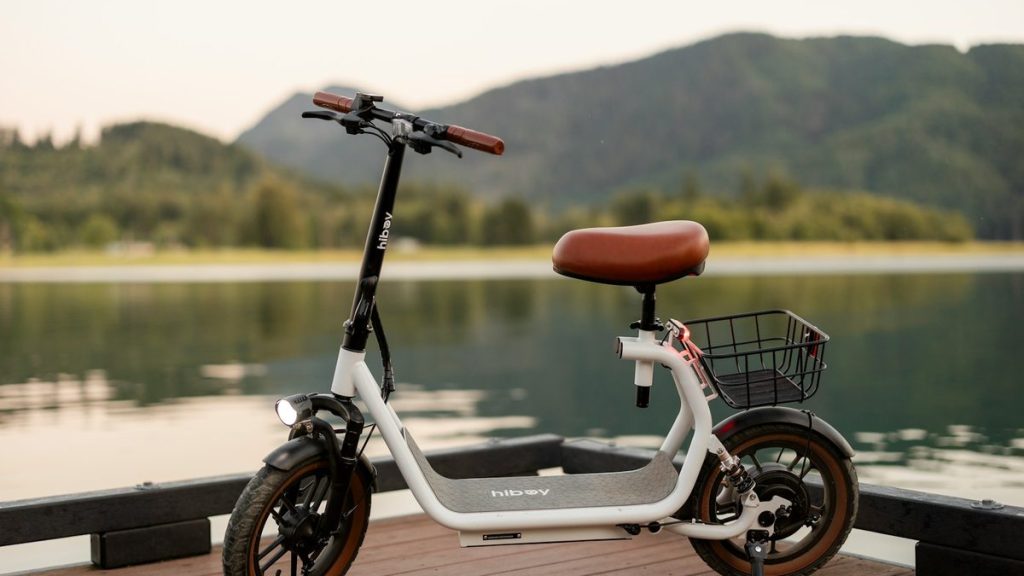
The Hiboy S2 is the sweet spot for most commuters. It has a 350W motor, hits 19 mph, and covers up to 17 miles on a charge. It weighs just under 30 pounds, folds in a couple of seconds, and the clip-on seat adjusts for height. At around $320 to $380 with the seat, nothing else this comfy is this affordable.
isinwheel S9Max — Best comfort
If your roads are rough, the S9Max shines. It runs a 500W motor, does about 21 mph, and gets close to 22 miles of range. Big 10-inch tires and dual suspension smooth out potholes, which you really feel when seated. It still folds fast and weighs about 35 pounds. Expect roughly $429 to $499 with the saddle.
Hiboy S2 Pro — Best for longer rides
The step-up S2 Pro adds a 500W motor, 10-inch tires, and up to 25 miles of range. It is a bit heavier at around 40 pounds, but that extra battery means fewer charges on a longer commute. The same style of removable seat fits it. Plan on about $429 to $499.
Gotrax A5 — Best fixed-seat budget
The Gotrax A5 comes with the seat built in, so there is nothing extra to buy. It cruises at 15.5 mph with around 15 miles of range on air-filled tires, and it costs about $300. It is heavier and slower than the Hiboy, but if you always want to sit and never stand, it is a simple, cheap choice.
HOVSCO Porto Max — Best long range
Need to go farther? The Porto Max pairs a 500W peak motor with a bigger 36V 10.4Ah battery for up to 35 miles. It still folds and weighs about 43 pounds, and it ships with a detachable seat and a front basket for errands. It lands around $599 to $699 and suits 10-mile-plus commutes.
EMOVE RoadRunner V3 — Best premium seated
If comfort is everything and folding matters less, the moped-style RoadRunner V3 has a plush built-in saddle, dual 500W motors, and around 50 miles of range near $1,695. It is more mini-moped than pocket scooter at 77 pounds, but the ride is couch-like. Best for riders with a garage, not a train platform.
Removable Seat vs. Built-In Seat
There are two ways to get a seat on your scooter. A removable seat clamps onto a folding commuter and pops off when you want to stand or save space. A built-in seat is part of the frame, like on a mini-moped, and it never comes off. Both work, but they suit different riders.
Removable seats win for flexibility and portability. You can ride standing in traffic, take the seat off to fold smaller, and still sit for the long haul home. The trade-off is that the seat post adds a little wobble compared to a welded frame, and cheap mounts can loosen over time. Built-in seats feel rock solid and usually come with bigger, plusher saddles, but the scooter is heavier and harder to fold and carry.
For most commuters who ride buses, trains, or toss the scooter in a trunk, a removable seat on a light folding scooter is the smarter pick. If you have a garage, a longer ride, and never plan to stand, a built-in seat gives you the comfiest cruise. Use the table below to see the trade-offs at a glance.
- Removable seat: lighter, folds smaller, ride sit or stand, cheaper
- Removable downside: can loosen, smaller saddle, slight post flex
- Built-in seat: rock solid, bigger cushion, best comfort
- Built-in downside: heavy, hard to fold, always seated
Set Up Your Seat and Ride Comfortably
A seat only feels good if it is set up right. Start with height. Sit down and put your feet on the deck. Your knees should have a slight bend, not be jammed up or fully straight. Set the post so you can brake and balance without straining. Most seats adjust with a quick-release clamp in seconds.
Keep a light bend in your elbows and let your arms relax on the bars. Do not lock them straight, or every bump travels into your shoulders. Scoot back a touch so your weight sits over the rear wheel and suspension. If your scooter has adjustable shocks, soften them a little for a smoother seated ride. Keep tires at the pressure printed on the sidewall, since soft air tires get squishy and slow.
Give yourself a bit more stopping distance than you would standing. Seated, you sit slightly higher and it takes a moment longer to put a foot down if you need to. Lean into turns gently rather than steering hard. After your first week, recheck every bolt on the seat and stem, because new clamps settle in and need a quick snug-up.
- Set seat height for a slight knee bend
- Keep elbows soft to absorb bumps
- Shift weight back over the rear wheel and suspension
- Check tire pressure weekly on air tires
- Re-tighten seat bolts after the first week
Safety, Laws, and Battery Care
A helmet is non-negotiable, seated or not. At 15 to 20 mph a fall still hurts, and a seated rider often sits a little higher. Bright clothing plus front and rear lights help drivers see you, especially if you commute at dawn or dusk. Fenders keep road spray off your back, which you notice more when seated.
Scooter laws change by city and state, so check yours before you ride. Many places cap scooters at 15 to 20 mph, ban sidewalk riding, and set a minimum age. Some bike lanes welcome scooters and some do not. A quick search for your city plus e-scooter rules saves you a ticket and keeps you on legal paths.
Treat the battery well and it will last for years. Charge indoors at room temperature, unplug once it is full, and avoid draining it to zero. Store the scooter around half charge if you park it for weeks. Never charge a wet scooter, and if the battery ever swells, gets hot, or smells odd, stop using it and contact the maker.
- Always wear a helmet; add gloves and lights for commuting
- Check local speed, sidewalk, and age laws before riding
- Charge indoors and unplug at 100 percent
- Store at about half charge for long breaks
- Stop using any battery that swells, overheats, or smells
| Your Commute | Look For | Good Pick |
|---|---|---|
| Under 5 miles, flat | Light fold, 15-17 mi range | Hiboy S2 or Gotrax A5 |
| 5-10 miles, some bumps | 500W, suspension, 20-25 mi | isinwheel S9Max or S2 Pro |
| 10-20 miles | Big battery, 30+ mi range | HOVSCO Porto Max |
| Train and walk mix | Under 35 lb, fast fold | Hiboy S2 |
| Comfort over portability | Moped seat, plush ride | EMOVE RoadRunner V3 |
| Factor | Removable Seat | Built-In Seat |
|---|---|---|
| Portability | Folds smaller, lighter | Heavy and bulky |
| Comfort | Good padded saddle | Bigger, plusher saddle |
| Flexibility | Sit or stand anytime | Always seated |
| Sturdiness | Slight post flex | Rock-solid frame |
| Best for | Trains, trunks, mixed riding | Garage, long cruises |
Common Mistakes (and How to Fix Them)
Fix: Pick range first. A scooter that claims 20 miles gives about 13 to 15 real miles with an adult aboard. Match rated range to your round trip plus 30 percent, then worry about speed.
Fix: Only add a seat the maker lists for your exact model. A random saddle on an unrated deck can crack the frame or snap the post. When in doubt, buy a scooter designed to carry a seated rider.
Fix: Spend two minutes setting the post so your knees have a slight bend. Too low and your legs cramp; too high and you cannot balance at stops. The quick-release clamp makes it easy.
Fix: Remember the saddle and post add a few pounds and block the fold. Pop the seat off before lifting the scooter onto a train or into a small trunk, then clip it back on.
Pro Tips
- 💡 Take the seat off when you fold for travel, then clip it back on at your stop. It saves space and makes the scooter easier to lift.
- 💡 Keep tire pressure at the number printed on the sidewall. Soft air tires feel squishy, slow you down, and quietly cut your range.
- 💡 Charge to about 80 to 90 percent for daily use and only fill to 100 percent before a long ride. It is easier on the battery over time.
- 💡 Add a phone mount and a cheap frame lock. A seated commuter is easy to hop off and grab a coffee, so lock it every time.
- 💡 Recheck the seat and stem bolts after your first week. New clamps settle in, and a quick snug-up stops the wobble before it starts.
A Real-Life Example
Marcus has a 7-mile ride to his downtown office with a short train hop in the middle. He used to stand the whole way on an old scooter and arrive with sore feet. He switched to a Hiboy S2 with the clip-on seat. Now he pops the seat off, folds the scooter, and carries it onto the train, then clips the seat back on for the last flat mile. He says his knees stopped aching within a week.
Diane is 58 and had given up on standing scooters after her hip started bothering her. A seated foldable with 10-inch tires and rear suspension brought her back. She rides the 4 miles to her studio, sits the whole way, and folds it into the corner of her class. The bigger tires soak up the rough sidewalk cracks that used to jar her, and she only charges it once every few days.
Frequently Asked Questions
Yes, they are excellent for commuting, especially on rides longer than 15 minutes. Sitting cuts fatigue in your feet, knees, and back, so you arrive fresh. A foldable model still tucks into a trunk, closet, or train, giving you comfort without losing portability.
On most commuter models, yes. Scooters like the Hiboy S2 and isinwheel S9Max use a clip-on seat that pops off in seconds, so you can ride standing whenever you want. Built-in seats on moped-style scooters do not come off, so choose a removable seat if you value that flexibility.
Aim for at least 30 percent more range than your round trip. Real-world range is often 60 to 75 percent of the claimed number once an adult is aboard and there are hills or cold weather. For most commutes, a rated 20 to 25 miles gives a safe daily buffer.
No, the seat itself does not lower the load limit, but you should still check the max load. Your body weight plus any bag needs to sit comfortably under the rated limit, ideally with room to spare so the frame feels planted and the motor pulls strongly.
A little. The seat and post add a few pounds and some bulk, but most removable seats pop off in seconds so you can fold the scooter to its normal size. Built-in seats make a scooter much heavier and harder to lift, so pick a removable seat if you carry it often.
Expect about $300 to $500 for a solid commuter with a seat, like the Hiboy S2, S2 Pro, or isinwheel S9Max. Long-range foldables run $600 to $700, and premium moped-style seated scooters can top $1,600. You do not need to overspend for a comfy daily ride.
Final Checklist ✅
- ✅ Measure your round-trip distance and add 30 percent for real-world range
- ✅ Confirm the maker sells a seat made for your exact scooter model
- ✅ Check folded size and weight so it fits your trunk, train, or stairs
- ✅ Pick 8.5-inch or larger tires with suspension for a smooth seated ride
- ✅ Set the seat height for a slight knee bend before your first ride
- ✅ Wear a helmet and check your local e-scooter speed and sidewalk laws
- ✅ Charge indoors, unplug at full, and store at half charge for long breaks