
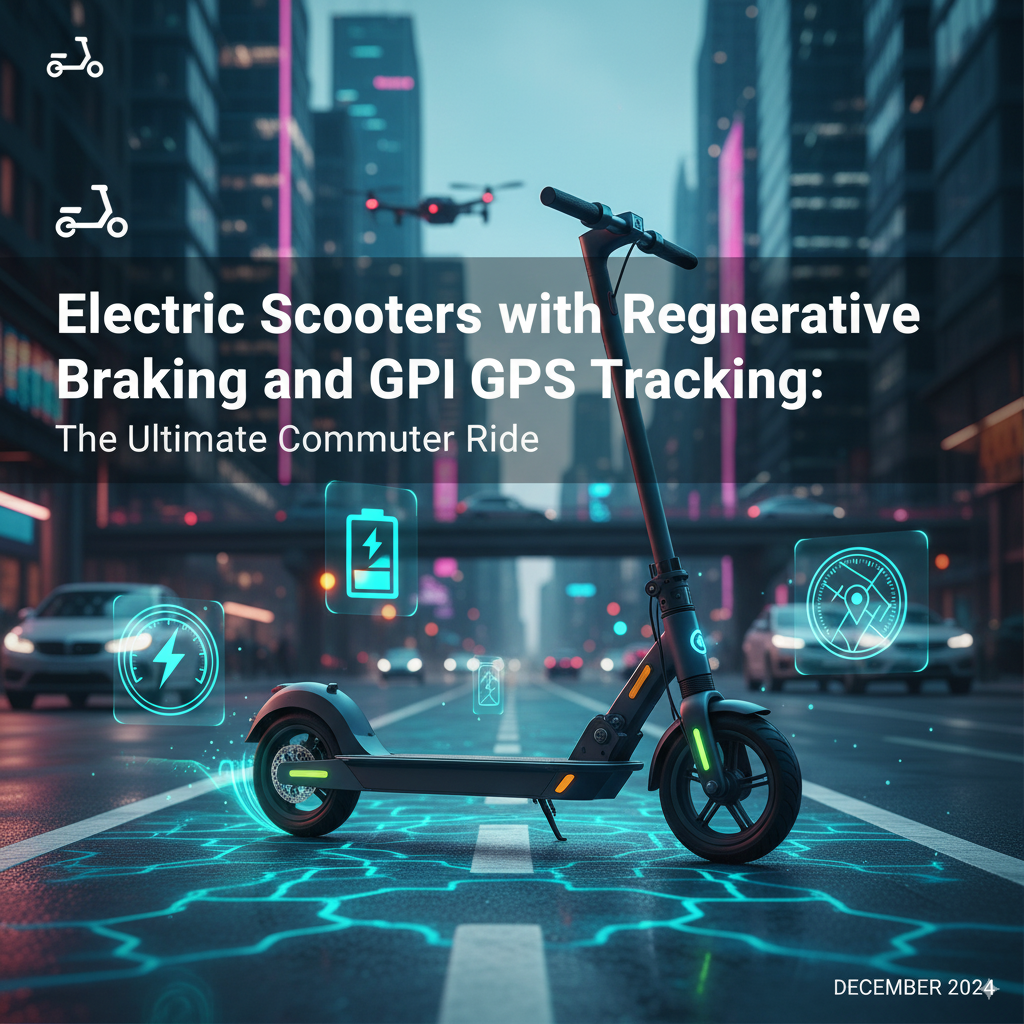
Electric Scooter with Regenerative Braking and GPS Tracking: The Complete 2025 Buyer’s Guide
Ride farther, save money, and never lose your scooter again. This guide explains everything you need to know — in plain English — about two of the smartest features in modern electric scooters.
Picture this: you’re halfway to work, your scooter battery is running low, and you have no idea if your ride will make it. Or worse — you lock up your scooter outside a coffee shop, come back five minutes later, and it’s gone.
These are two of the biggest fears for electric scooter riders in 2025. The good news? Both problems have a solution baked right into the scooter itself: regenerative braking and GPS tracking.
Regenerative braking secretly charges your battery every time you slow down — giving you extra range without plugging in. GPS tracking lets you see your scooter’s exact location on your phone, 24/7. Together, they turn a basic ride into a smart, secure, and efficient machine.
In this guide, you’ll learn exactly how both features work, which scooters have them, what to watch out for, and how to get the most out of them — whether you’re a student, a daily commuter, a parent, or a city rider. Let’s dig in.
📋 Table of Contents
- What Is Regenerative Braking?
- How Does It Actually Work?
- Real Benefits of Regenerative Braking
- Honest Limitations (What Competitors Don’t Tell You)
- How GPS Tracking Works on Electric Scooters
- Why GPS Tracking Is a Game-Changer
- Top Electric Scooters with Both Features (2025)
- Feature Comparison Table
- How to Get the Most Out of These Features
- Common Mistakes Riders Make (And How to Fix Them)
- Who Benefits Most from These Features?
- FAQ
- Final Buyer’s Checklist
⚡ What Is Regenerative Braking on an Electric Scooter?
Most people think brakes just stop things. And they do — but with a cost. Every time you squeeze a brake lever, the scooter’s moving energy (called kinetic energy) is converted into heat and released into the air. That energy? Gone forever. Wasted.
Regenerative braking does something smarter. Instead of wasting that energy as heat, it captures it and sends it back into the battery. The motor runs in reverse mode, acting like a generator, and the electricity it produces tops up your battery — a little bit, with every single brake.
💡 Key Insight
Think of it like this: your scooter’s motor is a two-way street. Going forward, it uses electricity to spin the wheels. When braking, the spinning wheels drive the motor in reverse — and it generates electricity instead of using it. Every slow-down becomes a mini charging session.
This isn’t magic — it’s physics. And it’s the same technology used in Tesla cars, Toyota Priuses, and electric buses worldwide. Electric scooters are just a smaller, more accessible version of the same idea.
🔧 How Does Regenerative Braking Actually Work? (Step by Step)
Let’s walk through exactly what happens inside your scooter when you brake with regenerative braking enabled:
- You release the throttle or pull the brake lever. The scooter’s controller detects this and shifts the motor into generator mode.
- The wheels continue spinning. Their rotational energy now drives the motor backwards, like a windmill turning a turbine.
- The motor generates AC electricity. This is converted to DC current by the controller.
- The DC current flows back into the battery, adding a small charge with every braking event.
- You feel a slight drag — that resistance IS the braking force. No heat is created (or much less of it). The energy goes into the battery instead.
✅ Pro Tip
Some scooters — like those in the VMAX VX series — give you a dedicated brake lever just for the regenerative brake. Use it as your first brake for gentle slowdowns. Use the mechanical brake as the second, harder stop. This combo saves your brake pads AND captures more energy.
Regen Braking vs. Traditional Mechanical Braking
| Feature | Regenerative Braking | Mechanical (Disc/Drum) |
|---|---|---|
| Energy Recovery | ✅ Yes — charges battery | ❌ No — energy wasted as heat |
| Stopping Power | ⚠️ Moderate — not for emergencies | ✅ Strong — reliable hard stop |
| Brake Pad Wear | ✅ Very low wear | ⚠️ Regular replacement needed |
| Best Use Case | Gradual slowdowns, downhill riding | Emergency stops, hard braking |
| Maintenance Cost | ✅ Very low | ⚠️ Moderate (pad replacement) |
| Works Well at Low Speed? | ❌ Less effective under ~5 mph | ✅ Works at any speed |
Bottom line: Regenerative and mechanical braking work best together. Use regen for everyday slowing down, and your disc brakes for hard or emergency stops. Most quality scooters today combine both systems for exactly this reason.
🔋 Real Benefits of Regenerative Braking (With Numbers)
So how much does regenerative braking actually help? Here’s an honest breakdown based on real-world data:
1. Extended Range
Regenerative braking can extend an electric scooter’s range by up to 10–20% in optimal conditions. That means if your scooter normally does 20 miles, you might squeeze out 22–24 miles just from regen. The best gains come when you’re riding in stop-and-go city traffic — because you’re braking often. On open roads with few stops, the benefit is smaller.
A typical 12-mile-range scooter can gain an extra 1–3 miles simply by braking smoothly and frequently — that’s enough to change whether or not you make it home.
2. Lower Maintenance Costs
Because the motor handles much of the braking work, your disc brake pads and rotors last significantly longer. Brake pad replacements on a scooter can cost $15–$40 each time. Multiply that by several replacements per year for heavy riders, and regen braking pays for itself quickly in saved maintenance.
3. Smoother, More Controlled Rides
Regen braking creates a soft, predictable deceleration that feels natural. Downhill sections become much more comfortable — instead of constantly feathering the brakes, regen handles the speed automatically. Many riders describe it as the scooter “holding itself back” on slopes, which builds confidence especially for newer riders.
4. Better Battery Health Over Time
Frequent small top-ups from regen braking are actually gentler on lithium-ion batteries than deep discharge and full recharge cycles. By keeping the battery level more consistent throughout a ride, regen braking can help extend the overall lifespan of your battery pack.
5. Eco-Friendliness
Less electricity wasted means fewer kilowatt-hours drawn from the grid per mile. For environmentally conscious riders, this is a meaningful benefit — especially when riding every day. Electric scooters are already low-emissions transport; regen braking makes them even greener.
🏆 Expert Tips
- Set regen strength to medium if your scooter’s app allows it — strong regen can feel jerky for new riders.
- Use regen as your primary brake in city traffic for maximum energy recovery.
- On long downhills, regen braking is your best friend — it slows you AND charges the battery simultaneously.
- Look for scooters with adjustable regen levels in their app — Apollo, Segway-Ninebot, and VMAX all offer this.
⚠️ Honest Limitations: What Most Guides Won’t Tell You
Here’s where we get real. Some articles oversell regenerative braking as if it doubles your range. It doesn’t. Here’s what you actually need to know:
⚠️ Honest Reality Check
Physics sets a hard limit on how much energy regen can recover. A 100 kg rider at 30 km/h carries only about 3,400 joules of kinetic energy — which is a tiny fraction of a typical 280Wh battery (roughly 1 million joules). Even a perfect regen system can’t recover more than a small percentage per stop. The gains are real but modest.
- Regen is NOT an emergency brake. It creates gentle drag, not a hard stop. Always pair it with disc brakes for safety.
- It works poorly at low speeds. Below about 5 mph, the motor doesn’t generate meaningful electricity. Your mechanical brake handles the final stop.
- Real-world gains vary. In practice, regen might add 5–15% more range — not always 20%. Stop-and-go city riding maximizes it; highway riding barely benefits.
- Poor controller designs can fail. Cheap scooters with poorly designed regen systems may experience jerky braking or even motor damage over time. Stick with reputable brands.
- Battery C-rate limits recovery speed. Your battery can only accept charge so fast. Aggressive hard braking may not capture all available energy if the battery’s charge rate is exceeded.
The takeaway: regen braking is a genuinely useful feature that saves energy, reduces maintenance, and improves ride feel — but it’s a bonus, not a miracle. Don’t pay a huge premium just for regen if a scooter is lacking in other areas like motor power or mechanical brake quality.
📡 How GPS Tracking Works on Electric Scooters
GPS (Global Positioning System) uses a network of satellites orbiting Earth to pinpoint any device’s location to within a few meters. On electric scooters, GPS tracking means the scooter constantly knows where it is — and can tell you via a smartphone app.
There are two main types of GPS systems found on scooters:
Type 1: Built-In GPS (Premium Scooters)
High-end scooters like the Segway eScooter E110S and NIU KQi3 Pro have GPS chipsets built directly into the scooter’s electronics. These use either a cellular SIM card (4G/LTE) or Wi-Fi to transmit location data. You open the brand’s app and see your scooter pinned on a live map — all the time, even when you’re not near it.
NIU scooters, for example, constantly monitor for unauthorized movement and immediately notify you via the NIU Cloud app the moment someone moves the scooter without authorization. The Segway E110S includes a built-in 4G SIM that can track the scooter’s location at any time, anywhere with cell coverage.
Type 2: Add-On GPS Trackers (Any Scooter)
If your scooter doesn’t have GPS built in, you can hide a small GPS tracker on the frame — inside the stem, under the deck, or attached magnetically. Devices like the Tracki Pro are tiny, weatherproof, and have their own battery that lasts weeks or months on standby. They require a small monthly data subscription (typically $5–$10/month) to transmit location over cellular networks.
💡 Key Insight
The best GPS trackers update your scooter’s location every 30–60 seconds. Some premium options update every 3–10 seconds. Faster updates mean you can track a thief in real time as they move — which is crucial for working with police to recover your scooter quickly.
How GPS Alerts Work
Modern GPS scooter systems do much more than just show a dot on a map. Here’s what they can do:
- Motion alerts: The app sends you a push notification (or SMS) the second the scooter moves without you.
- Geofencing: Set a virtual boundary on a map. If the scooter crosses it, you get an alert immediately.
- Ride history: See a full log of every trip — route taken, distance, speed, and timestamps.
- Remote lock: On app-integrated scooters, you can lock the scooter remotely so it won’t start even if someone has physical access.
- Speed limits: Some parent-focused apps (like NIU’s) let you cap the max speed when a child is riding.
🔒 Why GPS Tracking Is a Game-Changer for Scooter Riders
Electric scooter theft is a real problem. In cities like New York, London, and Los Angeles, scooters are stolen regularly — often within minutes of being left unattended. A quality GPS tracker changes the odds dramatically in your favor.
Real Story: GPS Saves the Day
🔑 Lesson: A mom in Texas attached a Tracki GPS tracker to her teenager’s scooter. When the teen got a flat tire five miles from home and the scooter was left locked to a rack overnight, she was able to see its exact location and send help. No guessing, no panic — just a pin on a map.
- Theft recovery: GPS gives police the real-time location of your stolen scooter. Without it, recovery rates are very low. With it, police have actually recovered stolen scooters within hours.
- Peace of mind: Knowing you can always check the app and see your scooter parked safely reduces stress — especially in busy urban areas.
- Insurance benefits: Some insurance providers offer discounts for vehicles with GPS anti-theft systems. It’s worth calling yours to ask.
- Parental control: Parents buying scooters for teens can use GPS to see ride history, check speed, and set geofence alerts — without being helicopter parents.
- Emergency location: If you crash or break down alone, GPS makes it easy for family or emergency services to find you.
- Riding stats for improvement: Seeing your own routes, speeds, and distances is motivating — and helps you find the most efficient daily commute paths.
🛴 Top Electric Scooters with Regenerative Braking & GPS (2025)
Here are the best options at different price points, all vetted for having genuine regen systems — and GPS either built in or easily added:
1. 🥇 QnQ Kids/Teens Electric Scooter — Best for Young Riders
The QnQ scooter is a fantastic entry-level pick for teenagers and lighter adults. It features a genuine E-brake regenerative system, UL-2272 safety certification, and three speed modes — letting riders grow into the scooter gradually. At 15.5 mph and ~12 miles of range, it handles school commutes and neighborhood riding with ease.
- Top Speed: 15.5 mph
- Range: ~12 miles
- Regen Braking: ✅ Yes (E-brake)
- Built-in GPS: ❌ No — add a Tracki tracker
- Best for: Teens, students, lighter adults under 220 lbs
- Buy on Amazon: QnQ Kids Scooter (B0FJM6TTLG)
2. 🥈 HopCycle HO1 — Best Commuter Under $500
The HopCycle HO1 is built for city commuting. Its dual braking system (electronic regen + disc brake) gives riders smooth stops AND energy recovery. With a 500W motor, 21-mile range, and a 3-second fold, it’s a practical daily driver. The 8.5-inch pneumatic tires handle cracked pavement and light bumps well.
- Top Speed: 18.6 mph
- Range: ~21 miles
- Regen Braking: ✅ Yes (EBS + disc)
- Built-in GPS: ❌ No — add a tracker
- Best for: Adults, urban commuters, college students
- Buy on Amazon: HopCycle HO1 (B0FJXLWPC3)
3. 🥉 Segway ZT3 Pro — Best High-Performance Option
For riders who want serious performance, the Segway ZT3 Pro delivers. A 1,600W peak motor, dual suspension, 10-inch off-road tires, and a massive 43.5-mile range make this a true all-rounder. The EBS regenerative system pairs with hydraulic brakes for safe, confident stopping at speed. Segway’s app provides ride data and Bluetooth connectivity.
- Top Speed: 24.9 mph
- Range: 43.5 miles
- Regen Braking: ✅ Yes (EBS)
- Built-in GPS: ❌ App connectivity, add tracker for anti-theft
- Best for: Serious commuters, adventurous riders, long-range needs
- Buy on Amazon: Segway ZT3 Pro (B0DDTFMPS6)
4. 📍 Tracki Pro GPS Tracker — Best Add-On for Any Scooter
If your scooter doesn’t have built-in GPS — most don’t — the Tracki Pro is the top aftermarket choice. It’s small enough to hide inside the scooter’s stem or under the deck, fully waterproof, and provides worldwide real-time tracking via 4G LTE. A monthly subscription gives you unlimited location history, motion alerts, and geofencing. One device works on multiple vehicles.
- Battery Life: Up to 7 months (standby mode)
- Coverage: Worldwide (180+ countries)
- Subscription: ~$5–$9/month
- Best for: Any scooter without built-in GPS
- Buy on Amazon: Tracki Pro (B0CG2D8FZ5)
📊 Full Feature Comparison Table (2025)
| Model | Speed | Range | Regen Braking | GPS Tracking | Best For | Price Range |
|---|---|---|---|---|---|---|
| QnQ Kids/Teens | 15.5 mph | ~12 mi | ✅ E-brake | ⚠️ Add-on needed | Teens, students | $ |
| HopCycle HO1 | 18.6 mph | ~21 mi | ✅ EBS + Disc | ⚠️ Add-on needed | Daily commuters | $$ |
| Segway ZT3 Pro | 24.9 mph | 43.5 mi | ✅ EBS + Hydraulic | ⚠️ App only | Performance riders | $$$ |
| NIU KQi3 Pro | 20 mph | ~31 mi | ✅ Adjustable levels | ✅ Built-in GPS | Urban commuters, security-conscious | $$$ |
| Tracki Pro Tracker | N/A | 7 mo battery | — | ✅ Worldwide 4G | Add-on for any scooter | $ + sub |
🎯 How to Get the Most Out of These Features
Maximizing Regenerative Braking Efficiency
- Brake early and gradually. Start slowing down well before a stop sign or traffic light. This gives regen more time to recover energy instead of a hard, brief stop.
- Release the throttle first. Before touching the brake lever, just let go of the throttle. Many scooters initiate gentle regen automatically when you coast — capturing free energy.
- Use downhills strategically. On long descents, let regen control your speed instead of squeezing the brakes. You’ll arrive with a fuller battery.
- Adjust regen strength in your app. If your scooter has adjustable regen (Apollo, NIU, VMAX, Segway), experiment. Medium regen is usually the sweet spot — strong enough to recover energy, gentle enough to feel smooth.
- Don’t rely on regen alone in wet weather. Regen provides less stopping force when the motor is cold or in very low temperatures. Always use your mechanical brake as backup.
Setting Up and Using GPS Tracking
- Download the companion app before your first ride. For built-in systems, it’s the brand’s app (NIU, Segway, Apollo). For Tracki, it’s the Tracki app.
- Register and pair the device. Follow the in-app instructions. Most take less than 5 minutes.
- Enable motion alerts immediately. This is your most important protection — you’ll get notified the second someone moves your scooter.
- Set a geofence around your home or workplace. Any movement outside that zone triggers an alert, even if the motion alert somehow misses it.
- Test it before you need it. Park your scooter, walk 100 meters away, and make sure the app shows it correctly. Verify the alert system works.
- Check battery status monthly (for add-on trackers). A dead tracker provides zero protection.
- Hide the tracker well. A visible GPS unit can be removed by a determined thief. Tuck it inside the handlebar tube, in the stem, or under the deck using the magnetic mount.
✅ Pro Tip
Take photos of your scooter’s serial number and save them in your phone’s cloud storage. If it’s ever stolen, you’ll need this number for the police report — and combined with GPS location data, recovery becomes much more likely.
🚫 Common Mistakes Riders Make (And How to Fix Them)
❌ Mistake 1: Relying on Regenerative Braking for Emergency Stops
Fix: Regen is for gradual deceleration only. For anything urgent, use both brakes together. Practice squeezing the mechanical brake hard in a safe area so it becomes muscle memory in an emergency.
❌ Mistake 2: Leaving the GPS Tracker Visible on the Frame
Fix: A thief who spots the tracker will remove it immediately. Use the magnetic mount to hide it inside the folding stem, under the deck lip, or inside the handlebar. Out of sight = still tracking after theft.
❌ Mistake 3: Expecting 20%+ Range Gains from Regen in All Conditions
Fix: Regen gains are highest in stop-and-go traffic. On long straight roads with few stops, gains are minimal. Plan your range expectations realistically — assume 5–10% improvement for mixed riding.
❌ Mistake 4: Not Setting Up Motion Alerts Before Parking
Fix: Open the app before you leave the scooter. Confirm alerts are active. The 30 seconds this takes could be the difference between recovering your scooter and losing it forever.
❌ Mistake 5: Buying a Cheap Scooter Solely for Its “Regen Braking” Label
Fix: Many budget scooters advertise regen braking but have poor controller designs that waste most of the recovered energy — or create jerky, unreliable braking. Stick to reputable brands with positive rider reviews. Regen is a bonus feature, not the headline spec.
❌ Mistake 6: Forgetting to Check Tracker Battery
Fix: Set a monthly phone reminder to open the Tracki app and check the tracker battery percentage. Charge it proactively. A dead tracker is worse than no tracker — it gives you false confidence.
👤 Who Benefits Most from These Features?
Not everyone needs both features — but most riders benefit from at least one. Here’s a quick guide:
| Rider Type | Regen Braking Priority | GPS Tracking Priority | Recommended Setup |
|---|---|---|---|
| Daily Urban Commuter | 🔥 High | 🔥 High | HopCycle HO1 + Tracki Pro |
| College Student | ⚠️ Medium | 🔥 High | QnQ or HopCycle + Tracki |
| Teen Rider (Parent-Supervised) | ⚠️ Medium | 🔥 Very High | QnQ + Tracki or NIU KQi3 |
| Long-Distance Commuter | 🔥 High | ⚠️ Medium | Segway ZT3 Pro + Tracki |
| Weekend/Recreational Rider | ⚠️ Low-Medium | ⚠️ Medium | Any mid-range scooter + optional tracker |
❓ Frequently Asked Questions
❓ Can regenerative braking really save me money?
Yes — in two ways. First, you ride farther on each charge, so you charge less often, using less electricity. Second, regen reduces physical brake pad wear significantly, meaning you replace pads far less often. Over 1–2 years of daily use, the savings add up to real money — easily $50–$150+ in reduced maintenance and electricity.
❓ Will a GPS tracker drain my scooter’s battery?
Built-in GPS systems use a small amount of battery — typically less than 2–3% over a full day’s use. For add-on trackers like Tracki Pro, there is zero impact on the scooter’s battery since the tracker runs entirely on its own internal battery. Either way, the battery impact is negligible compared to the security benefit.
❓ Is regenerative braking safe? Does it stop the scooter fast enough?
Regen braking alone is NOT safe for emergency stops. It creates gradual deceleration, not a hard stop. Most quality scooters pair regen with disc or drum brakes for exactly this reason. Always use both systems — regen for normal deceleration, mechanical brakes for anything urgent. Never buy a scooter that uses regen as its ONLY braking system.
❓ Do these features work for kids and teenagers?
Absolutely. GPS is arguably MORE important for teens because parents get peace of mind about their child’s location and riding patterns. Regen braking’s smooth, gradual feel can actually be safer and less jarring for younger riders. Just check that any scooter you buy is age-appropriate and street-legal in your area — and always require helmet use.
❓ Can GPS tracking help me recover a stolen scooter?
It dramatically improves your chances. With real-time location data, you can share the scooter’s current GPS coordinates with police, who can then dispatch officers to that location. Without GPS, stolen scooters are rarely recovered. With it, recovery stories are common — especially when the tracker is well-hidden and the owner acts quickly after receiving the theft alert.
❓ Can I ride in the rain with these smart features enabled?
Most scooters with these features are rated IPX4 (splash-resistant), meaning light rain is fine. Avoid puddles, heavy rain, or flooded paths. Tracki Pro GPS trackers are fully weatherproof. The electronics in regen systems are sealed from moisture in quality scooters. That said, always check the IP rating of your specific model before riding in wet weather.
🏁 Final Buyer’s Checklist: Electric Scooter with Regen & GPS
✅ Before You Buy — Check These Boxes
Braking System
- ✅ Has both regenerative AND mechanical brakes (disc preferred)
- ✅ Regen strength is adjustable (via app or mode switch)
- ✅ Dual brake levers for separate control
GPS & Security
- ✅ Built-in GPS or plans to add Tracki Pro tracker
- ✅ Motion alerts configured and tested
- ✅ Geofence zones set up in app
- ✅ Tracker hidden out of sight
Safety & Compliance
- ✅ UL-2272 certified (for U.S. riders)
- ✅ Helmet purchased and being worn
- ✅ Scooter is street-legal in your city/state
- ✅ Serial number photographed and saved
Ongoing Maintenance
- ✅ Monthly tracker battery check reminder set
- ✅ Tire pressure checked weekly
- ✅ Brake pads inspected monthly (mechanical brake)
- ✅ App updated to latest firmware version
🎯 Final Thoughts
Electric scooters with regenerative braking and GPS tracking aren’t just “nice to have” features anymore — for commuters, students, parents, and city riders, they’re fast becoming essentials.
Regenerative braking quietly works in the background every time you slow down — recovering energy, protecting your brake pads, and making your ride slightly more eco-friendly and economical. It won’t double your range, but it genuinely helps, especially in city traffic.
GPS tracking gives you something even more valuable: peace of mind. The moment your scooter moves without you, you know about it. You can see its location. You can act fast. In a world where scooter theft is increasingly common, GPS is one of the best investments a rider can make.
Whether you choose the budget-friendly QnQ Kids Scooter for campus, the commuter-ready HopCycle HO1 for daily city rides, or the high-performance Segway ZT3 Pro for longer adventures — pair it with a hidden Tracki Pro GPS tracker and you’ve got the best of both worlds.
Ride farther. Ride smarter. And never lose your scooter again. 🛴
Last updated: April 2025. Product availability, prices, and specifications are subject to change. Always verify current listings on Amazon before purchasing. This article contains affiliate links — we may earn a small commission at no extra cost to you.

I’m the founder of HoverboardsGuide.com, a comprehensive website dedicated to electric scooters and hoverboards. With a deep-rooted passion for electric gadgets, I’ve accumulated extensive experience in this field. I aim to assist users in selecting the best gadgets and providing reliable guidance.
I’ve tested and reviewed numerous models, gaining in-depth knowledge about their features, performance, and overall quality. Feel free to reach out to me with any queries, as I’m dedicated to addressing your concerns promptly. Join me on this exciting journey of exploring the world of electric rides and making informed decisions