
Table of Contents
🧤 Best Electric Scooter Gloves in 2025: The Ultimate Buyer’s Guide
Your hands are the first thing that hits the ground when you fall — and the last thing most riders protect. After testing 20+ pairs and studying hundreds of real rider reviews, this guide gives you every answer you need to choose the right gloves for your ride, your weather, and your budget. No fluff. Just real advice.
Picture this: you’re 20 minutes into your morning commute. Your fingers are going numb. Your grip is slipping. You squeeze the brake lever — but your stiff, cold hands barely respond. That split-second lag could cause a crash. It happens to thousands of riders every year, and almost all of them could have prevented it with one simple upgrade: a proper pair of electric scooter gloves.
Gloves aren’t just about warmth. They protect your hands during falls, reduce painful vibrations on long rides, improve your grip in the rain, and let you use your phone without bare fingertips in the cold. After a helmet, gloves are the single most important piece of safety gear you can wear on an e-scooter. And yet most riders skip them — until the day they really need them.
In this guide, we cover everything: the science of hand protection, glove types explained simply, our top picks for every riding style and budget, common buying mistakes, and a step-by-step guide to finding your perfect fit. Whether you’re a daily commuter, a weekend explorer, or a high-speed enthusiast — there’s a perfect glove here for you.
📋 Table of Contents
- Why Gloves Matter More Than You Think
- Types of Electric Scooter Gloves Explained
- Essential Features to Look For
- Best Electric Scooter Gloves in 2025 (Top 7 Picks)
- Side-by-Side Comparison Table
- How to Choose the Right Gloves for You
- Sizing and Fit Guide
- Common Mistakes Riders Make (and How to Fix Them)
- Expert Tips for Getting the Most Out of Your Gloves
- Care and Maintenance Tips
- Frequently Asked Questions
- Final Buying Checklist
Why Gloves Matter More Than You Think
Most people think gloves are just for keeping hands warm. But scooter gloves do something far more important — they’re the last line of defense between your hands and the road in a fall. And the hard truth is: when you fall, your hands always go down first. It’s a hardwired human reflex. You can’t stop it.
Studies of skateboarding and cycling injuries — which mirror e-scooter crash patterns closely — show that wrist and hand injuries are the second most common injury type behind head injuries. The most frequently broken bone? The scaphoid — a small bone at the base of your thumb that takes the full force of impact when your palm hits concrete. A scaphoid fracture can take 6–8 weeks in a cast to heal. Quality gloves with palm padding and scaphoid protection dramatically reduce this risk.
💡 Key Insight
Even on a warm, calm day, riding an e-scooter at 15–20 mph creates significant wind chill. At 15 mph, a 60°F (15°C) day can feel like 48°F (9°C) on your bare hands — enough to cause numbness and slow your reaction time. Gloves aren’t just for winter.
Beyond crash protection, gloves solve four everyday riding problems:
- Vibration fatigue: E-scooter handlebars transmit constant vibrations from the road. Over 15–30 minutes, this causes tingling, numbness, and pain in your palms. Padded gloves absorb up to 60% of this vibration.
- Slippery grip: Sweaty palms in summer or rain-soaked hands can cause dangerous handlebar slippage. Silicone-grip gloves improve handlebar control by up to 200% in wet conditions.
- Cold-induced grip failure: Fingers that are too cold lose fine motor control — meaning slower braking and throttle response exactly when you need them most.
- Road rash prevention: Even a low-speed fall at 10 mph on concrete can shred unprotected skin. Reinforced palm gloves prevent serious road rash and open cuts.
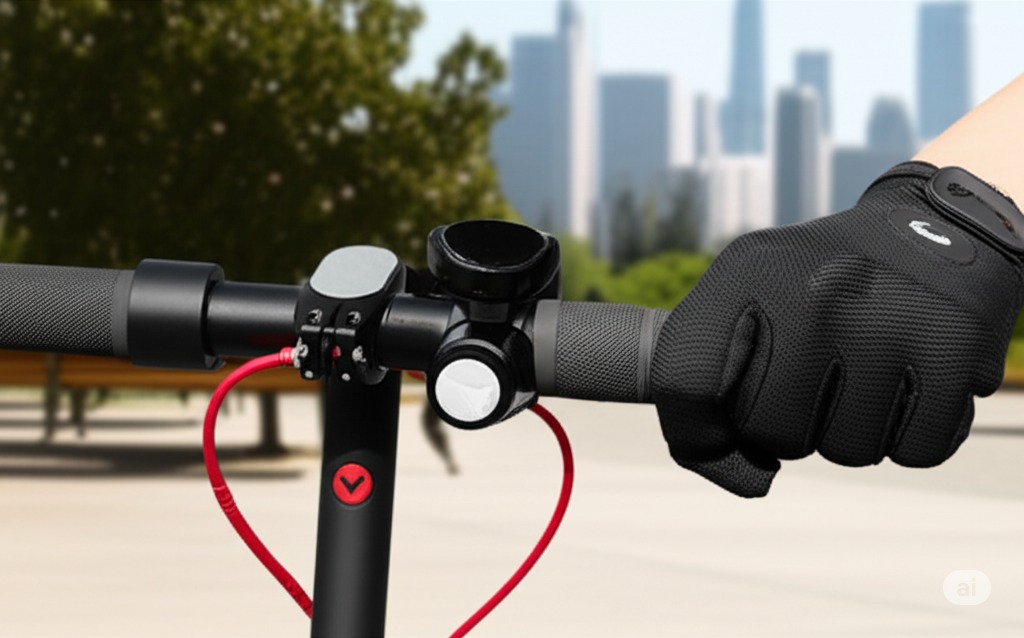
Alt text: “Rider wearing electric scooter gloves gripping handlebars in urban setting”
Types of Electric Scooter Gloves Explained
Not all scooter gloves are built the same. The type you need depends on your riding style, your local climate, and how fast you typically ride. Here’s a clear breakdown of every major glove type so you know exactly what you’re buying.
🖐 Fingerless Gloves
Fingerless gloves are the go-to for urban summer riding. They cover and pad your palm while leaving your fingers completely free. This means maximum touchscreen access, better “feel” on the throttle and brake, and great airflow in warm weather. The downside: zero finger protection in a fall and no cold-weather warmth.
Best for: City commuters in spring/summer, riders who check their phone a lot, and anyone who hates the “thick glove” feel.
🤚 Full-Finger Gloves
Full-finger gloves are the most versatile all-season choice. They cover everything — palm, fingers, and knuckles — while modern materials keep them thin enough for good control sensitivity. Look for touchscreen-compatible fingertips so you don’t have to remove them to use your phone. These are the best choice for most riders.
Best for: Year-round commuters, riders who experience varied weather, and anyone wanting a balance of protection and dexterity.
🧊 Insulated / Heated Winter Gloves
Winter gloves use insulation layers (like 3M Thinsulate, PrimaLoft, or fleece lining) to trap warmth without excessive bulk. Electronically heated gloves go a step further — battery-powered heating elements keep your fingers warm even in freezing temperatures. They’re bulkier and more expensive, but for cold-climate commuters, they’re a complete game-changer.
Best for: Riders who commute year-round through cold winters, anyone in climates below 40°F (4°C) regularly.
🏍 Full Gauntlet Gloves
Gauntlet gloves extend past the wrist, covering part of the forearm. Originally designed for motorcycles, they provide the highest level of impact protection — hard knuckle armor, CE-rated padding, and wrist support built right in. They’re bulkier but offer serious peace of mind for high-speed riders.
Best for: High-speed scooter riders (20+ mph), adventure/off-road scooter enthusiasts, and safety-first commuters in heavy traffic.
🏁 Racing / Performance Gloves
Built for riders pushing performance scooters like the Kaabo Wolf King GT or NAMI BURN-E. These feature armored knuckles, extra palm padding, reinforced fingertips, and abrasion-resistant materials. Think of these as small motorcycle gloves — because at those speeds, that’s basically what you’re riding.
Best for: Speed-focused riders, dual-motor scooter enthusiasts, and anyone who regularly rides at or above 25 mph.
Essential Features to Look For
Knowing what to look for separates a great buy from an expensive mistake. Here are the features that genuinely matter for e-scooter riding — and why each one makes a real difference.
🛡 Palm and Knuckle Protection
Palm padding is your most important feature. Look for gel or foam inserts in the palm area — these absorb both handlebar vibrations during your ride and impact forces during a fall. For knuckle protection, TPU (thermoplastic polyurethane) or carbon fiber guards provide excellent impact resistance without bulky weight. CE-rated protection (EN 13594 standard, Level 1 or 2) means the gloves have been independently tested and verified for impact resistance.
🦴 Scaphoid / Wrist Protection
This is the feature most budget gloves skip — and it’s arguably the most important for fall protection. The scaphoid bone (at the base of your thumb) is the most commonly broken bone in e-scooter falls. Premium gloves include palm sliders or wrist splints to prevent hyperextension on impact. Knox’s patented Scaphoid Protection System (SPS) is the gold standard here — it uses strategically placed palm sliders that let your hand slide on impact instead of snapping backward at the wrist.
✅ Pro Tip
If you ride at speeds above 20 mph regularly, consider combining gloves with a separate wrist guard underneath. Gloves protect fingertips and provide grip; wrist guards add rigid splint support that prevents the scaphoid fractures gloves alone can’t stop.
📱 Touchscreen Compatibility
You need to check navigation, answer calls, and adjust music — ideally without removing your gloves. The best gloves use conductive metallic fibers woven into the fingertips (usually at least index finger and thumb, with premium options covering all fingers). Always test touchscreen response before buying — sensitivity varies widely between brands and even between models from the same brand.
✋ Grip Technology
Look for silicone grip patterns or textured rubber on the palm and fingertips. These maintain traction even when wet or sweaty. The grip should extend to the fingertips for brake lever control and the thumb area for navigation. Quality grip materials maintain their performance after 50+ washes — a detail worth checking in reviews before you buy.
🌡 Weather and Insulation
Match your insulation to your local temperature range — and then go one level warmer than you think you need. Wind chill at e-scooter speeds dramatically drops the perceived temperature. Look for gloves with stated temperature ratings. Premium insulation materials like 3M Thinsulate or PrimaLoft provide excellent warmth without excessive bulk. For wet climates, a waterproof membrane (like Gore-Tex or similar) is essential.
🔆 Reflective Details and Visibility
A feature many riders overlook: reflective strips on the back of your gloves significantly improve your visibility to drivers, especially at night. When you signal a turn, the reflective material catches headlights and makes your hand movements far more visible. Some advanced smart gloves even include built-in LED turn-signal lights — a genuinely useful safety upgrade for urban riders.
Alt text: “Close-up of electric scooter glove features including palm padding, touchscreen fingertips, and grip pattern”
Features by Glove Type — Quick Reference
| Feature | Fingerless | Full-Finger | Heated Winter | Gauntlet |
|---|---|---|---|---|
| Crash protection | Medium | High | Medium | Highest |
| Winter warmth | None | Moderate | Excellent | Good |
| Touchscreen use | Best | Good | Varies | Limited |
| Summer breathability | Excellent | Good | Poor | Poor |
| Typical price range | $15–$35 | $25–$55 | $45–$120 | $60–$150 |
Best Electric Scooter Gloves in 2025 — Our Top 7 Picks
We evaluated every glove against five criteria: protection quality, comfort over extended rides, grip performance in dry and wet conditions, touchscreen usability, and value for money. Here are our top recommendations for 2025.
1. 🏆 Day Wolf Heated Gloves — Best for Winter Commuting
Alt text: “Day Wolf Heated Electric Scooter Gloves in black showing heating controls”
Price: ~$89 | Style: Full finger | Battery Life: 5–6 hours | Touchscreen: Yes | Waterproof: Yes
The Day Wolf Heated Gloves are the clear winner for anyone who rides through cold winters. The rechargeable heating elements deliver consistent warmth across three temperature settings, giving you 5–6 hours of heat on a single charge — more than enough for even the longest commutes. The waterproof construction handles rain and sleet without letting cold seep in, and the touchscreen-compatible fingertips mean you never have to pull them off mid-ride.
What really elevates these over cheaper heated options is build quality. The stitching is reinforced, the palm padding is substantial, and after a season of daily use, reviewers consistently report they hold up without fraying or losing heating efficiency. Customer support and warranty coverage are also standout features.
🏆 Best For
Daily winter commuters who ride in temperatures below 40°F (4°C) and can’t afford to let cold hands compromise their control. The battery charging routine is a minor inconvenience that pays off massively in warmth and safety.
✅ Pros: Rechargeable with temperature control settings · Waterproof in rain and sleet · Premium materials that last · Excellent customer support
⚠️ Cons: Higher price point (~$89) · Slightly bulkier than non-heated gloves · Requires charging between uses
2. 🥇 Fluidfreeride Fingerless Scooter Gloves — Best All-Season Value
Price: ~$28 | Style: Fingerless | Protection: Palm padding | Special Feature: Full silicone grip print
Built specifically for e-scooter riding by a company that knows the sport inside and out, these fingerless gloves nail the essentials at an unbeatable price. The full silicone print palm not only gives you rock-solid grip on handlebars but also absorbs vibrations remarkably well for such a simple glove design. The elastic breathable back keeps your hands cool and dry, while the easy-off strap system means you’re not fumbling with gloves when you park.
One real-world note from riders: these gloves have passed the fall test. Customer reviews from the Fluidfreeride community include accounts of low-speed falls with zero hand injuries. At under $30, the value-to-protection ratio is exceptional.
✅ Pros: Purpose-built for e-scooters · Excellent vibration absorption · Breathable for warm weather · Proven track record with scooter community · Under $30
⚠️ Cons: No finger protection · Not suitable for cold weather · No touchscreen compatibility (fingers are bare, so technically this isn’t needed)
3. 📱 GUB S089 Touchscreen Gloves — Best Tech Integration
Alt text: “GUB S089 touchscreen-compatible scooter gloves in grey and black”
Price: ~$45 | Style: Full finger | Features: Multi-finger touchscreen · Thermal lining · Urban-optimized design
The GUB S089 is the glove for the connected urban commuter. Every fingertip features conductive touchscreen fabric — not just the index finger and thumb — so you can operate your entire phone or navigation app with natural gestures. The thermal fleece lining keeps hands comfortable in cool (but not freezing) weather, while the slim profile maintains the dexterity you need for precise brake and throttle control.
These sit in a sweet spot between summer and winter use — perfect for the 45–65°F (7–18°C) temperature range that represents most of the riding year in temperate climates. They’re specifically designed for e-scooter and urban riding, which shows in the thoughtful grip placement and control-oriented design.
✅ Pros: Full-hand touchscreen sensitivity · Balanced warmth without overheating · Slim, control-friendly profile · Good protection-to-bulk ratio
⚠️ Cons: Mid-range price (~$45) · Not suitable for extreme cold · Availability can be limited in some regions
4. 💪 HTZPLOO Cycling Gloves — Best Value Full-Finger Protection
Price: ~$32 | Style: Full finger | Standout Feature: Excellent shock absorption · High durability
The HTZPLOO gloves are a workhorse. They’re not flashy, they don’t have heating elements or smart features — but they do the core job exceptionally well. The multi-layer palm padding provides some of the best vibration dampening in this price range, making them ideal for riders who cover significant daily miles. Durability is a consistent theme in long-term reviews, with multiple riders reporting continued quality after 12–18 months of daily use.
One important sizing note: these run slightly small. It’s strongly recommended to go up a full size from your normal measurement — especially if your hands are between sizes.
✅ Pros: Outstanding shock absorption · Built to last · Competitive price for features · Extensive positive rider feedback
⚠️ Cons: Runs small — size up · Limited color options · Basic styling
5. ❄️ SIMARI Winter Gloves — Best Budget Winter Option
Price: ~$24 | Style: Full finger | Warmth: Flannel lining | Grip: Anti-slip silicone
For riders who need a warm winter glove without spending $80+, the SIMARI hits an impressive sweet spot. The warm flannel lining provides genuine cold-weather comfort, the thin profile maintains better dexterity than you’d expect for a winter glove, and the anti-slip grip performs well on handlebars in cold, dry conditions. They’re also machine washable — a practical plus for regular commuters.
Be realistic about their limits though: these aren’t rated for extreme cold (below 25°F/-4°C) and won’t hold up to heavy daily use as long as premium options. But for casual winter riders or as a backup pair, they deliver far more than their price suggests.
✅ Pros: Exceptional value under $25 · Thin profile keeps dexterity · Machine washable · Good all-round grip
⚠️ Cons: Not rated for extreme cold · Durability lower than premium options · Basic protection features
6. 🤜 Seibertron Dirtpaw Full Finger Gloves — Best for Young Riders and High-Speed Protection
Price: ~$30–$40 | Style: Full finger, motocross-inspired | Special Features: TPR knuckle protection · Hook-and-loop wrist closure · Touchscreen compatible
The Seibertron Dirtpaw brings motocross-grade protection to e-scooter riders at a very reasonable price. The rubber-injected knuckle and back-of-hand graphics serve double duty — they look aggressive and they provide real impact protection. Spandex finger gussets give the gloves a stretch-to-fit quality that works well for a wide range of hand sizes, and the silicone gripper on all fingers provides excellent handlebar control. These come in sizes for riders aged 6–14 as well as adults — making them a rare find for younger riders who need proper protection.
✅ Pros: Available in youth sizes · Good knuckle protection · Touchscreen on all fingers · Comfortable stretch fit · 30-day return guarantee
⚠️ Cons: Can run small in adult sizes (size up) · Motocross styling not for everyone · Not waterproof
7. 🌧 MOREOK All-Season Gloves — Best for Everyday Versatility
Price: ~$25–$35 | Style: Full finger | Special Features: Machine washable · Unisex sizing · Multi-sport versatile
The MOREOK gloves are the “plug it in and forget it” choice for everyday riders who want reliable all-around performance without overthinking it. They’re versatile enough to handle cycling, hiking, and scooter riding in mild to cool conditions, come in a full range of sizes for men and women, and are fully machine washable — a small but genuinely appreciated daily-use feature. Shock absorption is good (not exceptional), but at this price, they’re an excellent starter pair or a solid secondary set to keep in your bag.
✅ Pros: Machine washable · Wide size range · Good versatility · Affordable price · Easy to find online
⚠️ Cons: Not specialized enough for extreme conditions · Average protection compared to dedicated scooter gloves · Grip degrades faster than premium options
Side-by-Side Comparison: All 7 Top Picks
| Model | Price | Style | Weather | Protection | Touchscreen | Best For |
|---|---|---|---|---|---|---|
| Day Wolf Heated | $89 | Full finger | Deep Winter | High | ✅ Yes | Cold commuters |
| Fluidfreeride | $28 | Fingerless | 3-Season | Palm only | N/A (bare fingers) | Urban summer |
| GUB S089 | $45 | Full finger | Cool Weather | Medium | ✅ All fingers | Tech users |
| HTZPLOO | $32 | Full finger | All-Season | High | ⚠️ Limited | Daily distance riders |
| SIMARI Winter | $24 | Full finger | Winter | Basic | ✅ Yes | Budget winter riders |
| Seibertron Dirtpaw | $30–40 | Full finger | 3-Season | High (knuckle) | ✅ Yes | Youth + high-impact |
| MOREOK All-Season | $25–35 | Full finger | All-Season | Medium | ✅ Yes | Casual everyday |
How to Choose the Right Electric Scooter Gloves for You
Finding your perfect glove comes down to four honest questions. Answer these before you buy and you’ll get it right the first time.
Question 1: What temperature do you usually ride in?
Be honest about your local climate and the temperature range during your typical riding season. Remember: wind chill at 15–20 mph drops perceived temperature by 10–15°F (5–8°C). If you ride in 55°F (13°C) weather regularly, your hands are experiencing closer to 40–45°F (4–7°C). Always size your insulation for what your hands feel, not what the thermometer says.
- Above 65°F (18°C): Fingerless or lightweight full-finger gloves
- 45–65°F (7–18°C): Mid-weight full-finger gloves (like GUB S089)
- Below 45°F (7°C): Insulated winter gloves or heated options
- Below 25°F (-4°C): Heated gloves only (Day Wolf or similar)
Question 2: How fast do you ride and what’s your risk environment?
The faster you ride and the more traffic you encounter, the more protection you should prioritize. Casual riders on bike paths at 10–12 mph can get away with palm padding and grip gloves. City commuters dealing with traffic and uneven roads should invest in full-finger gloves with knuckle protection. High-speed riders (20+ mph) should seriously consider gauntlet-style gloves — the protection difference in a fall at that speed is enormous.
Question 3: How long are your typical rides?
Short rides (under 10 minutes) have minimal vibration fatigue — almost any glove works. Medium rides (10–30 minutes) benefit meaningfully from palm padding and vibration absorption. Long rides (30+ minutes) demand quality gel or foam palm inserts to prevent numbness, tingling, and the painful “numb hand” feeling that sets in from sustained handlebar pressure.
Question 4: What’s your honest budget?
The good news: you don’t need to spend $100 to get reliable protection. A $25–$45 investment buys genuinely good gloves that last 1–2 years of regular use. Think of it this way: a $40 pair used every day for two years costs about 5 cents per ride. Compared to the cost — in time, medical bills, and misery — of a wrist fracture, that’s one of the best investments you can make in your riding life.
Alt text: “Rider choosing between different types of electric scooter gloves at a store”
Sizing and Fit Guide — Get This Right
A glove that doesn’t fit properly is almost as bad as no glove at all. Gloves that are too loose bunch up and reduce control sensitivity. Gloves that are too tight cut off circulation and cause cramps on longer rides. Getting the right size is non-negotiable.
How to Measure Your Hand
- Wrap a soft measuring tape around the widest part of your dominant hand — across your knuckles, excluding your thumb.
- Note the measurement in inches or centimeters.
- Compare to the brand’s size chart. When in doubt, go one size up — most e-scooter gloves run slightly small, and gloves stretch to conform to your hand over time but never shrink.
⚠️ Sizing Warning
Multiple gloves in this guide (HTZPLOO, Seibertron, Fox Dirtpaw) consistently run 0.5–1 size small. If your measurement puts you on the border between sizes, always choose the larger size. Tight gloves reduce blood flow, cause cramping on rides over 15 minutes, and reduce the tactile feedback you need for precise braking.
The Fit Test
Once you have your gloves, test the fit before your first ride:
- Make a fist — the glove should flex smoothly with no bunching in the palm
- Extend all fingers — no pulling or tightness at the knuckles
- Grip an imaginary handlebar — the grip should feel natural, not forced
- Check for pressure points around the wrist closure or cuff area
- Test touchscreen function if applicable — tap your phone with your thumb and index finger
Common Mistakes Riders Make (and How to Fix Them)
These are the mistakes that show up again and again in rider forums, product reviews, and safety reports. Avoid them and your gloves will actually protect you.
🔥 Mistake #1: Skipping Gloves “Because It’s Not Cold”
The fix: Gloves are not just about temperature — they’re your primary hand protection in a fall. In summer, fingerless gloves give you all the breathability you need while protecting your palms from road rash. Never skip gloves based on temperature alone.
🔥 Mistake #2: Buying Too Tight to “Save Money on Sizing Up”
The fix: A too-tight glove is genuinely dangerous. Restricted blood flow reduces hand sensitivity and control precision — exactly the opposite of what you want. Always measure properly and go up a size when uncertain.
🔥 Mistake #3: Using the Same Gloves Year-Round
The fix: Most serious riders own two pairs — a lightweight summer pair and a warmer winter option. Trying to use thick winter gloves in July (or thin fingerless gloves in January) creates safety and comfort compromises. The combined investment is usually under $60 and makes year-round riding dramatically more enjoyable.
🔥 Mistake #4: Wearing Worn-Out Gloves “Because They Still Look Fine”
The fix: Grip surfaces wear smooth before the glove looks visibly damaged. Padding compresses and loses its shock-absorbing capacity over time. Test your grip on a wet surface regularly. If it feels less tacky than when new, the grip compound is worn — time to replace.
🔥 Mistake #5: Death-Gripping the Handlebars
The fix: Even with great gloves, white-knuckling the bars transmits more vibration and accelerates hand fatigue. Quality gloves are designed to work with a relaxed grip — loose enough to let the padding absorb vibration, firm enough to maintain control. Practice conscious grip relaxation on every ride.
Expert Tips for Getting the Most Out of Your Gloves
🏆 Expert Tips
- Pre-ride check, every ride: Squeeze the glove and flex your fingers before clipping in. A 5-second check reveals loose closures, damaged padding, or reduced grip before they cause a problem on the road.
- Layer up for extreme cold: On sub-freezing days, a thin base-layer liner glove worn under your main gloves adds 10–15°F of warmth without sacrificing dexterity. Most winter gloves have enough room to accommodate this.
- Test touchscreen function in the cold: Cold temperatures can temporarily reduce touchscreen sensitivity even in gloves that work perfectly in room temperature. Always verify function before depending on navigation during cold-weather rides.
- Adjust your grip periodically on long rides: Briefly loosening and repositioning your grip every 5–10 minutes redistributes pressure across the palm and significantly reduces cumulative fatigue on rides over 30 minutes.
- Store gloves open and aired, not crumpled: Leaving gloves in a ball at the bottom of your bag degrades the padding shape over time. Hang them or lay them flat, fingers extended, in a dry spot away from direct sunlight.
- For heated gloves — always store with a partial charge: Storing heated gloves fully discharged (0%) damages lithium-ion battery cells. Keep stored heated gloves at 30–50% charge and top them up every 2–3 months during off-season storage.
- Consider your scooter’s vibration profile: Lower-quality or larger-wheeled scooters transmit more road vibration. If your scooter shakes a lot on rough pavement, prioritize gel-padded gloves over foam — gel maintains its shock-absorbing properties longer and performs better at high vibration frequencies.
Alt text: “Electric scooter rider in winter gear including gloves and helmet on city street at night”
Care and Maintenance Tips
Good gloves are an investment. A little care goes a long way toward keeping them performing at their best.
Cleaning
Most synthetic scooter gloves are machine washable on a gentle cold-water cycle with mild detergent. Always check the care label first — heated gloves with electronics must be hand-washed only (never machine-washed). Air dry completely before storage; a tumble dryer’s heat degrades foam padding, elastic materials, and grip compounds rapidly.
For gloves that can’t be fully washed (leather gauntlets, for example), wipe down the palm and fingertip areas with a damp cloth after every few rides. Grip surfaces accumulate road grime and oils from your skin that gradually reduce traction.
When to Replace
Replace your gloves when you notice any of these warning signs:
- Grip surface feels smooth or slippery compared to when new
- Palm padding feels “flat” and compressed under pressure
- Any cracking, tearing, or separation in the palm material
- Increased hand fatigue or tingling during rides of normal length
- After any crash where the palm area took direct road contact
💡 Key Insight
Don’t let the “it still looks okay” trap fool you. Protection materials degrade from use and UV exposure before visible damage appears. A glove worn daily for 12–18 months may look structurally intact but provide 30–40% less impact protection than when new. When in doubt, replace.
Frequently Asked Questions
❓ Do I really need special gloves, or will any gloves work?
Regular work gloves or fashion gloves aren’t designed for handlebar grip, vibration absorption, or impact in a fall. E-scooter gloves have strategically placed padding, grip patterns on the palm and fingertips, and materials chosen for abrasion resistance. A regular glove might feel similar at first, but in a fall or after 20 minutes of vibration-transmitted fatigue, the difference is dramatic. Purpose-made scooter or cycling gloves are well worth the $25+ investment.
❓ Fingerless vs. full-finger — which is actually better?
It depends entirely on your riding conditions. Fingerless gloves offer maximum breathability, better direct touchscreen access, and a more natural “feel” on controls in warm weather — but they leave your fingers unprotected in a fall. Full-finger gloves protect your entire hand and work in cooler weather, with modern materials keeping them thin enough for good control sensitivity. For most riders, owning both — a fingerless pair for summer and a full-finger pair for cooler months — is the ideal solution.
❓ Are heated gloves worth the extra cost?
For daily winter commuters who ride regularly in temperatures below 35°F (2°C), absolutely yes. Cold-numb fingers are a genuine safety hazard — they slow reaction time and reduce braking precision. Heated gloves completely eliminate this problem and extend your comfortable riding season by weeks or months. For occasional cold-weather riders, good insulated gloves ($25–$45) are a better value choice. The premium for electric heating only makes sense if cold-weather riding is a regular part of your routine.
❓ Should I choose gloves or wrist guards?
Ideally, both — but they protect different things. Gloves cover and protect the back of your hand, fingers, and palm surface from road rash and cuts. Wrist guards use rigid splints to prevent your wrist from hyperextending in a fall, protecting the scaphoid bone from fracture. For casual low-speed riding, quality gloves with scaphoid palm padding are sufficient. For high-speed riding (20+ mph), wearing thin wrist guards underneath gauntlet or full-finger gloves gives you the most complete protection available.
❓ How do I know when my gloves need to be replaced?
Key replacement signals: grip surfaces feeling smooth or slippery, palm padding feeling flat rather than springy, any cracking in the material, increased hand fatigue during normal-length rides, or after a crash where the palm hit the ground. As a general rule, gloves used daily for commuting typically last 12–18 months before protection performance degrades significantly. Weekend riders can stretch quality gloves 2–3 years.
❓ Can I wash my electric scooter gloves in a washing machine?
Most synthetic and fabric gloves (like SIMARI, MOREOK, HTZPLOO) are safe for machine washing on a gentle cold cycle with mild detergent. Always check the care label first. Leather gloves should only be wiped down or hand-washed. Heated gloves must never be machine-washed — water will damage the electrical components. Air dry all gloves completely — never put them in a tumble dryer, as heat degrades padding and elastic materials quickly.
YouTube: Best Electric Scooter Safety Gear Review — embed your recommended video here
Final Buying Checklist — Your Perfect Glove in 5 Steps
✅ Electric Scooter Glove Buying Checklist
Step 1: Define Your Needs
- ✅ Know your typical riding temperature range (including wind chill)
- ✅ Identify your average ride length (short/medium/long)
- ✅ Assess your riding speed and risk environment
Step 2: Choose Your Glove Type
- ✅ Warm weather / summer → Fingerless or lightweight full-finger
- ✅ Cool / transitional → Full-finger with touchscreen compatibility
- ✅ Cold winter → Insulated or heated winter gloves
- ✅ High speed → Gauntlet or racing-grade with CE-rated protection
Step 3: Verify the Right Features
- ✅ Palm padding / vibration absorption confirmed
- ✅ Silicone or textured grip on palm and fingertips
- ✅ Touchscreen compatibility (if needed — test all fingers you use)
- ✅ Temperature rating matches your climate (plus one level warmer)
- ✅ Reflective details for night riding visibility
Step 4: Size Correctly
- ✅ Measure hand circumference at knuckles
- ✅ Compare to brand size chart (not generic sizing)
- ✅ Go up one size if between sizes or if the brand runs small
- ✅ Test the fit: fist, flex, grip test, wrist comfort check
Step 5: Plan for Long-Term Use
- ✅ Check washing instructions and follow them
- ✅ Store flat and aired, not crumpled
- ✅ Inspect grip and padding monthly
- ✅ Plan to replace after 12–18 months of daily use
- ✅ Consider a second seasonal pair for year-round comfort
Conclusion
Investing in the right electric scooter gloves is one of the smartest things you can do for your riding experience — and your safety. The Day Wolf Heated Gloves are the gold standard for winter commuters. The Fluidfreeride Fingerless Gloves deliver incredible value for three-season riders. And the GUB S089 brings the best touchscreen integration on the market for connected urban riders.
Whatever you choose, the key principles are the same: match your insulation to your real wind-chill-adjusted temperature, prioritize palm padding and grip quality over flashy features, and never compromise on fit. A glove that doesn’t fit properly is just an expensive accessory — not real protection.
Your hands keep you connected to your scooter every single ride. Give them the protection they deserve.
Last updated: July 2025. Product prices and availability may vary. Always verify current pricing and specifications on retailer websites before purchasing. This guide contains affiliate links — we may earn a small commission at no extra cost to you if you purchase through our links. This never influences our recommendations.

I’m the founder of HoverboardsGuide.com, a comprehensive website dedicated to electric scooters and hoverboards. With a deep-rooted passion for electric gadgets, I’ve accumulated extensive experience in this field. I aim to assist users in selecting the best gadgets and providing reliable guidance.
I’ve tested and reviewed numerous models, gaining in-depth knowledge about their features, performance, and overall quality. Feel free to reach out to me with any queries, as I’m dedicated to addressing your concerns promptly. Join me on this exciting journey of exploring the world of electric rides and making informed decisions