Kick scooters build balance, slow electric scooters add fun. Here is how to pick the right first ride for your 6-year-old, plus tested picks and safe speeds.
If you are hunting for the best scooters for 6-year-olds, you are shopping at a sweet spot. Six is the age when many kids move past the wobbly toddler stage and really start to ride. Their balance is better, their legs are stronger, and their confidence is growing fast. The right scooter now can turn into hours of outdoor fun and a genuine boost for coordination and independence.
But six is also a tricky in-between age. Your child might be ready for a nimble two-wheel kick scooter, or they might still love the stability of three wheels. A few kids are even ready for a slow, speed-limited electric scooter. There is no single right answer, and that is exactly why this guide exists.
Below, we break down what to look for, compare kick scooters against electric models, and share our tested top picks for this age. We also cover safe speeds, helmet fit, and simple ways to teach a brand-new rider. By the end, you will know exactly which scooter fits your six-year-old and your budget.
What Makes a Scooter Right for a 6-Year-Old?
The best scooters for 6-year-olds share a few simple traits. First, they fit. A scooter that is too tall or too heavy is hard to steer and no fun to ride. Look for adjustable handlebars that set to roughly your child’s waist or belly-button height, so the scooter can grow with them over a couple of years. The deck should sit low to the ground, and the whole scooter should be light enough for your child to pick up and carry, usually under about 8 pounds for a kick scooter.
After fit, focus on ride quality and controls. Polyurethane (PU) wheels roll far smoother than cheap plastic ones and soak up bumps in the sidewalk. A simple rear foot brake, the kind you step on over the back wheel, is the easiest for young kids to master, so skip complicated hand brakes at this age. Finally, check the weight limit. Most quality kids’ scooters support 100 to 143 pounds, which leaves plenty of room for a growing six-year-old.
- Adjustable handlebars that set to around waist height
- Smooth polyurethane (PU) wheels, not thin plastic
- A simple rear foot brake over the back wheel
- A low, wide deck for stable footing
- A light frame your child can lift and carry
- A weight limit of at least 100 lbs
| Model | Type | Best For Age | Top Speed | Weight Limit | Approx. Price |
|---|---|---|---|---|---|
| Micro Kickboard Maxi Deluxe | 3-wheel kick | 5-12 | Leg-powered | 110 lbs | $130-150 |
| Razor A2 | 2-wheel kick | 5+ | Leg-powered | 143 lbs | $35-40 |
| Razor A3 | 2-wheel kick | 5+ | Leg-powered | 143 lbs | $45-55 |
| Jetson Jupiter LED | 2-wheel kick | 5+ | Leg-powered | ~110 lbs | $40-56 |
| Gotrax Scout Pro | Electric | 4-7 | 6 mph | 110 lbs | $100-150 |
| Segway Ninebot Zing E8 | Electric | 6-12 | 8.7 mph | 110 lbs | $180-200 |
Kick Scooter vs. Electric: Which Is Better at Age 6?
For most six-year-olds, a kick scooter is the smartest first choice, and often the only one they need. Kicking along builds the balance, leg strength, and coordination that every young rider depends on. Kick scooters are cheap, need no charging, and let your child move at their own natural pace. There is a reason nearly every scooter expert recommends starting here.
Electric scooters are exciting, but here is the honest truth: most are rated for ages 8 and up because they hit 10 mph or faster. Studies and testers agree that most six-year-olds simply cannot process a surprise obstacle fast enough to brake at that speed. That does not rule electric out entirely. A few models are built specifically for little kids and cap out at a gentle 6 mph. The Gotrax Scout Pro, rated for ages 4 to 7, is the standout example. If you do go electric, choose one of these slow models and treat it as a supervised treat, not a daily solo ride.
Why start with a kick scooter
Kick scooters teach the core skill of balancing on two wheels while your child controls every bit of the speed. They cost less, weigh less, and never leave a kid stranded with a dead battery. Even if you plan to buy electric later, a few months on a kick scooter makes that transition far safer.
When an electric scooter makes sense
An electric scooter is a fine choice if your child already balances well, rides confidently, and can stop on command. Stick to a model capped at 6 mph, keep it in the lowest speed mode at first, and walk alongside until you fully trust their braking. Save the faster 8 to 10 mph models for age 8 and up.
2-Wheel or 3-Wheel? Picking the Right Base
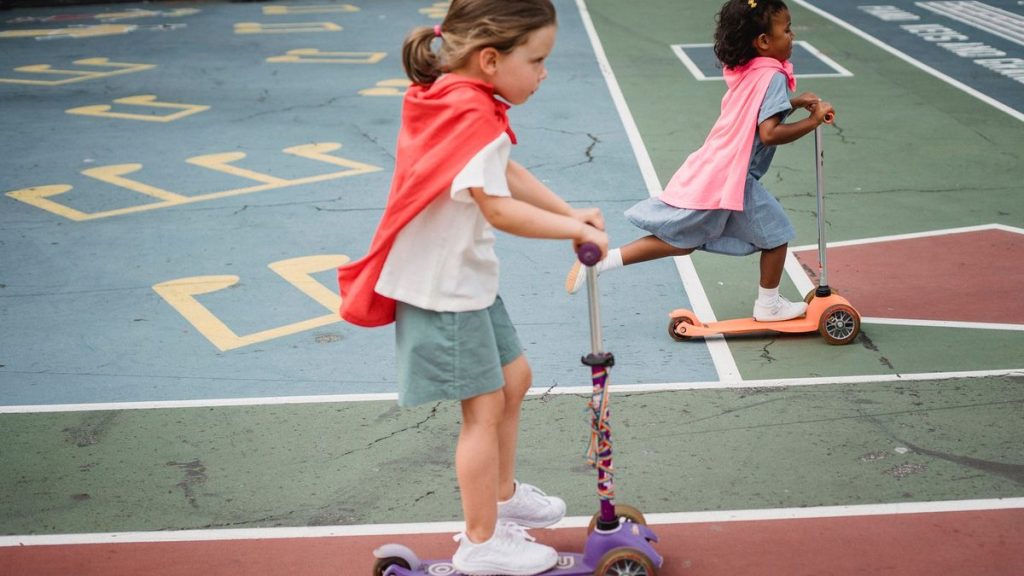
One of the biggest questions parents ask is whether to buy a two-wheel or three-wheel scooter. At age six, both can be right, and it truly depends on your child. A three-wheel scooter is more stable and usually uses a lean-to-steer design, where your child leans their body in the direction they want to turn. That makes it forgiving and confidence-building for cautious or beginner riders, and the wider deck gives little feet a steady platform.
A two-wheel scooter is lighter and more agile. It steers by turning the handlebars, just like a bike, and it rewards a child who already has decent balance. Many six-year-olds are ready for two wheels, especially if they have ridden a three-wheeler before or can already balance on a bike. If your child is brand new to scooting, though, there is no shame in starting on three wheels and upgrading in a year.
Choose 3 wheels if…
Your child is new to scooters, tends to be cautious, or has struggled with balance. Three wheels let them build confidence without tipping over, and the lean-to-steer design feels natural and fun from the very first ride. It is the safer starting point for a true beginner.
Choose 2 wheels if…
Your child already rides a bike or balance bike, has used a three-wheel scooter before, or craves speed and sharp turns. A two-wheeler like the Razor A2 or A3 will challenge them, sharpen their coordination, and keep them interested as their skills grow.
Best Scooters for 6-Year-Olds: Our Top Picks
We looked at dozens of models and rider reviews to pick scooters that genuinely fit six-year-olds, with the right size, safe speeds, and quality that lasts. Here are our favorites across kick and electric, for every budget.
If you want one safe, all-around electric pick for a six-year-old, the Gotrax Scout Pro is our top recommendation. There is more detail on it further down the page.
- Best overall kick scooter, Micro Kickboard Maxi Deluxe: A premium Swiss-designed three-wheeler for ages 5 to 12, up to 110 lbs. Buttery-smooth PU wheels, lean-to-steer control, and an adjustable T-bar that grows for years. Around $130 to $150, and worth it.
- Best budget pick, Razor A2: A classic two-wheel kick scooter for ages 5 and up, around $35 to $40. Foldable, light, and tough, with a rear fender brake. The A3 (about $45 to $55) adds bigger wheels and front suspension if your budget stretches.
- Best for fun and visibility, Jetson Jupiter LED: A two-wheel kick scooter covered in light-up LEDs on the wheels and stem, around $40 to $56. Kids love the glow, and it makes them easier to see. Adjustable handlebars and a rear brake round it out.
- Best electric for age 6, Gotrax Scout Pro: The rare electric scooter genuinely built for little kids. Rated ages 4 to 7, capped at a safe 6 mph, with an 80W motor, 110 lb limit, and a light-up front wheel. Around $100 to $150.
- Best step-up electric, Segway Ninebot Zing E8: For a confident rider near the top of this age range, the Zing E8 (ages 6 to 12) offers multiple speed modes and a parental speed lock, topping out near 8.7 mph. Around $180 to $200.
Safe Speeds and Setup for New Riders
Speed is where most scooter accidents start, and the good news is that you control it. If you choose an electric scooter, lock it to the lowest speed mode for the first few weeks. Many kids’ models, like the Gotrax Scout Pro, are capped at 6 mph out of the box, which is about as fast as you want a new six-year-old rider to go. Only step the speed up once your child brakes reliably and steers with confidence.
Where your child rides matters just as much as how fast. Start on a flat, enclosed surface, such as an empty driveway, a quiet cul-de-sac, or a vacant parking lot early in the morning. Avoid hills, which build speed faster than a child can handle, and steer clear of traffic, crowds, and steep driveways. For the first several rides, walk right alongside your child so you can grab the handlebar or steady them if needed. The table below shows how to match speed and setting to your child’s skill.
Safety Gear Every Young Rider Needs
No scooter is complete without safety gear, and a helmet is the single most important piece. Helmets reduce head injuries by roughly 85% and brain injuries by about 88%, numbers no parent should ignore. Choose a helmet certified by the CPSC, and look for the sticker inside. It should sit level, about two finger-widths above the eyebrows, with just one finger of room between the chin and the strap. The same helmet your child wears for biking works perfectly for scooting.
Beyond the helmet, young riders take a lot of tumbles in the early weeks, so pad the parts that hit the ground first. Knee pads, elbow pads, and wrist guards are cheap insurance against scrapes and sprains. Closed-toe shoes are a must, with no sandals or bare feet near those wheels. Once your child is geared up, falls become minor bumps instead of tears and Band-Aids.
- A CPSC-certified helmet, fitted snug and level
- Knee pads and elbow pads for early tumbles
- Wrist guards for catching falls on the hands
- Closed-toe shoes, never sandals or bare feet
- Bright or light-up clothing for visibility
- Gloves for extra grip and scrape protection (optional)
How to Teach Your 6-Year-Old to Ride
Teaching a six-year-old to ride is easier than teaching a bike, since there is no pedaling to coordinate and both feet start on the ground. Begin with standing and balancing, then add gentle scooting, and save turning and speed for last. Keep sessions short and full of praise. A frustrated, tired child learns nothing, but a proud one will beg to practice again tomorrow.
Here is a simple step-by-step that works for most new riders:
- Stand and coast: Have your child put one foot on the deck and push gently with the other, coasting a few feet with both feet down between pushes.
- Practice braking: Before any real speed, teach them to press the rear foot brake and stop on your command. Repeat until it is automatic.
- Add steady scooting: Once balanced, let them build a slow, steady rhythm of pushing and gliding on a flat surface.
- Learn gentle turns: Show them how to lean (on a 3-wheeler) or turn the bars slowly (on a 2-wheeler) in wide, easy arcs.
- Build confidence: Gradually let them ride a little farther and faster, but only as their braking and steering hold up.
| Feature | Kick Scooter | Electric Scooter |
|---|---|---|
| Skill building | Excellent, builds balance | Limited, throttle does the work |
| Top speed | Child’s own pace | 6-10 mph (pick 6 mph) |
| Price range | $35-150 | $100-200 |
| Charging | None needed | 2-4 hours |
| Weight to carry | 5-8 lbs | 9-18 lbs |
| Best first step? | Yes, always | Only after kick-scooter practice |
| Rider Level | Recommended Type | Speed Mode | Where to Ride |
|---|---|---|---|
| Brand-new beginner | 3-wheel kick | Leg-powered | Driveway, flat path |
| Confident on 3 wheels | 2-wheel kick | Leg-powered | Empty lot, quiet path |
| Steady on 2 wheels | Slow electric (6 mph) | Lowest mode | Enclosed flat area, parent alongside |
| Rides a bike well | Electric (6-8 mph) | Low to medium | Quiet, traffic-free paths |
Caring for the Scooter and Its Battery
A kids’ scooter that’s looked after will easily last until your child outgrows it — and hold decent resale value too. The maintenance is minimal, but a few habits make a big difference, especially with the battery.
Charge the scooter after rides, but unplug it once it’s full rather than leaving it plugged in for days on end. Try not to store it fully drained for long stretches, since a battery left empty for weeks slowly loses capacity. Keep it indoors at room temperature — extreme cold or heat is hard on lithium batteries — and use only the charger that came with it.
Everything else is common sense. Wipe the deck and wheels down when they get grimy, and check that the handlebar clamp and folding latch are tight before each ride, since these can loosen with use. Solid airless tires need no attention at all, which is one more reason they’re great for kids. A quick 30-second bolt check every week or two keeps the ride solid and safe.
- Charge after use, then unplug once full — don’t leave it charging for days
- Store indoors at room temperature; don’t leave the battery empty for weeks
- Use only the original charger that came in the box
- Check the handlebar clamp and folding latch are tight before each ride
- Wipe down the deck and wheels to keep both grip and looks
| Age | Recommended Top Speed | Best Scooter Type | Notes |
|---|---|---|---|
| 3-5 | 3-6 mph | Kick scooter or slowest electric (Scout PRO) | Parent alongside, flat enclosed area only |
| 6-7 | 5-8 mph | Speed-locked kids electric | Lowest mode first, close supervision |
| 8-10 | 8-12 mph | Kids electric (Razor E90, E100) | Ready for more once braking is solid |
| 11-13 | 10-15 mph | Larger kids and teen models | Traffic awareness still developing |
Common Mistakes (and How to Fix Them)
Fix: Most six-year-olds cannot brake in time for a surprise even at 10 mph. Choose a model capped at 6 mph, or lock an electric scooter to its lowest speed mode until your child proves they can stop on command.
Fix: A helmet cuts head injury risk by about 85%. Buy a CPSC-certified helmet that sits two finger-widths above the eyebrows, and add knee and elbow pads for the tumble-heavy early weeks.
Fix: An adult or 8+ scooter with high handlebars is hard for a six-year-old to control. Look for adjustable handlebars that set to around your child’s waist or belly-button height.
Fix: Cheap plastic or PVC wheels feel rough and slip easily. Polyurethane (PU) wheels roll smoother, grip better, and last far longer, and they are well worth the small extra cost.
Pro Tips
- 💡 Lock any electric scooter to its slowest speed mode for the first few weeks, then step it up only when your child brakes reliably.
- 💡 Start on a flat, enclosed space like an empty driveway or quiet parking lot, with no hills, no traffic, and no crowds.
- 💡 Choose adjustable handlebars so the scooter grows with your child and lasts several years instead of months.
- 💡 Teach braking before speed. Have your child practice stopping on your command before they ever pick up the pace.
- 💡 Check that both feet fit on the deck and the brake is a simple rear foot brake, since hand brakes confuse young kids.
A Real-Life Example
When our neighbor bought her six-year-old a fast 10 mph electric scooter for his birthday, it sat in the garage after week one. He could not stop it in time and took a scary tumble on the sidewalk. They swapped it for a slower 6 mph model plus a three-wheel kick scooter for practice days.
Within a month he was zipping around the cul-de-sac, braking on command, and begging to ride every evening. The lesson stuck with us: match the scooter to the child, start slow, and let confidence, not speed, lead the way.
Frequently Asked Questions
Most kids can start on a three-wheel scooter around age 2 to 3 and move to a two-wheel model around 5 to 6. By six, many children have the balance for a two-wheeler, though cautious riders still do great on three wheels. The key is matching the scooter to your child’s skill, not just their birthday.
Yes, but only a slow, speed-limited model. Most electric scooters are rated for ages 8 and up because they hit 10 mph or more, which is too fast for a young beginner. Look for a model capped at 6 mph, such as the Gotrax Scout Pro (rated 4 to 7), and keep a parent walking alongside at first.
It depends on your child’s balance. A three-wheel scooter is more stable and easier for cautious or beginner riders, while a two-wheel scooter is more agile and builds balance for confident kids. If your six-year-old already rides a bike or balances well, a two-wheeler is a great next step.
Around 6 mph is the safe ceiling for most six-year-olds. At that speed a child can still react and brake for a surprise obstacle. Faster models that reach 8 to 10 mph are better saved for ages 8 and up, once your child rides confidently and stops on command.
Absolutely, a helmet is non-negotiable. Helmets reduce head injuries by about 85% and brain injuries by about 88%. Choose a CPSC-certified helmet that sits two finger-widths above the eyebrows with just one finger of room under the chin strap. The same helmet your child wears for biking works fine.
A good kick scooter costs about $35 to $150, and a safe kids’ electric scooter runs roughly $100 to $200. Budget kick scooters like the Razor A2 (around $40) are perfect for beginners, while premium picks like the Micro Maxi Deluxe last for years. You do not need to overspend to get a safe, quality ride.
Weight is rarely the limiting factor — most kids’ electric scooters support 110 to 121 pounds, which is far more than any 6-year-old weighs. What matters more is height and fit: your child should be able to stand comfortably on the deck with the handlebar somewhere between their belly button and chest. Adjustable-height models like the Gyroor KS2 and Segway ZING E8 are handy because they grow with your child.
Final Checklist ✅
- ✅ Confirm the scooter’s age and weight rating fits your child
- ✅ Decide between 2 or 3 wheels based on your child’s balance
- ✅ Choose adjustable handlebars set to about waist height
- ✅ Make sure it has a simple rear foot brake
- ✅ For electric, pick a 6 mph model or lock the lowest speed mode
- ✅ Buy a CPSC-certified helmet plus knee and elbow pads
- ✅ Pick a flat, traffic-free spot for the first practice rides